

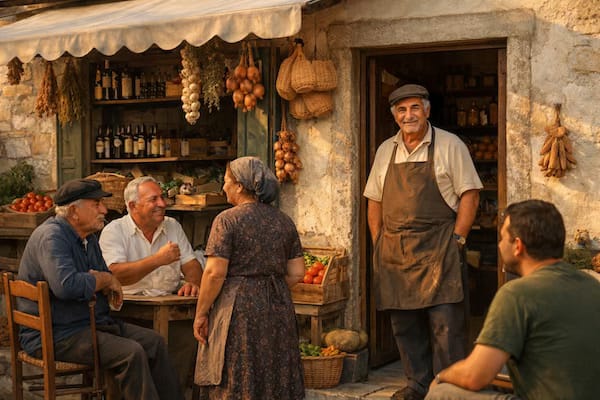
My family carries proof that Greeks do this seriously.
Sometime after 212 BC, when Greek political power in Sicily came to an end with the Roman conquest of Syracuse, my ancestors somehow found their way to Souli, in Epirus.
That is the historical part.
The properly Greek part comes later.
Generations on, the patriarch of the family was a grocer named Thanasis.
So people called him Bakal-Thanasis.
Grocer Thanasis.
Not a polished surname. Not something noble-sounding for the family tree. Just the practical Greek answer to a practical Greek question:
Which Thanasis?
The grocer.
And like many things in Greece, what began as a description slowly became identity. Generations passed, language shifted, people moved, history happened, and somewhere along the way that old village shorthand evolved into the family name we still carry today:
Athanassiadis.
Thanassis, in everyday Greek. Athanasios, if we are being formal.
And why the -adis?
Because after the exodus from Souli, my family eventually moved to Constantinople, today’s Istanbul. That matters, because surnames ending in -adis are traditionally linked to families from that world, just as -akis usually points toward Crete.
So even the ending tells a story.
The grocer became a nickname.
The nickname became a name.
And the name kept traveling.
That tells you almost everything you need to know about Greece.
Here, your real name is often just the opening offer.
After that, society steps in and improves it.
You may be born Giorgos, Kostas, Eleni, or Maria, but sooner or later your actual name stops being the most useful thing about you. What matters is how people know you, where they place you, and which detail stuck first.
So you become:
the Cretan
the Cypriot
the tall one
the short one
the blond one
the doctor
the electrician
the kiosk guy
Mitsos’s son
the widow from the corner
the woman with the cats
And once that label sticks, that is it. You are done.
The best part is that the facts no longer even need to remain true.
The blond one may now be bald or redheaded.
The kid from Crete may be seventy-four.
The electrician may not have touched a wire since the 1980s.
The doctor may not even be a doctor. He may be a dentist, a veterinarian, or just a man who once gave somebody an aspirin and sounded confident.
It does not matter.
In Greece, once the neighborhood files you under something, the archive is closed.
And this is not always unkind. Very often it is the opposite. It is local memory at work. It is how communities keep track of each other. Not as abstract individuals, but as people attached to a place, a profession, a family, a visible trait, or one memorable detail.
It is identification through familiarity.
Not official.
Not delicate.
But extremely effective.
And none of this belongs only to the past.
We now live in Kalamata, where roughly 97% of the male population seems to be named Panagiotis or Panos.
My wife quickly understood that some kind of survival system was needed.
So she created one.
There is Original Panagiotis.
Panagiotis Big Shoes.
Panagiotis Pharmacy.
Panagiotis Feta Cheese.
And just like that, without even noticing, she had become fully Greek.
Because when half the town shares the same first name, people must be organized somehow. And in Greece, that means one identifying detail is enough to carry the whole person.
That is the Greek genius of it.
The country does not just know who you are.
It knows how to place you.
And once it places you, that version of you can outlive everything else.
Even your name.
before Greece renames you
What label, nickname, or family name stuck in your world and never left? I have a feeling every Greek family has at least one story.
Siga, siga 💙
Nick in Athanassiadis