

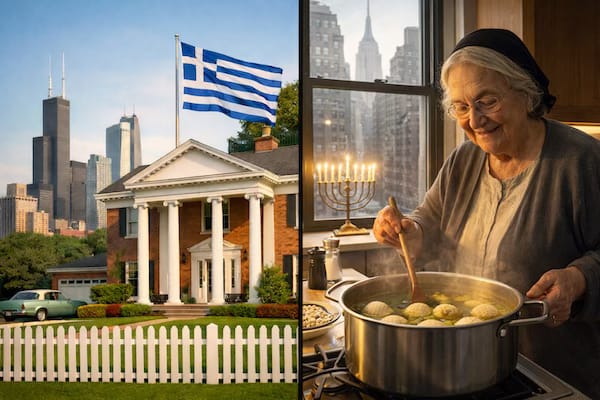
Why do Greek movies always send the rich uncle to Chicago… while Jewish stories send everyone to Manhattan?
Apparently Greeks and Jews have a lot in common.
I know this now.
Credit my Jewish wife. Before her, I had absolutely no idea.
Turns out we both built entire cultures around food, family, and arguing about things that happened in 1932.
Not politically.
Not historically.
But emotionally.
Both cultures developed in diaspora. Both survived centuries of upheaval. And both created languages full of words that simply refuse to translate.
The kind of words that make English shrug and say, “close enough.”
That’s what started me thinking after writing about ξενιτιά (xenitiá) — that deeply Greek word describing the condition of living far from home, while emotionally never quite leaving it.
Once you start thinking about ξενιτιά (xenitiá), you begin noticing other parallels.
Including one that always makes me laugh.
Chicago vs. Manhattan
If you grew up watching old Greek black-and-white movies, you know the character.
The wealthy uncle from America.
And almost without exception… he is always from Chicago.
Not New York.
Not Boston.
Not Los Angeles.
Not even Astoria.
Always Chicago.
He arrives wearing a suit, speaking Greek with an American accent, sprinkling English words into his sentences like oregano.
“Hello everybody! I bring presents from America!”
And instantly the entire village understands:
This man has made it.
In Greek storytelling, Chicago became less of a city and more of a symbol.
America itself.
The place where people left poor and returned legendary.
It didn’t matter if the uncle actually owned a restaurant, a diner, or a shoe repair shop. The mythology was already written.
If you lived in Chicago, you had succeeded.
Now compare that with the Jewish immigrant imagination.
For them, the mythological geography is completely different.
The center of gravity is Manhattan.
First the Lower East Side.
Later the Upper East Side.
Jewish stories — from Yiddish theater to Woody Allen films — are filled with apartments, neurotic conversations, family dinners, intellectual arguments, and the eternal search for decent bagels within walking distance.
Where the Greek immigrant story often features the returning uncle, the Jewish story often revolves around the family that never leaves the apartment but somehow builds an entire universe inside it.
Different cities.
Same emotional engine.
Both cultures developed words that English can’t quite hold.
Greek gives us:
ξενιτιά (xenitiá)
The ache of living away from home.
καημός (kaimós)
That lingering emotional ache after something passes.
μεράκι (meraki)
Putting part of your soul into something you create.
Meanwhile Yiddish offers:
Schlep
Effort mixed with inconvenience and mild complaining.
Kvetch
Complaining elevated to cultural tradition.
Chutzpah
Audacity with attitude.
Mensch
A person of real character.
None of these translate perfectly.
Because they carry centuries of migration, survival, humor, and memory.
And perhaps that’s the deepest similarity.
Both cultures deal with hardship the same way.
Through humor.
A Greek mother asks:
“Έφαγες;”
(Have you eaten?)
Which really means:
I love you.
A Jewish mother says:
“You’re too thin. Eat something.”
Which also means:
I love you.
Different language.
Same operating system.
And that’s why the immigrant geography always makes me smile.
In the Greek imagination:
America = Chicago + wealthy uncle.
In the Jewish imagination:
America = Manhattan + rent-controlled apartment + strong opinions.
Different cities.
The modern version of the old Greek movie uncle may actually be Mr. Portokalos in My Big Fat Greek Wedding.
He is the same archetype — the immigrant who carries the entire homeland inside his head and is fully prepared to explain its greatness to anyone within hearing distance.
The Jewish cultural equivalent might be less a single character and more a personality type. Think a Manhattan grandmother standing in a small apartment kitchen, stirring a pot of soup and insisting you sit down and eat something immediately.
Mr. Portokalos believes every word comes from Greek.
A Jewish grandmother believes every problem can be solved with chicken soup.
Different theories. Same level of confidence.
And the story continues.
People leaving home.
Building new lives somewhere else.
And never quite stopping talking about where they came from.
Every culture has a few.
Greek just happens to have a suspiciously large supply of them.
I started this series exploring words like μεράκι (meraki), λεβεντης (leventis) , and ξενιτιά (xenitiá) — the kinds of words that carry entire emotional universes inside them.
What comes next?
Honestly… I’m not entirely sure yet.
But if Greek culture has taught me anything, it’s this:
Something will come up.
Stay tuned.
If you’ve experienced it, you already know.
If you haven’t… the Greeks have a word for it.
If you enjoyed this piece, subscribe to the newsletter.
More stories about Greece, language, culture, and the occasional discovery that my wife has been right all along.

Discussion
Pull up a chair. Add a memory, a correction, a laugh, or something the story brought to mind.
No comments yet. We have been waiting for you...