

We spent a couple of days in Methoni, which is what you do when you live in Kalamata and suddenly remember there is an actual castle by the sea just sitting there, waiting for you to stop doing admin work.
Naturally, within the first eleven minutes, we found the bakery.
This is not travel advice. This is Greek survival.
Before you ask where the beach is, before you ask where the castle is, before you ask where to park without angering three generations of local residents, you locate the bakery.
The best one, as far as we could tell, was Athanasiou.
Established in 1904.
Of course it was.
Because in Greece, a bakery is not “new.” A bakery is either from 1904, from your grandmother’s village, or from a cousin who has very strong opinions about koulouri.
I asked the obvious question.
“Are you related to the famous Athanasiou in Kalamata?”
No, no, no, they said.
The Greek “no, no, no” is not a simple denial. It is a full municipal document. It means no, absolutely not, please do not confuse us with those people, although naturally we respect them, probably know them, may be connected through a baptism, but legally and spiritually no.
So I tried again.
“What about the other Athanasiou bakery in Kalamata? The one branded as Alesis?”
Oh no, they said.
Different Athanasiou.
Naturally.
Then, just when I thought the Athanasiou Bakery Map of Messinia could not get more complicated, they added:
“By the way, we are opening a bakery in Kalamata.”
Of course they are.
“Where?”
“On Avras.”
Now this time, for once, I did not have to nod like a man pretending to know.
I know exactly where Avras is.
This made the story even more dangerous, because now the new Athanasiou bakery was no longer an abstract future bakery somewhere in Kalamata. It had coordinates. It had a street. It had entered my personal carbohydrate radius.
There was only one problem.
They are waiting for a three-phase electricity connection.
Τριφασικό ρεύμα.
Because apparently you can have flour, ovens, recipes, family history, ambition, location, signage, and a bakery lineage dating back to 1904, but if DEH does not have the special box, the bread remains theoretical.
This is Greece at its most Greek.
A bakery can survive two world wars, occupation, civil war, dictatorship, inflation, the euro, the memoranda, tourists asking if baklava is vegan, and people ordering cappuccino freddo in February.
But the opening may still depend on whether somebody, somewhere, has the correct electrical box.
Siga, siga.
The croissants will wait.
Still, the question stayed with me.
What is it with Athanasiou and bakeries in Messinia?
Naturally, after this, I had to investigate.
Not seriously, you understand. I am not the BBC. I am a man who had already eaten bakery products and was now trying to justify it as research.
But the Athanasiou situation is not simple.
There is the Pylia original transformed into Methoni/Pylos line, proudly wearing the “since 1904” badge, which in Greek bakery years is basically prehistoric. This is the traditional side of the story: bread, dough, ovens, family recipes, and the kind of place where “established in 1904” does not feel like marketing so much as a warning that they have been doing this since before your grandfather had opinions.
Then there is Alesis, also carrying the 1904 inheritance, but with a more modern Kalamata identity. Alesis sounds clean, designed, branded. It comes from άλεση, the milling of wheat, which is exactly the kind of word that makes bread sound both ancient and ready for Instagram.
And then there is Athanasiou 1938, the famous Kalamata name, the one everybody seems to know. This branch went in a more pastry-and-sweets direction: the elegant boxes, the diples, the chocolates, the “we are bringing something to dinner and therefore civilization will continue” category of Greek life.
So what we have is not one bakery.
We have an Athanasiou baking constellation.
There is 1904.
There is 1938.
There is Pylia.
There is Pylos.
There is Methoni
There is Kalamata.
There is Alesis.
There is the famous one.
There is the other famous one.
There is the one that is absolutely not related.
This is Greece. A family name does not simply exist. It expands. It opens branches. It becomes a pastry counter. It becomes a local orientation system.
“Turn left after Athanasiou.”
“Which Athanasiou?”
Exactly.
And more importantly, this was not the first time Greece had given me a surname that felt less like a family name and more like a business plan.
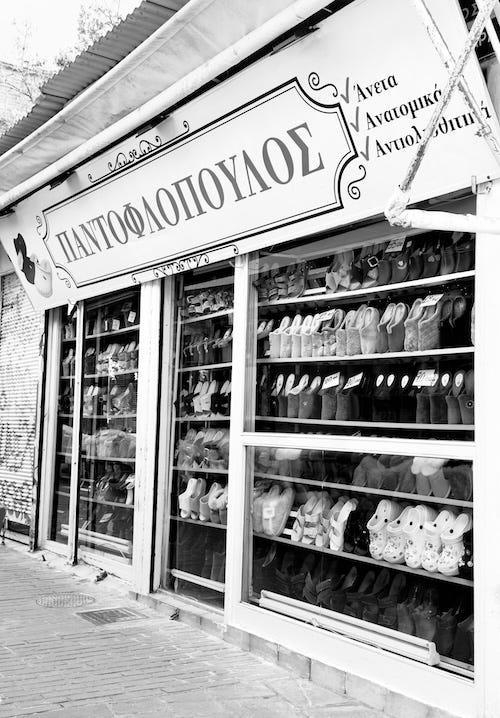
In Ioannina, I saw a slipper shop.
A proper slipper shop. Shelves full of παντόφλες (pantofles). Soft ones, practical ones, old-lady ones, tourist ones, the kind your mother buys you because “the floor is cold,” even when the floor is not cold and you are 69 years old.
And there, above the store, was the name:
Pantoflopoulos.
A man selling slippers.
Named Pantoflopoulos.
At that point, what choice did he have?
You cannot be named Pantoflopoulos and open a sushi restaurant. That would be an act of rebellion against the ancestors.
In America, people say, “Follow your passion.”
In Greece, apparently, your must name your surname into retail.
The more I thought about it, the more I realized Greek surnames are full of occupational ghosts.
Papadopoulos means somewhere, somehow, there was a priest in the family story.
Mylonas points to a miller.
Psaras smells faintly of fish.
Raptis is a tailor.
Karvounis has charcoal somewhere in the ancestral smoke.
Sideris sounds like iron.
Bakalis belongs near a grocery counter.
Manavis belongs near fruit and vegetables, preferably while correcting you about tomatoes.
Kafetzis is never far from coffee.
Fournaris sounds suspiciously close to an oven.
And if your name is Psomas, I am sorry, but I expect bread.
Maybe not from you personally. I am reasonable. You may be an accountant. You may be a dentist. You may be an emotionally unavailable software engineer. But somewhere behind you, in the fog of the family tree, I expect a loaf.
Greek names carry history the way old houses carry damp.
They tell you about fathers, villages, occupations, physical features, priests, Turks, Venetians, islands, mountains, nicknames, trades, and some uncle nobody wants to discuss before the second coffee.
Sometimes the connection is real.
Sometimes it is ancient.
Sometimes it is accidental.
And sometimes it is just Greece having a little fun at your expense.
Of course, family names are not destiny. Nobody is required to become what the name suggests. A Papadopoulos does not have to enter the priesthood. A Psaras does not have to sell fish. A Raptis does not have to hem pants. A Karvounis is not legally obligated to appear in public covered in charcoal.
But in Greece, coincidence rarely stays small.
It gathers cousins.
It attracts theories.
It sits down, orders coffee, and becomes a story.
That is the real Greek profession: connecting things.
A name to a village.
A village to a grandmother.
A grandmother to a bakery.
A bakery to another bakery.
Another bakery to a family that is absolutely, definitely, certainly not related.
No, no, no.
Completely different Athanasiou.
Unless, of course, you go back far enough.
This is where every Greek conversation becomes genealogy with snacks.
You start by asking, “Is this bakery related to the one in Kalamata?”
Ten minutes later, you are learning that somebody’s mother was from Pylos, somebody’s brother-in-law knew your cousin in the Air Force, somebody had a shop near the old bus station, and the original family may have come from a village where half the people had the same last name and the other half were not speaking to them.
By then, you have bought two tiropites, a loaf of bread, and a small bag of koulourakia you did not technically need.
This is how they get you.
Not with marketing.
With lineage.
I am beginning to think Greek small businesses should not have logos. They should have family trees.
Forget “Since 1904.”
Give me the real information:
Athanasiou Bakery
Established 1904
Not related to the other Athanasiou
Probably related to somebody you know
Waiting for DEH
Three-phase electricity pending
Ask again after Easter
Now that is branding.
And Pantoflopoulos?
He needs no slogan.
The man achieved nominative perfection.
Maybe that is why I love these little discoveries so much.
They are not famous ruins. They are not UNESCO sites. They are not the things travel guides tell you to photograph.
They are storefronts.
Signs.
Names.
Conversations at counters.
So now I am investigating.
Not professionally, of course. This is Greece. Professional investigations require stamps.
I am conducting the more reliable kind: asking people behind counters while buying something I do not technically need.
If your name is Athanasiou and you own a bakery, please report to the nearest koulouri.
If your name is Pantoflopoulos and you sell slippers, congratulations. You have won Greece.
If your surname secretly matches your profession, please let me know. I am building a database.
Or possibly just an excuse to visit more bakeries.
Either way, research must continue.
With receipts.
And maybe a tiropita.
Siga, siga 💙
Nick in Kalamata