

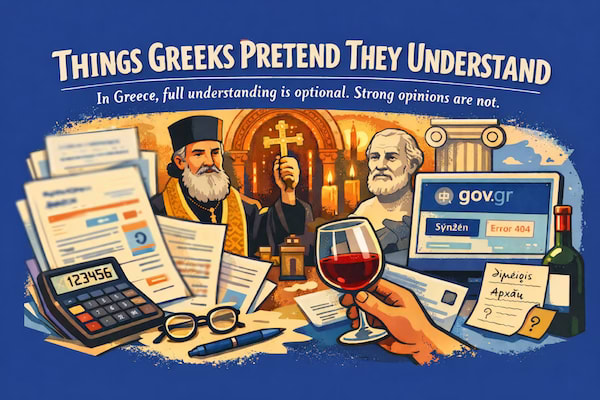
The older I get, the more I admire a very specific Greek talent.
Not knowledge.
Not expertise.
Not even competence, exactly.
Confidence.
Not the loud, motivational-speaker kind.
The quieter Greek version. The kind that allows someone to stare at a tax form, a utility bill, a church service in ancient-sounding Greek, or a government website that looks like it was assembled during a power outage, and still nod as if everything is perfectly clear.
This is one of our great national survival skills.
Because if Greeks waited to fully understand everything before proceeding, the country would come to a complete stop by Tuesday morning.
So instead, we developed a system.
We squint.
We comment.
We ask one uncle, one neighbor, and one man at the kafeneio.
Then we continue with absolute certainty.
There are many things Greeks pretend to understand. Here are just a few.
Bills, in Greece, are never just bills.
They are narratives.
You open one with caution. Electricity, water, phone, κοινόχρηστα, something from a municipality, something from a service you do not fully remember signing up for. There are boxes, codes, adjustments, itemized charges, and at least one line that seems written less to inform you than to test your character.
Does anyone actually understand all of it? No.
But everyone studies it with the intensity of a forensic accountant.
A Greek will look at the page for thirty seconds, exhale heavily, tap one corner, and say something like, “They’ve added nonsense again.”
What nonsense?
No one knows.
But it has definitely been added again.
Tax forms belong to the same family.
There is no Greek alive who has ever looked at a tax declaration and thought, “Yes. Clear. Logical. Human.”
No, the proper Greek reaction is to freeze for a moment, then say the sacred national phrase:
“Άστο, θα το δει ο λογιστής.”
Leave it. The accountant will look at it.
In Greece, accountants are not professionals.
They are emotional support.
They are interpreters of sacred texts.
They are the final barrier between the citizen and complete psychological collapse.
Then there are government websites.
This is where modern Greece really shines.
You begin with confidence. After all, now everything is digital. Very advanced. Very European. Very efficient.
You log in with your codes.
Then again.
Then again for reasons never fully explained.
A page opens. Another page replaces it. A button appears. A button disappears. You are redirected to something official-looking but also suspiciously temporary. Somehow the whole experience feels both bureaucratic and experimental at the same time.
At some point a Greek person will inevitably say, “It’s easy.”
This is never true.
What they mean is that they personally suffered through it once in 2022 and emerged alive.
Church language is another national miracle.
Most Greeks can follow the emotional logic of the service perfectly. They know when to stand still, when to cross themselves, when to lower their voice, when to take the candle, when to say “Χριστός Ανέστη,” and when to look mildly offended if someone does something out of sequence.
But the language itself? That is another matter.
Large parts of it float through the air in glorious, ancient majesty while the average person catches fragments. A phrase here. A holy word there. Maybe a “Κύριε ελέησον” if we’re lucky.
And yet nobody panics.
Because in Greece, understanding every word is apparently optional.
Participating correctly is what matters.
Which may be one of the most Greek concepts of all.
And then there is wine.
Now, I am sure there are true experts out there. Serious people. Knowledgeable people. People who can identify notes of cherry, tobacco, forest floor, dark fruit, and the emotional history of the barrel.
But many Greeks approach wine discussion the same way they approach many things: with firm opinions built on unstable foundations.
Someone swirls the glass. Someone nods. Someone says, “Very good body.”
What does that mean exactly?
Nobody wants to be the one to ask.
Because this is Greece. We may not know, but we will not be humiliated in public.
So we continue bravely.
“Balanced.”
“Round.”
“Nice finish.”
At the end of the day, all anyone really wants to know is this:
Does it go with the lamb?
And will I regret it tomorrow?
The truth is, Greece has always functioned on a mix of improvisation, inherited confidence, and social interpretation.
We do not always understand the system.
We understand the mood of the system.
We understand who to ask.
Who not to ask.
When to nod.
When to complain.
And when to say, with deep authority, that things were better before.
This may sound like chaos.
And perhaps, objectively, it is.
But it is also its own kind of order.
A living one.
A human one.
A system held together not by total clarity, but by rhythm, instinct, ritual, and the unshakable belief that if things become truly complicated, somebody’s cousin will know what to do.
And maybe that is why Greece keeps going.
Not because everybody understands everything.
But because enough people are willing to act like they do.
And somehow, against all evidence, that is often enough.
Siga, siga 💙
Nick in Kalamata