

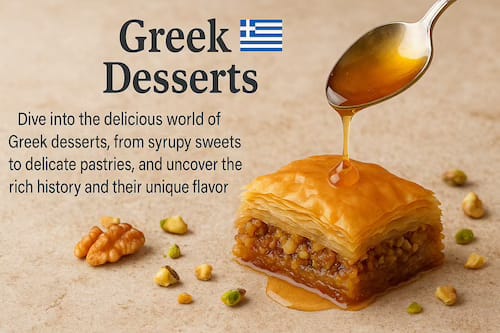
If you don’t like, or are allergic to honey, sesame seeds, or nuts, you better not move to Greece. They are everywhere, hiding in plain sight, waiting to ambush you in the most delicious way.
Take yesterday, for example. We went with visiting friends to Kentrikon (Κεντρικόν in Kalamata), a lively mezedopolio (think of small plates that keep coming until you can’t breathe). I decided to order an appetizer for my friends to taste: baked feta wrapped in delicate phyllo dough, drizzled with honey, and sprinkled with sesame seeds. Their reaction? A collective, wide-eyed, mouth-full “YUM!!!”
That’s Greece in a bite: salty, sweet, crunchy, gooey, and unapologetically generous with the honey jar.
And if you thought honey was reserved only for desserts, think again. Here it sneaks into cheese, meat, bread, and even salads. Greeks will drizzle it on anything that stands still long enough.
For almost thirty years in the U.S., my wife and I kept hearing doctors, nutritionists, and morning show hosts preaching about the health benefits of the “Mediterranean diet.” (My wife wrote a great piece about the “diet”. You can read it here).
“Eat like the Greeks!” they’d say, waving their hands toward some imaginary Santorini kitchen. “Fresh fish, vegetables, a drizzle of olive oil, and you’ll live to 100!”
When we mentioned we were moving back to Greece, the reaction from doctors and friends was unanimous:
“Oh my God, the food! The healthiest in the world!”
And yes, it’s true, until you land, say, in Kalamata.
Welcome to the Real Mediterranean Diet.
Within minutes of your arrival, the scent of freshly baked something envelops you, phyllo, honey, orange zest, and sugar. You don’t walk into the Mediterranean diet; you float into it like a cartoon character floating toward a bakery that’s clearly trying to test your willpower..
Forget quinoa. This is the real Greek lifestyle plan: breathe, gossip, and consume anything ending in “-pita.”
If you dare refuse dessert, prepare to be blacklisted for life.
(“He said no to galaktoboureko? Barbarian!”)
The Sweet Law of Greek Hospitality
By now, you should have a sense why there’s a gazillion places to buy desserts in Greece. Because in Greece, dessert isn’t just dessert, it’s currency.
You’re invited to a house? Whether it’s for dinner, a birthday, or just to say hi, you better bring a dessert. Not a present. Not flowers. Not a toy for the kids. A dessert!
It’s an unspoken rule, passed down through generations: you arrive holding a white box with red string from the nearest zacharoplasteio (patisserie), and the hostess opens it like it’s the Holy Grail.
And when that lid opens and someone gasps,
“Ahhh you shouldn’t have! Oh my God, it’s from Kosmikon!!!”
and that’s when you know you’ve achieved Greek social nirvana.
Kosmikon, for the uninitiated, is not just a patisserie, it’s an institution. People have stronger emotional attachments to its desserts than to their Wi-Fi. Bring a box from Kosmikon, and you’re instantly elevated from “guest” to “family.”
Every neighborhood has its own favorite zacharoplasteio, but Kosmikon is the Beyoncé of the dessert world, legendary, untouchable, and likely to be sold out when you get there.
For cities and town that are not fortunate to be close to Kosmikon don’t despair. You still have plenty of zacharoplasteia, each claiming the best galaktoboureko, freshest ekmek, or most authentic portokalopita.
They thrive because no one dares show up empty handed. You can forget your wallet, your ID, even your spouse, but never show up without a box of sweets.
The Greek Dessert Hall of Fame
A whirlwind tour of Greece’s most beloved sugar ambassadors, each with its own backstory, region, and syrup personality.
Baklava
Perhaps the world’s most contested dessert. Greeks, Turks, Syrians, Lebanese — everyone claims it. Delicate phyllo layered with nuts and honey syrup. The original “peace talks” dessert.
Origin: Byzantine diplomacy through dessert.
Best served: Everywhere.
Recipe →
Loukoumades
Golden, bite-sized dough balls fried to perfection and drenched in honey, cinnamon, and joy.
Origin: Ancient Greece — supposedly given to Olympic champions as edible medals.
Modern use: Best enjoyed while standing in line at a street festival, burning your fingers and pretending to share.
Recipe →
Kataifi
Imagine baklava, but with a wild hair day. Shredded phyllo dough wrapped around nuts, buttered generously, and soaked in syrup until your dentist starts texting you.
Origin: Middle Eastern roots, perfected in Greek pastry shops with a healthy disregard for restraint.
Fun fact: The word kataifi means “shredded,” but it’s really Greek for “you won’t stop at one piece.”
Recipe →
Diples
The Maniots swear these golden fried rolls of phyllo drizzled with honey were invented in their mountains. Cretans disagree, claiming their xerotigana are the real deal.
Origin: Peloponnese weddings — because what’s marriage without deep-fried symbolism?
Fun fact: “Dipla” means “folds.” Like the ones you’ll develop after eating them.
Recipe →
Xerotigana (Cretan Rival)
The Cretan cousin of diples. Fried, crunchy, spiraled, and soaked in honey.
Origin: Crete.
Cultural note: Cretans claim they’re lighter. Maniots disagree. Wars have started over less.
Recipe →
Galaktoboureko
Custard wrapped in phyllo and drenched in syrup — the crown jewel of Greek desserts.
Origin: Somewhere between Smyrna and heaven.
Fame alert: Made world-famous when the Clintons ordered it from a patisserie in Kalamata.
Recipe →
Bougatsa
Thessaloniki’s pride and joy, flaky phyllo filled with semolina cream, sugar, and sometimes cheese (because Greece can’t decide between dessert and breakfast).
Origin: Northern Greece.
Nickname: “Bougatsa with cream” for dessert, “Bougatsa with cheese” for breakfast confusion.
Recipe →
Galatopita
Think of it as bougatsa’s rustic cousin — milk pie without the phyllo, baked in a village oven with semolina and love.
Origin: Central Greece.
Tip: Eat warm. Like most Greeks, it gets grumpy when cold.
Recipe →
Ravani
A semolina sponge cake soaked in syrup, often flavored with lemon or orange.
Origin: Ottoman-era favorite.
Meaning: Proof that syrup can unite empires.
Recipe →
Portokalopita
Orange phyllo cake soaked in syrup, the most aromatic of them all.
Origin: Crete or Epirus, depending who’s louder.
Personality: Bright, zesty, and capable of replacing antidepressants.
Recipe →
Karidopita
The walnut cake of your dreams — spiced with cinnamon, nutmeg, and regret.
Origin: Found in every Greek home around the holidays.
Tip: Best served with a scoop of ice cream and zero guilt.
Recipe →
Sokolatopita
Greek chocolate cake soaked in syrup (because apparently nothing escapes syrup).
Origin: Athens, 1980s patisseries.
Note: Pair with espresso. Prepare for silence.
Recipe →
Melomakarona
Christmas in a cookie: honey soaked, walnut topped, spiced with orange and cinnamon.
Origin: Ancient funeral bread that evolved into joy.
Season: December only — unless yiayia says otherwise.
Recipe →
Kourabiedes
The other Christmas cookie. Powdered sugar bombs of joy (and dry-cleaning bills).
Origin: From Persia via Ottoman pastry diplomacy.
Warning: Never wear black while eating.
Recipe →
Fanouropita
Cake dedicated to St. Fanourios, patron saint of lost things.
Origin: Baked to help you find what you’ve lost — keys, wallet, patience.
Bonus: Vegan, so you can call it healthy.
Recipe →
Amygdalota
Almond cookies — soft, chewy, and usually found at weddings and baptisms.
Origin: Cycladic islands, especially Andros though they fight with Hydra.
Texture: Edible marzipan hugs.
Recipe →
Melopita
Honey pie from the island of Sifnos — cheesecake’s Greek cousin.
Origin: Sifnos.
Taste: Light, floral, deceptively angelic.
Recipe →
Moustokouloura
Dark, chewy cookies made with grape must.
Origin: Peloponnese.
Fun fact: Originally made during wine-making season when nothing (especially sugar) went to waste.
Recipe →
Yes, the Mediterranean diet is healthy, in theory.
But here in Greece, dessert isn’t about calories; it’s about hospitality, history, and diplomacy.
Say “no” to a slice of galaktoboureko and you’re not refusing calories, you’re rejecting centuries of culture, gossip, and syrup based bonding.
So take the dessert. Always take the dessert.
It’s not just food, it’s a passport to belonging.
Disclaimer: When you walk into any zacharoplasteio tis geitonias (neighborhood patisserie) and see another 937 deliciously smelling baked things, you’ll quickly realize that the above list is just the tip of the (Greek) iceberg. And yes, Greece does get cold, really cold. In Kato Nevrokopi, for example, winter temperatures can drop to -20°C, which is the perfect excuse to bulk up with a little extra galaktoboureko insulation.
🍯 Bonus: Want to taste them all without guilt? Just walk to the patisserie, it counts as cardio.
📬 Subscribe for more stories from Greece at mybigfatfunnylife.substack.com