

There are many ways to understand a country.
You can study its history.
You can learn its language.
You can examine its tax system, if you have a strong heart and no plans for the afternoon.
Or you can sit in a Greek car and listen to the seat belt alarm.
Beep.
Beep.
Beep.
This is not just a sound. This is a political statement.
In some countries, a seat belt alarm is treated as a mild reminder. You buckle up, the car stops yelling, and everyone continues with life.
In Greece, the seat belt alarm is often treated as an occupying force.
The car beeps.
The driver sighs.
The car beeps again.
The driver looks personally offended, as if Renault, Toyota, Hyundai, and possibly the European Union have gathered in a secret conference room to ruin your morning.
“Why is it beeping?” someone asks.
“Because you are not wearing the seat belt.”
“I know.”
Beep.
“Then wear it.”
“I am only going to the bakery.”
Beep.
“The bakery is still located on Earth, where physics applies.”
Beep.
At this point, the Greek mind begins to work.
Not toward compliance, of course. That would be too easy.
No, the Greek mind begins to search for the πατέντα.
The workaround.
The hack.
The little trick that defeats the system without technically admitting defeat.
Because Greeks do not always break rules directly. Sometimes they enter into a philosophical negotiation with them.
A friend recently wrote to me with a possible topic. He remembered Greeks who would buckle the seat belt and then sit on top of it, just so the alarm would stop. Reading his note I also remembered, from years ago, those shirts with a diagonal black stripe printed across the chest to mimic a seat belt, in case a policeman was paying attention. My sister in law was using one.
This is not fiction.
This is Greek engineering.
Why solve the safety problem when you can solve the appearance-of-compliance problem?
The seat belt shirt was a masterpiece. It said, “Officer, please observe that I am participating in society,” while the actual human body inside the shirt remained completely unattached to the vehicle.
It was not a safety device.
It was theater and fashion at the same time.
And apparently, if the policeman was tired, the sun was in his eyes, and everyone involved agreed not to examine the situation too closely, it was convincing theater.
The same spirit lives on today.
In our little Renault Clio, the back seat has its own opinions. If someone sits in the back and does not buckle up, the car begins to beep.
Not once.
Not politely.
Not with a gentle French reminder.
It beeps with the confidence of a small European car that has read the manual and intends to enforce it.
Beep.
Beep.
Beep.
Now, here is the important detail. This is not, as far as I know, Greek law personally reaching into our car and demanding order from the back seat. This is Renault. The car itself has decided that if there are humans in the back seat, those humans will either buckle up or listen to the electronic song of shame.
This creates a beautiful conflict.
On one side: modern automotive safety systems.
On the other side: three Greeks in the back seat who have survived governments, ministries, tax offices, power outages, ferry schedules, and cousins who said they would “come by in ten minutes” and were last heard from during the drachma years.
You think a beep is going to defeat them?
Please.
Within seconds, solutions are discussed.
“Maybe if I sit differently.”
Beep.
“Maybe the bag is triggering it.”
Beep.
“Maybe if we buckle it behind us.”
Beep.
“Maybe if we buckle it and sit on top of it.”
Silence.
Victory.
The car thinks everyone is safe.
The passengers think they have outsmarted the car.
Renault, somewhere in France, feels a disturbance in the force.
This is the Greek approach to many systems. The system presents a rule. The Greek does not immediately ask, “How do I follow this rule?”
The Greek asks, “What exactly does the system think it knows?”
And this is not limited to seat belts.
The same small revolution happens with helmets.
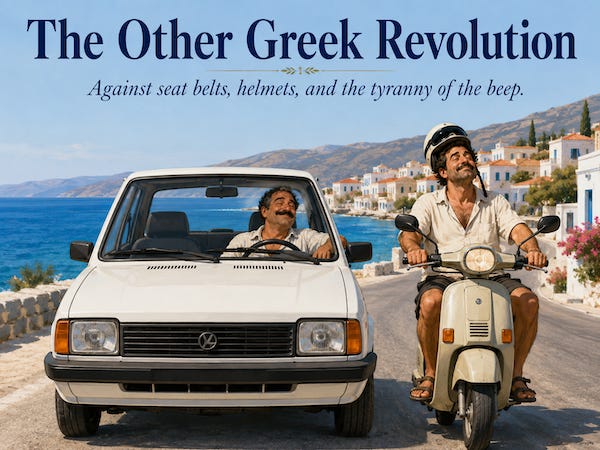
Spend enough time in Greece and you will see people on scooters, motorcycles, and ATVs wearing helmets in several creative ways.
Properly on the head is one option.
But there are others.
The helmet may be resting on the handlebar.
It may be hanging from the elbow.
It may be balanced loosely on top of the head like a decorative bowl.
It may be worn only near known police territory, then removed once freedom has been restored.
Sometimes the helmet is present, but not exactly participating.
It is not there to protect the skull.
It is there to protect the driver from a fine.
This is an important distinction.
The logic is simple: the police want to see a helmet. Fine. Here is a helmet. We never agreed on the precise relationship between the helmet and the head.
Again, theater.
Again, technical compliance without spiritual surrender.
Of course, this is where the funny part and the serious part meet.
Seat belts and helmets were not invented to annoy us. They are not little bureaucrats with straps. They are not part of a global conspiracy to prevent Greeks from enjoying a two-minute drive to the periptero.
They exist because bodies are fragile and roads are unpredictable.
But try explaining that to a man who has been driving the same road since 1966 and believes familiarity is a form of divine protection.
“I know this road.”
Yes, but does the other driver know this road?
“I am careful.”
Yes, but is the teenager on the scooter careful?
“I am only going slowly.”
Yes, but the concrete wall is not. It is already there.
The problem is that safety devices are boring. They offer no drama, no flexibility, no cleverness. They simply ask you to do the sensible thing before the sensible thing becomes necessary.
This is not always compatible with the Greek temperament.
Greeks are excellent in emergencies. Truly excellent.
If something breaks, someone will fix it with wire, tape, a cousin, and a cigarette.
If the water stops, someone knows a guy.
If the electricity bill looks like it was written by a drunk oracle, someone will explain three possible reasons, two of which involve “the system.”
If a pipe bursts, a neighbor appears with tools before you have finished panicking.
But prevention?
Prevention is less exciting.
Prevention does not allow for a good story. Prevention does not allow you to say, “You will not believe what happened.” Prevention is just sitting there, quietly buckled, like a responsible adult.
Where is the poetry in that?
Still, Greece is changing.
You see more people wearing seat belts now. More helmets, too. More children properly strapped in. More drivers who accept that the car is not beeping because it hates them, but because it has a job.
But the old spirit has not disappeared.
It has simply adapted.
The seat belt alarm is no longer a warning. It is an opponent.
The helmet is no longer safety gear. It is a prop.
The rule is not always a rule. Sometimes it is an opening offer.
And the Greek driver, facing all of this, does what Greeks have done for generations.
He studies the system.
He identifies the weakness.
He invents a solution.
Then he tells you, with complete confidence:
“Έλα μωρέ. It’s fine.”
And maybe it is fine.
Until it isn’t.
So yes, buckle up.
Wear the helmet.
Let the Clio be proud of you.
And if you are Greek and still feel the urge to defeat the beep, at least admit what is really happening.
You are not just avoiding a seat belt.
You are participating in the other Greek revolution:
not against empire, but against restraint.
Siga, siga 💙
Nick in Kalamata