

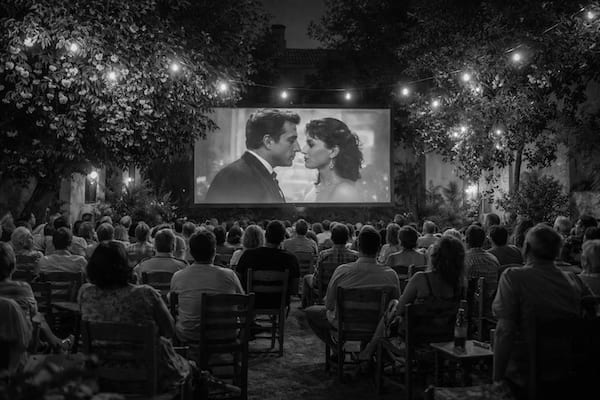
There was a time in Greece when going to the cinema did not feel like entering an entertainment complex.
It felt like entering the neighborhood.
Not the multiplex. Not numbered seats. Not giant cups of cola requiring upper-body strength. Not a “premium viewing experience” designed by people who seem to believe comfort alone is culture.
I mean the old local cinema. And especially the θερινό σινεμά (therinó sinemá), the summer cinema.
Slightly crooked chairs. A screen that looked like it had survived history. Sound that occasionally came from one direction while the dialogue seemed to come from another. Mosquitoes that had clearly not paid, but entered anyway. The smell of jasmine, warm night air, and somebody’s contraband koulourákia or pasatempo (roasted pumpkin seeds).
And of course, at least one person explaining the plot too loudly.
“Don’t trust him.”
“She’ll go back to the first one.”
“This one dies in the end.”
Thank you, sir. We were all hoping for less suspense.
And sometimes the audience did more than comment.
Sometimes it improved the film.
I still remember one screening: crime movie, dark house, murderer entering quietly, wall-to-wall carpet under his feet, walking slowly toward the bathroom where a woman was taking a shower. The entire audience was holding its breath. He kept getting closer. Closer. Closer.
And then, from somewhere in the darkness, came the line:
“Marathon. Wall-to-wall carpets.”
Marathon, for the uninitiated, was a Greek carpet company.
The whole cinema burst out laughing.
And that was the neighborhood cinema in Greece.
Even suspense could become communal.
In Greece, going to the cinema once did not mean disappearing into private silence with a room full of strangers pretending not to exist. It meant entering a temporary public. Half the neighborhood was there. People had opinions. Reactions were not internal. The film was not always treated as a sacred object. Sometimes it felt more like a topic everyone had gathered to discuss while it was still happening.
You did not just watch the movie.
You watched it with the couple whisper-fighting in the back row. With the aunt who had already seen it and felt morally obligated to prepare the rest of you. With the child asking difficult questions at full volume. With someone laughing too early, someone coughing theatrically, and someone else reacting to the plot as if the actress on screen had personally insulted their family.
And somehow, this did not ruin it.
It was the experience.
Because entertainment had not yet been optimized into something smooth, silent, and individual. It was still communal. Slightly inconvenient. Deeply human. You were not sealed into your own perfect viewing bubble. You were part of a room, a courtyard, a neighborhood, a summer evening with commentary.
And sometimes, not even a proper cinema.
In towns and villages, someone would bring an old projection machine. Everyone else brought their own chair. And the movie would be played on the side wall of a house in an empty lot—until one year the lot was not empty anymore, and that was the end of that cinema.
True story.
One time I was visiting a village and the projection screen turned out to be a bedsheet summoned by someone’s yiayiá (grandmother), as if this were the most natural piece of cinema infrastructure in the world.
And honestly, maybe it was.
That is what made it beautiful.
It did not need branding. It did not need luxury seating. It did not need perfect acoustics or a menu with twelve popcorn variations and something called a “nacho cheese experience.”
It needed a projector.
A wall.
A few chairs.
A summer night.
And people willing to sit together and watch something flicker in the dark.
That was enough.
More than enough, actually.
Because what those old neighborhood cinemas offered was not efficiency. It was atmosphere. Not polish, but ritual. Not isolation, but participation. Entertainment was still social then. A film was not just content. It was an occasion.
You went out, saw people, heard people, got bitten by three mosquitoes, learned far too much about your neighbor’s opinion of the lead actor, and still came home feeling you had been part of something.
Today everything is better, technically.
The picture is sharper.
The seats recline.
The air-conditioning works.
No one is projecting Sophia Loren onto a bedsheet held up by optimism and clothespins.
But something small and human has gone missing.
Back then, even going to the movies felt communal. A little messy. A little noisy. Entirely unoptimized. And maybe that is why it stayed with us.
In Greece, even entertainment once felt like a shared responsibility.
And naturally, everyone had notes.
Did you ever watch a film at a neighborhood cinema or a θερινό σινεμά in Greece? I’d love to hear what you remember—especially if someone in the audience felt obliged to help the plot along.

Discussion
Pull up a chair. Add a memory, a correction, a laugh, or something the story brought to mind.
No comments yet. We have been waiting for you...