

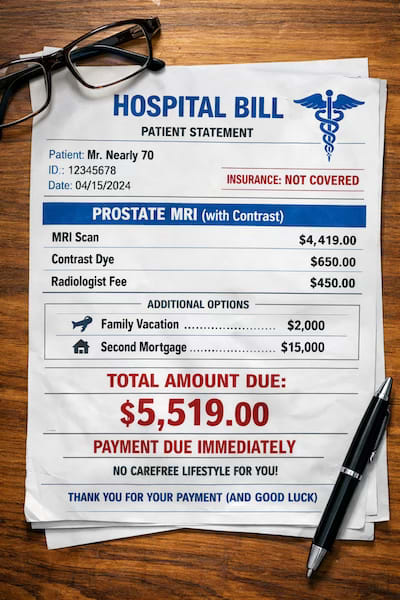
Greek healthcare may raise your blood pressure, but sometimes it lowers everything else.
I have written before about healthcare and costs in Greece.
But this one deserves its own little corner.
The other day, I accompanied a family member to a urologist. At some point, the doctor turned to me and asked, “How old are you?”
“Almost 70,” I said proudly, dressed as usual like a man prepared for a casual mountain rescue rather than a chilly morning in Athens. Barefoot shoes, shorts, and the general appearance of someone whose wife might lovingly describe him as a fruitcake (ο ανδρας μου το φρουτο).
Everyone else was dressed sensibly.
I was dressed in optimism.
The doctor looked at me and asked, “What’s your PSA?”
“My what?”
No idea, I said.
Without missing a beat, he replied, “I’m writing you a prescription. I want you to do a prostate multiparametric MRI with contrast. Right away.”
Now, if you want to make a room go quiet, that is an excellent sentence.
I had no idea what that was. It sounded serious, expensive, and vaguely space-program related.
To an English speaker, it sounds like Greek. To us Greeks, when things become truly incomprehensible, we say it is all Chinese. But that is another story.
Anyway, the prescription came out with official codes and everything, and because I am insured through the Greek National Health System, it looked as if my share would be around €35.
At which point I thought: Well, this is surprisingly civilized.
Then I spoke to a radiologist in Kalamata.
That was when I learned that, unless there are very specific circumstances, this particular test is generally not covered by EOPYY. Unless, perhaps, you get lucky and secure a place in a public hospital sometime before the next ice age.
So no, not everything is perfect in the land of national healthcare.
But then again, perfection is not exactly what the American system is offering either.
You are insured in the US, you say? Good for you. In a few years, you may already have paid what amounts to a respectable down payment on a house just in premiums. And that is before anyone even puts you in the machine.
Then comes the next adventure: getting the MRI approved.
Because in America, being insured and being covered are not always the same thing. Depending on the plan, the indication, and the paperwork, you may still be dealing with prior authorization, co-pays, deductibles, and the general feeling that a committee somewhere needs to be persuaded that your prostate has earned the right to be photographed.
How is that for a process?
Before finding out the real out-of-pocket cost here, I did what no sensible person should do in a medically vulnerable moment.
I went online.
Which, naturally, was a terrible idea.
Up came an article from the American Journal of Roentgenology dated in 2022 reporting that the median charge in the United States for this exam was $4,419 in 2019.1
And it got worse.
There was a 26-fold variation between the lowest median facility charge—$593 without contrast—and the highest, a majestic and completely deranged $15,150.
I kept searching, hoping to find some good news. The best I could come up with was something in the neighborhood of $2,000 with contrast.
At that point, my head began to spin.
A family vacation for four?
For one MRI?
At that point, I did not need contrast dye. I needed a moment. Or two…
Finally, I made my first call.
“Hello, I need this test. I have a prescription. I’m covered by EOPYY.”
The lady was cordial.
“Yes, but this is not covered by EOPYY.”
I took a breath.
“How much would it be?” I asked softly, like a man bracing for impact.
“€240.”
I was so relieved I nearly said, “Perfect, I’ll do it immediately, do you have a machine available in the parking lot?”
But before I could blurt anything out, she added, “We need to schedule it. Nothing available before Greek Easter which happened to be in 3 days.”
Fair enough, I said. I’ll call you back, and hung up.
But of course I could not leave it there. Once activated, my inner researcher becomes both tireless and deeply annoying.
So I called around.
One hospital in Athens: €290.
Another imaging center in Kalamata: €250.
Another: €170.
At that point, enough due diligence. I booked the €170 one.
I went in. Did the scan. Everything smooth.
Then came the grand finale.
I walked up to pay, and the lady at the desk handed me a brochure.
“As part of your test,” she said, “and included in the price you are paying, you now have the option to do 35 blood-related tests here for free.”
Thirty-five.
Not one. Not five. Not a polite little bundle.
Thirty-five.
I could do them all at once, a few at a time, whatever I wanted. Valid for a full year.
At this point I was no longer a patient. I was part of a loyalty program. Delta SkyMiles Diamond Medallion.
Then she added one more thing.
“By the way, your total today is €166 instead of €170 . We are not charging you for the contrast dye drug.”
I think my mouth stayed open all the way home.
Thirty-five blood tests for free.
How much would that cost in the US?
Honestly, I did not dare look.
And I certainly was not going to let Google AI ruin the moment.
So yes, the Greek National Health System can absolutely drive you mad.
There are waits. Bureaucracy. Public facilities that can look as if renovation plans were last discussed during a coalition government nobody clearly remembers 37 years ago.
But still.
€166 out of pocket for a prostate multiparametric MRI with contrast.
Not thousands of $$$
Not a line of credit on your house.
Not a family budget summit with spreadsheets, calculators, and concern.
So the next time we start complaining, as we Greeks professionally do, about healthcare in Greece, it is worth remembering this:
It may test your patience.
But very often, it does not try to repossess your life.
Thankfully, the results came back good. And as we say in Greek, «κακό σκυλί ψόφο δεν έχει» — which roughly translates to “a bad dog does not die easily.” It is one of those darkly funny Greek expressions that basically means: I am still here, still barking, and apparently not that easy to get rid of.
Have you ever had a medical bill in Greece that shocked you in a good way? I would love to hear it.
Siga, siga 💙
Nick in Kalamata
https://www.ajronline.org/doi/10.2214/AJR.22.28152
References: https://pubmed.ncbi.nlm.nih.gov/30213713/

Discussion
Pull up a chair. Add a memory, a correction, a laugh, or something the story brought to mind.
No comments yet. We have been waiting for you...