

After our younger son left for college, Karen and I looked at each other across the quiet house and had the conversation many parents have when the last child leaves.
Now what?
For years, the house had been full of schedules, school calendars, groceries, laundry, sports, noise, worry, and our son announcing there was nothing to eat while standing in front of a refrigerator full of food.
Then suddenly, silence.
No backpacks.
No last-minute forms.
No teenage shoes creating a small archaeological site by the door.
Just us.
Two adults staring at each other like a committee that had lost its main project.
So we asked the dangerous question.
Maybe it was time to repurpose ourselves.
Europe?
Maybe.
Greece?
Now Karen became interested.
Very interested.
“Let’s go,” she said.
This is one of the many reasons I love my wife.
She is brave.
She is adventurous.
She is optimistic.
She also had absolutely no idea what she had just triggered.
Karen thought we were discussing a move.
A change of scenery.
A European adventure with better tomatoes.
What she did not know was that somewhere deep inside her husband, behind the American habits, the Costco membership, the Florida routines, the Publix muscle memory, and twenty-five years of marriage, another man was waiting.
Not hiding.
Waiting.
Nikolaos.
And Greece was about to wake him up.
Karen thought we were changing countries.
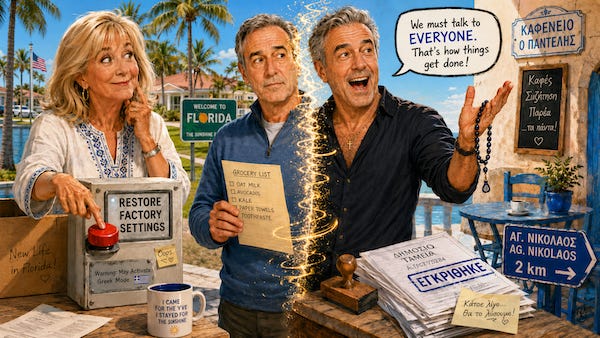
She did not know she had pressed the restore factory settings button.
That button should come with a warning label.
There are things your wife knows about you after twenty-five years.
How you take your coffee.
Which chair you prefer.
How you look when you are about to say something sarcastic but are making a brief attempt at civilization.
Which mood means, “Leave him alone for ten minutes.”
Which mood means, “Change the subject before he gives us a TED Talk no one requested.”
Karen knew me very well.
At least she knew the American versions.
California Nick.
Upstate New York Nick.
Florida Nick.
Husband Nick.
Father Nick.
The man who knew how to operate in American life.
Stand in line.
Answer emails.
Navigate parking lots.
Understand three grocery store chains.
Pretend weather over 95 degrees was still technically survivable.
Then we moved to Greece.
And another version began to appear.
Not dramatically.
There was no lightning over Kalamata.
No bouzouki music from the heavens.
No old village woman pointing at me and saying, “He has returned.”
It was quieter than that.
A phrase.
A reaction.
A look at a road.
A sudden opinion about bread.
A conversation with a stranger that lasted longer than Karen expected.
A small emotional ambush from something that, to her, looked perfectly ordinary.
A sign.
A smell.
A sound.
Karen had not moved to Greece with a new husband.
She had moved to Greece with the same husband in a place where an older part of him had more oxygen.
Maybe I did not know that part was still there either.
In America, I was Nick.
Nick fit on my driver’s license.
Nick answered emails.
Nick could survive American customer service.
That was my battlefield.
Refunds.
Complaints.
Bank lines.
T-Mobile lines.
Xfinity lines.
The mysterious American art of calling, waiting, pressing 1, pressing 3, pressing 0, being transferred, explaining the problem again, asking for a supervisor, and making something happen before the human spirit left my body entirely.
That part I could do.
I could negotiate.
I could complain.
I could escalate.
I could make a company regret putting me on hold.
But asking for a favor?
Different story.
Calling a restaurant and saying, basically, “I know your website says no, but can you help me?”
In America, that felt like asking a machine to develop a soul.
In Greece, something changed.
Here, I handle those things.
Not because Greece is easier.
Please.
Let us not lose our minds.
I handle them because I can feel my way through them.
I can hear the person on the other end of the phone.
Not just the words.
The mood.
The hesitation.
The opening.
The moment when the official answer is no, but the human answer might still be yes.
Yesterday, for example, we had a visitor from the States.
I suggested to Karen that we try a new restaurant within walking distance.
I checked online.
No reservation available until 10:30.
Too late.
In America, the website would have spoken.
In Greece, the website had merely expressed an opinion.
So I called.
A few minutes later, we had a table at 8:00.
Easy peasy.
Native language.
Native instincts.
Native favor-detection system.
That is the difference.
In America, I knew how to push.
In Greece, I know how to ask.
That surprised Karen.
It surprised me too.
Old instincts came back before I realized they had gone anywhere.
I could hear when a sentence was not finished.
I could see a small hesitation and know another document was coming.
I could tell when “no problem” meant no problem, and when “no problem” meant the problem had just entered the building wearing sunglasses.
This is not knowledge you learn from a website.
It sits in your bones.
Then one day you are standing in a Greek square, sipping a freddo cappuccino with your American wife, and suddenly you are not just translating words.
You are translating atmosphere.
Other things came back too.
My voice, for example.
In America, I thought I spoke normally.
Karen may have other legal testimony, but this is my story.
In Greece, my volume adjusted itself to the landscape.
A balcony requires one level.
A family table requires another.
A conversation with a man across the street who may or may not be part of the conversation requires full public-service announcement mode.
Karen discovered that Greek is not always a language you speak.
Sometimes it is a language you launch.
And then there were the conversations.
In America, small talk had rules.
How are you?
Good.
And how are you?
Wonderful.
Everybody lies politely and moves on.
In Greece, a simple exchange can become a full investigation.
Where are you from?
Where were you born?
How long were you in America?
Why did you come back?
Do you have children?
Where are they?
Do you rent or own?
What floor?
Is the building quiet?
Do you know this person?
Of course you know this person.
No?
You must know his cousin.
Sit down.
Karen watched me enter these conversations as if I had been given a password I did not know I still remembered.
Outside a shop.
At a bakery counter.
Beside a parked car.
Near a table at a taverna.
Within minutes, I was no longer just a customer.
I was a file being updated.
At first, Karen looked at me as if to say, “Do you know this person?”
No.
Of course not.
That is not the point.
In Greece, knowing the person is optional.
Entering the conversation is mandatory.
And somehow, I knew how.
That was the part Karen saw.
Not just that I spoke Greek.
Not just that I knew the foods, the streets, the jokes, the paperwork traps.
She saw me recognize things I could not always explain.
Small things.
Ordinary things.
Things that do not announce themselves as important.
A faded sign.
A chipped marble step.
An old man with worry beads.
Someone saying “έλα” into a phone and somehow fitting five meanings into two syllables.
These things do not make you cry.
They do something more dangerous.
They make you quiet.
Karen notices that.
She notices when I stop making jokes.
That is when she knows something has reached me.
Not the Instagram Greece.
Not the staged Greece.
The other Greece.
The one that sits there smoking, complaining, feeding you, confusing you, welcoming you, ignoring you, and somehow recognizing you at the same time.
That is the Greece that brought back Nikolaos.
Not the dramatic returning-home version.
Real life is messier.
I did not come back and become a village elder.
I did not start wearing black, quoting Kazantzakis, and blessing olive trees.
I still check my phone too much.
I still get irritated by bad websites.
I still want things to work.
I still like air conditioning.
Well.
Sometimes.
In America, the Greek part of me had learned to behave.
It did not disappear.
It just got compressed into a more convenient travel size.
Then Greece opened the suitcase.
Not neatly.
Nothing in Greece opens neatly.
Sometimes it was funny.
Sometimes exhausting.
Sometimes beautiful.
Sometimes all three before lunch.
That is what Karen had to meet.
Not a new husband.
The same husband in a different order.
Same Nick.
More Nikolaos.
That reset button really should have come with a large warning label.
Siga, siga 💙
Nick in Kalamata