

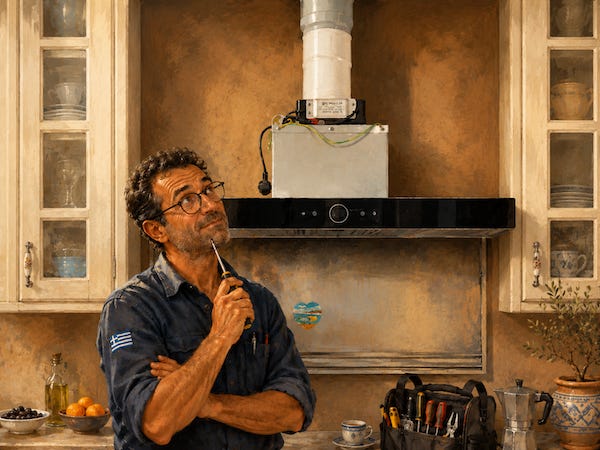
Patent.
In English, it sounds serious.
Legal.
Official.
A patent belongs in an office with fluorescent lights, forms, signatures, fees, lawyers, and people who say “intellectual property” without laughing.
In America, a patent lives at the United States Patent and Trademark Office.
In Greece, a πατέντα (patenta) lives in the back of a white van.
Sometimes in a plastic bag.
Sometimes in the pocket of a man named Socratis.
Not Socrates the philosopher.
Socratis the electrician.
Very different man.
Possibly more useful.
In Greeklish, “patent” became πατέντα (patenta), and somewhere along the way it stopped meaning “protected invention” and started meaning:
“We will make this work.”
Not correctly.
Not officially.
Not according to the manufacturer.
But work.
And in Greece, this is often enough.
As I have written before, things in Greece do not simply die.
That is too final.
Too Western.
Too pessimistic.
In Greece, when something breaks, its life has just begun.
A chair loses a leg.
A window refuses to close.
A washing machine starts sounding like a ferry docking in Piraeus.
A kitchen fan dies two minutes before your eggs are poached.
In other countries, people say, “We need to replace it.”
In Greece, someone says:
“Κάτσε να δούμε.” = “Wait. Let’s see.”
This is the beginning of the resurrection.
My latest resurrection attempt began with dinner.
I had just come back from Athens to our house in Kalamata. The next evening, feeling civilized and slightly smug, I decided to make poached eggs with salad.
Lovely.
Light.
Healthy.
The kind of dinner that says, “I am a mature adult who has made peace with vegetables.”
I approached the stove.
Above it sits our fancy kitchen fan. Stainless steel. Modern. Impressive. The kind of appliance that looks like it should understand Bluetooth, even if it does not.
I pressed the light button.
Nothing.
“Oh crap,” I thought.
The bulb is out.
Fine. Bulbs die. We mourn briefly and move on.
Then I pressed the plus button to turn on the fan.
Nothing.
No light.
No fan.
No hum.
No polite electronic beep.
Nothing.
Then I remembered something.
The day before, while I was still in Athens, I had received an alert on my phone that the power was off in Kalamata.
Aha.
Of course.
A power cut.
Maybe it tripped something.
Maybe the appliance had experienced trauma.
So I checked the breakers.
Everything normal.
This is the worst result.
When the breakers are down, life is simple. You lift the switch and feel like Thomas Edison.
When everything looks normal and nothing works, now you are entering Greek appliance theology.
I would not let go.
My lovely wife says I am like Beany, RIP, our little Yorkie, when she stuck her teeth into something she should not have.
She is not wrong.
Beany was small, sweet, adorable, and completely unreasonable.
So am I, apparently, when a kitchen fan refuses to explain itself.
I removed the filters.
I looked inside.
No fuse.
No smoke.
No burned smell.
No tiny note from the fan saying, “I have left you.”
Nothing.
So naturally, I went to the internet.
This is what modern men do now.
We used to hunt.
Now we type the model number into Google and read forum posts written by a man in Ohio in 2017.
“Disconnect the power.”
“Wait ten minutes.”
“Reset the control board.”
“Hold two buttons at the same time.”
The usual sacred texts.
I tried everything.
Nothing worked.
Tomorrow is another day, I thought.
This is what Greeks say when they are losing.
The next day I found the model.
I looked up parts.
Maybe it was the circuit board.
One was available.
The rest were on backorder.
Backorder is one of those words that sounds harmless until you live in Greece. In Greece, backorder means the part may arrive in two weeks, two months, or during the Second Coming.
I called the company in Athens.
A recorded voice answered.
“For Attica and Northern Greece, press 1.”
“For Southern Greece, press 2.”
Beeep, after pressing 2.
A lovely lady came on the line.
“Ah, Kalamata,” she said.
This is never good.
Kalamata is beautiful, but in customer-service geography it often means, “Please light a candle and begin the ritual.”
She gave me another number.
In Athens.
I called.
“Ah, Kalamata,” they said.
Again.
Now we were making progress in the same way a hamster makes progress on a wheel.
“We are the central service company. You need to call this number.”
They gave me a cell number of a local guy in Kalamata.
Finally.
Local.
Human.
Possibly wearing work boots.
I called the cell phone.
The man who answered sounded as if he was halfway up a ladder, holding a drill with his teeth, while being attacked by pigeons.
“This is not a good time,” he said, or something close to it, while shouting over the background noise of Greek reality.
Then he gave me a five-digit number and yelled:
“Kalamata code! Call the office.”
Before hanging up.
This is normal.
In Greece, information is often delivered like contraband.
You receive part of it, shouted from a moving vehicle, and are expected to reconstruct the rest from cultural memory.
But the man came.
As promised.
On Saturday.
This, by itself, deserves a national holiday.
He arrived with a mechanic’s bag and glasses.
Thoughtful.
Serious.
The kind of man who has seen things inside appliances that would make younger technicians leave the profession.
He touched the buttons.
Nothing.
And because appliances are evil, I half expected the fan to suddenly turn on the moment he arrived.
Like the car that refuses to make the noise when you take it to the mechanic.
“You swear it was doing it all week,” you say.
The mechanic looks at you with pity.
The car sits there silently, innocent as a lamb, knowing exactly what it has done.
But the fan did not betray me.
It stayed dead.
Respect.
The technician removed the chimney.
“Ah,” he said.
Now he could see the hidden switch and power plug.
They were tucked away like state secrets.
He started testing.
Buttons.
Power.
Connections.
Nada.
I waited.
There is always a moment in Greece when the professional becomes quiet.
This is when you know the news is coming.
Finally, he said:
“Sir, I don’t have good news.”
Never a sentence you want to hear from a doctor, a mechanic, an electrician, or a man holding part of your kitchen fan.
“It is dead. Like really dead.”
I appreciated the clarification.
There is dead, and then there is Greek-technician dead.
“It could be one circuit board. It could be both. No way to tell.”
Of course.
One mystery had become two mysteries.
“I need to come back, dismantle it, and take it with me. If we need parts from the manufacturer, it will be at least two months and three hundred euros.”
Two months.
Three hundred euros.
For a fan whose main job is to remove the smell of fried onions.
Then he paused.
And here it came.
The sentence every Greek knows.
The sentence that separates official civilization from actual civilization.
“I do have a guy.”
Of course he has a guy.
There is always a guy.
Greece does not run on institutions.
Greece runs on guys.
A guy who knows air conditioners.
A guy who fixes shutters.
A guy who can find parking in Kolonaki.
A guy who knows someone at the electricity company.
A guy who can repair an Italian espresso machine with a paperclip and two insults.
This guy, apparently, could check the circuit boards.
Maybe fix them.
Maybe bypass them.
Maybe perform some kind of electrical baptism behind a curtain.
“If you are lucky,” the technician said, “maybe seventy or eighty euros.”
Lucky.
I love how Greek luck works.
You begin with a poached egg and end up negotiating the resurrection of a kitchen appliance through an unnamed circuit-board whisperer.
I told him I would speak with our landlord.
Back and forth.
Calls.
Messages.
Official repair.
Unofficial repair.
Replacement.
Waiting.
Not waiting.
The fan, meanwhile, continued being dead with great confidence.
Then today, Sunday mind you, Socratis arrived.
Again, not Socrates the philosopher.
Socratis the electrician.
Socrates asked questions like, “What is virtue?”
Socratis asks questions like, “Where is the switch?”
And frankly, on a Sunday in Kalamata, I know which one I need.
He went through the same ritual.
Touched the buttons.
Opened things.
Looked.
Tested.
Shook his head.
Greek professionals have many head shakes. This was not the catastrophic head shake. Not yet. It was the thinking head shake.
He took a picture of the model.
“Let me see,” he said.
Then he gave us the word.
“We may come up with a πατέντα.”
There it was.
The Greek Patent Office had opened.
No paperwork.
No lawyers.
No trademark search.
Just one electrician, one dead fan, one landlord, one tenant, one mysterious circuit board, and the ancient Greek belief that if the manufacturer made something too complicated, this is the manufacturer’s problem, not ours.
A πατέντα.
In Greece, this word is magic.
It means invention, yes.
But not polished invention.
Not Silicon Valley invention.
No keynote presentation.
No man in a black turtleneck saying, “We think you’re going to love it.”
A Greek πατέντα is rougher.
Wiser.
Slightly illegal-looking, even when it is perfectly fine.
It means:
“We will bypass the stupid part.”
“We will connect this to that.”
“We will put a switch here.”
“We will hold it with a screw.”
“We will make it manual.”
“We will remove the unnecessary brain of the machine.”
“We will bring it back to life.”
A πατέντα is what happens when official design meets Greek survival.
And this is not the exception.
This is one of the most used Greek words outside of gyros.
A door that will not close?
Πατέντα.
A curtain rod that is too short?
Πατέντα.
A garden hose leaking in three places?
Πατέντα.
A car window that only goes up if you hit the door twice and pray?
Πατέντα.
A remote control held together with tape, hope, and one battery inserted at a spiritually correct angle?
Πατέντα.
A village gate tied with wire since the Olympics?
Πατέντα.
Not Athens 2004.
The first Olympics.
There is no shame in a πατέντα.
On the contrary.
There is pride.
People gather around it.
They inspect it.
They ask questions.
“Who did this?”
“My cousin.”
“Very good.”
There is respect in the room.
Because a πατέντα says something important.
It says: we did not surrender.
The thing broke, yes.
The manufacturer abandoned us, yes.
The part is on backorder, yes.
The official repair costs more than the appliance’s emotional value, yes.
But we are still here.
With wire.
With tape.
With a guy.
With another guy.
With Socratis.
In countries with perfect systems, maybe you do not need πατέντες.
Good for them.
May their warranties be honored and their customer service lines answered.
But in Greece, the straight road is often closed, the replacement part is unavailable, the official technician is in Patras, the company changed distributors, the model was discontinued, the manual is in Italian, and the landlord is asking if maybe you pressed the wrong button.
So you learn to improvise.
You learn that dead is not dead until three men have looked at it, one cousin has been called, and someone has said:
“Άστο πάνω μου.”
“Leave it to me.”
Only then does the object know its fate.
The fan may still die.
Let us be honest.
Socratis may return and say, “No. This one is finished.”
There may be no πατέντα.
There may be only replacement, money, delay, and until it starts humming again, the smell of omelet lingering over Kalamata like a personal failure.
But for now, hope lives.
Because Socratis has seen the body.
Socratis has taken the picture.
Socratis has spoken the word.
Πατέντα (patenta).
And in Greece, that means the patient has not yet been declared dead.
It only means surgery will not be according to the manual.
Siga, siga 💙
Nick in Kalamata