

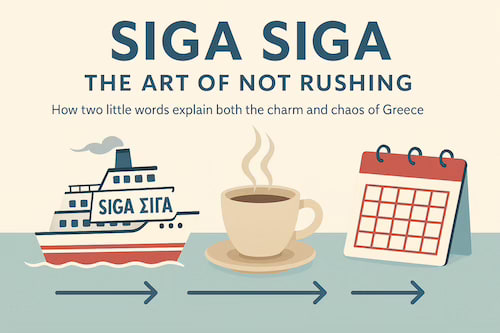
Two words explain why Greece feels both magical and maddening and why I’m slowly learning to let go of the clock.
I was raised to move fast.
Greece is teaching me to move well.
There are two words you’ll hear in Greece more often than kali orexi (enjoy your meal) or pame gia kafe (let’s go for coffee).
Siga siga.
Literally: slowly, slowly.
But siga siga isn’t just a phrase. It’s a way of life. An unofficial national motto. It shapes how Greeks approach work, bureaucracy, relationships, parking, and the flexible concept of “on time.”
At first, siga siga feels like a vacation for your nervous system.
You arrive stressed, jet-lagged, still measuring life in deadlines. Someone smiles and says, “Relax. Siga siga.” You imagine long lunches, olive groves, and a life without alarms. Finally, you think, a culture that doesn’t equate urgency with importance.
Then reality arrives, politely, but unhurried.
When we moved into our apartment in Kalamata, the WC developed an unforgettable smell. We called a plumber.
“Tomorrow,” he said.
Tomorrow became the weekend.
The weekend became “after the holiday.”
Which holiday? Details felt unnecessary.
In Greece, siga siga is elastic. It can mean hours. Or months.
Ferries operate on the same principle.
Once, in Gytheio, we stood at the port watching our ferry sit motionless long past its scheduled departure. The crew smoked calmly. Someone shrugged. “Siga siga.” Eventually, the ferry sailed, less according to the clock, more according to fate.
Even bureaucracy follows the rhythm.
I once needed a document stamped. I arrived early. The clerk was there too, along with her koulouri, her coffee, and her cigarette. Only after this morning ritual did she look up.
“I need special xartosima for that,” she said.
“I don’t have them.”
“Come back tomorrow.”
Here’s the thing: Greeks don’t experience this as dysfunction. They experience it as balance. Of course, if you’re still running on deadlines and meetings, it can feel like dysfunction, like time is being stolen from you. But as you get older, and a little less convinced that urgency equals importance—and that every email is an emergency—you start to see the trade being offered. Fewer checked boxes. More actual life.
Why rush through life when you can stroll? Why panic about schedules when tomorrow is not guaranteed? Life here isn’t a Swiss train timetable—it’s more like a rural bus route in the Mani, where stops adapt to real life.
And slowly—siga siga—you stop fighting it.
You stop checking the time.
You start noticing people.
A neighbor drops off figs.
An old man teaches you about xorta (greens). There are hundreds of varieties—some wild, some cultivated, some that look identical to me. He rattles off their names effortlessly, explains which hillside they come from, and pauses, mildly concerned that I don’t already know this. I nod respectfully and pretend I will remember any of it.
The sea waits, every day, without urgency.
Yes, sometimes things don’t get fixed.
Yes, some paperwork never appears.
And we are still waiting to receive a letter we addressed to ourselves as a test a month ago.
But life goes on—rich, social, unhurried, and full.
So when someone tells you siga siga, don’t roll your eyes.
Take a breath. Order another coffee, or a tsipouro. Or both.
You’ll be sitting there, gazing out at the sea, listening to the waves settle against the rocks, long enough to forget why you checked the time in the first place.
Let the world slow down.
Karen, my New Yorker wife, has fully embraced the Greek national motto. She orders another coffee, stops checking the time, and treats “we’ll see” like a complete life philosophy. As for me, I’m still learning. I sneak glances at my watch, then at her, and pretend I’m relaxed. My fully formed Siga Siga wife didn’t rush ahead. She just sat there smiling… fully aware I’d get there eventually.
You may find that what looks like inefficiency is actually Greece’s quiet wisdom:
life is too short to rush through.
And if this resonated, consider subscribing.
No rush, of course. Do it siga siga.
The button will still be here tomorrow.

Discussion
Pull up a chair. Add a memory, a correction, a laugh, or something the story brought to mind.
No comments yet. We have been waiting for you...