

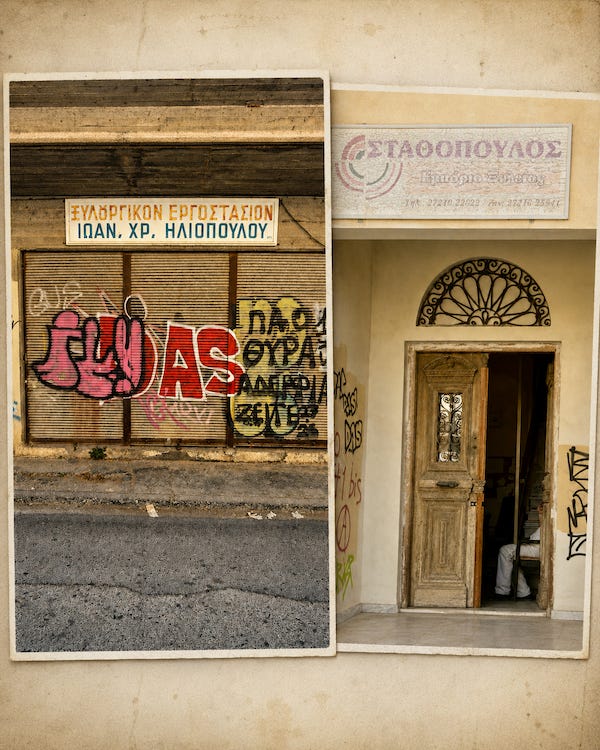
There is an older part of Kalamata that has always fascinated me.
It was once something of a carpenter and furniture district, and traces of that world are still everywhere.
Old workshops.
Furniture makers.
Hand-painted signs.
Some businesses are still operating. Some are shuttered. Others look more like relics than stores, their windows dusty and their lettering fading into the walls.
Whenever I walk through there, I wonder about the people who worked inside.
How many tables did they build?
How many chairs?
How many wardrobes and kitchen cabinets are still sitting in Kalamata homes decades later?
Then, during our recent trip to Ermoupoli, Syros, I met Dimitris.
Well…
First I killed him.
Walking through town, I noticed an old storefront.
The window was so covered in dust that you could barely see through it. The door was secured with a large padlock, and above it hung an old sign:
Ξυλουργείο ο Δημήτρης (Xylourgeio o Dimitris)
Dimitris’s Carpentry Shop.
I peered inside.
Darkness.
Dust.
Silence.
Poor Dimitris, I thought.
Long gone.
Another old family business that had reached the end of the line.
Perhaps the children had moved to Athens.
Or Germany.
Maybe they became accountants, software developers, or simply decided they had no interest in spending their lives surrounded by sawdust and varnish.
So, standing there on a sidewalk in Ermoupoli, I constructed Dimitris’s entire life story.
He had learned the trade as a young man.
Opened his own shop.
Worked there for fifty years.
Built furniture for half the island.
The children grew up.
Nobody wanted to take over.
Dimitris retired.
The shop closed.
Eventually…
RIP Dimitris.
I may even have given the poor man a respectable funeral.
The following afternoon, I walked past again.
And stopped.
The padlock was gone.
The door was open.
A dim light glowed from inside.
Wait.
What?
The dead carpentry shop was alive.
And apparently so was Dimitris.
Breaking news from Syros: reports of Dimitris’s death had been greatly exaggerated.
Naturally, I had to go inside.
When a man returns from the dead, the least you can do is introduce yourself.
Inside was exactly what I hoped it would be.
Not a “design studio.”
Not an “artisan wood concept.”
Not a “bespoke furniture experience.”
A carpentry shop.
Wood.
Tools.
Machines.
Sawdust.
Things leaning against other things that had probably been leaning there since 1966.
And Dimitris.
Very much alive.
Very much working.
And completely unaware that I had declared him deceased twenty-four hours earlier.
Soon there was coffee.
Because this is Greece.
Eventually everything involves coffee.
And we talked.
About the shop.
About Syros.
About work.
About life.
About…
Τα παλιά (ta palia)
The good old days.
Back in Kalamata, I started looking at those fading signs differently.
They had always been there.
I simply hadn’t been reading them.
Ψιλικά (psilika)
Small everyday goods.
The little neighborhood shop where you could buy cigarettes, batteries, chewing gum, matches, aspirin, a newspaper and whatever else you suddenly discovered you needed.
Today:
Mini Market. Convenience Store.
Possibly available on an app.
Μπακάλικο (bakaliko)
Neighborhood grocery shop.
The grocer knew which olives you liked, sliced your cheese and quite possibly knew more about your family than you did.
Today:
Supermarket.
Aisle 7.
Scan your loyalty card.
Καφεκοπτείον (kafekopteion)
Coffee roasting and grinding shop.
You smelled the coffee before you reached the door.
Today:
Specialty Roastery.
Same idea.
Better typography.
And then there were the trades.
Ραφείο (rafeio)
Tailor shop.
Τσαγκάρικο (tsagariko)
Shoemaker’s shop.
Σιδηρουργείο (sidirourgeio)
Blacksmith’s workshop.
Ξυλουργείο (xylourgeio)
Carpentry workshop.
Businesses named not after marketing concepts, but after what someone actually did with his hands.
Often the name above the door was simply the name of the person inside.
Nikos the tailor.
Giorgos the shoemaker.
Dimitris the carpenter.
No branding agency required.
Of course Greece is changing.
It should.
Not everything about the old days was better. Nostalgia has a wonderful way of removing the poverty, hard labor, bad plumbing and occasional dictatorship from our memories.
But I wonder whether something is lost when every μπακάλικο becomes a mini market, every καφεκοπτείο becomes a roastery, and every old workshop becomes an Airbnb or a tasteful little shop selling candles.
Maybe it is simply progress.
Maybe I am becoming nostalgic.
Maybe I am becoming old.
That last possibility is becoming increasingly difficult to dismiss.
Still, I feel lucky to be living in Greece while both worlds continue to exist.
I can order something from my phone and have it delivered to my door.
And I can walk down a side street, notice a fading hand-painted sign, push open an old wooden door and meet the man whose name has been above it for half a century.
I can still sit with Dimitris.
Drink coffee.
Talk about τα παλιά.
Hear stories that have never been uploaded anywhere.
No QR code.
No Instagram account.
No request for a five-star review.
Just a carpenter in his workshop.
Still making things.
Still opening the door.
Still very much alive.
And now, when I walk through the old carpenter district in Kalamata, I pay a little more attention to the fading signs.
Some may belong to businesses long gone.
But I’ve learned not to rush to conclusions.
Sometimes the door is only closed.
And Dimitris might still be inside.

Discussion
Pull up a chair. Add a memory, a correction, a laugh, or something the story brought to mind.
No comments yet. We have been waiting for you...