

There are phrases in Greek that cannot be translated.
Not because the words are difficult.
The words are easy.
The problem is that the phrase does not arrive alone.
It arrives with history.
With bureaucracy.
With relatives.
With one man who said yes.
Another man who said no.
A third man who said, “Come back tomorrow.”
This is why Greek has phrases that are less like language and more like emergency exits.
One of them is:
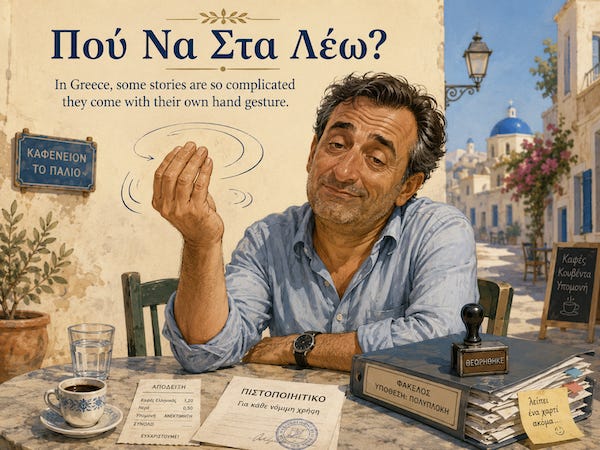
Πού να στα λέω…
Literally, it means:
Where should I tell them to you?
Which, of course, means absolutely nothing.
And also everything.
Nobody is asking for directions.
Nobody is saying, “Should I tell this story in the kitchen? On the balcony? Beside the tax office, where human hope goes to be photocopied?”
No.
It means:
Where do I even begin?
How much time do you have?
Are you sitting down?
Has your coffee arrived?
Are you emotionally insured?
Because this is not a simple story.
This is Greece.
And in Greece, even a simple story needs a prologue, three supporting characters, one historical grievance, and someone saying, “You know who his mother is, don’t you?”
You ask an innocent question.
“How was your morning?”
The other person exhales.
Looks away.
Raises one hand.
Makes a small circular motion in the air.
At this point, you know.
The morning was not a morning.
The morning was an episode.
There was an errand.
There was a place that was supposed to be open.
It was not open.
Or it was open, but the right person was not there.
Or the right person was there, but the computer was down.
Or the computer was working, but only for people whose paperwork was not like yours.
Naturally.
This is where Greek becomes wonderfully efficient.
First comes the warning:
Πού να στα λέω…
Then comes the shorter version:
Άστα.
Leave it.
Don’t ask.
Do not make me open this box.
There are things inside.
Old things.
Greek things.
Things with receipts.
And when the situation has gone beyond language, beyond reason, beyond the reach of normal human repair, there is the final form:
Άστα να πάνε.
Let the whole thing go.
Let it fall into the sea.
Let it move to Patras.
Let it become someone else’s problem.
This is not advice.
It is a diagnosis.
You do not solve it.
You survive it.
And then there is the hand.
Because Greek is not merely spoken.
Greek is spoken, shouted, sighed, blessed, blamed, and delivered with the hand.
The hand is essential.
Without the hand, the phrase is only a sentence.
With the hand, it becomes a documentary with emotional layers.
The fingers gather slightly.
The wrist loosens.
The hand rises somewhere between the chest and the face.
Then it makes a small circular motion.
Not a wave.
Not a shrug.
Not exactly a spiral.
More like the person is stirring an invisible pot of disaster.
Around and around and around.
This motion says:
There were complications.
There were delays.
There were people.
There were opinions.
There was probably a misunderstanding.
There was definitely someone named Giorgos.
And no, we are not starting from the beginning.
The hand saves time.
In English, you might say, “It’s a long story.”
How adorable.
“It’s a long story” sounds manageable.
It suggests the story has a beginning, middle, and end.
The Greek version makes no such promise.
It warns you the story may contain side roads.
It may include someone’s grandmother.
It may require a map of the Peloponnese.
It may begin in 1981.
It may involve a property line, a baptism, a ferry schedule, and the phrase, “Back then, things were different.”
You ask, “What happened at the bank?”
The hand begins.
Circle, circle, circle.
Suddenly you are not at the bank anymore.
You are in 1993, when somebody opened the original account.
Then Athens, because the paperwork is there.
Then Kalamata, because the person who knows how to fix it works only Tuesdays.
Then a folder.
Then another folder.
Then someone says, “You need the certificate.”
Which certificate?
The certificate.
Ah.
Of course.
The certificate.
Why didn’t you say so?
You ask, “Did you get it done?”
The person looks at you.
Silence.
The hand.
The circle.
Άστα.
Translation:
No.
But also yes.
But mostly no.
Something happened.
Something almost happened.
Something should have happened.
Something may still happen.
But not today.
And certainly not before lunch.
There is also the social version.
This is not bureaucracy.
This is worse.
Family.
Someone asks, “How was the wedding?”
The hand comes up immediately.
Now we are in dangerous territory.
Because Greek weddings are not events.
They are weather systems.
There was the bride’s side.
There was the groom’s side.
There was the aunt who did not like where she was seated.
There was the cousin who drank too much.
There was the priest who rushed.
There was the photographer who disappeared.
There was the mother who cried beautifully.
There was the other mother who cried competitively.
There was an argument about the music.
Another about the food.
A third about whether the first two arguments were actually arguments.
By midnight, nobody remembers who started it.
By Monday, everyone has a theory.
By Wednesday, it has become family history.
You ask, “Was it nice?”
The hand circles.
Perfect.
No further questions.
This is the genius of the phrase.
It gives information without giving information.
It allows the speaker to express total emotional exhaustion while technically revealing nothing.
It is gossip with the door still closed.
Confession without evidence.
Therapy without the bill.
And the listener understands.
Not the facts.
The facts are unavailable.
The facts may never be available.
But the feeling arrives perfectly.
That is the Greek specialty.
Facts are optional.
Feeling is mandatory.
A Greek person can tell you an entire story with three words, two sounds, and one hand movement.
The rest is choreography.
Greeks love explaining things.
A Greek person can explain a parking dispute like it is a Supreme Court case.
A Greek person can explain why the tomatoes were better last year with the intensity of a climate scientist.
A Greek person can explain why one bakery is superior to another bakery while standing in front of a third bakery.
Explaining is not the problem.
The problem is that some things are so tangled that explanation becomes a trap.
So when someone raises the hand and begins the circle, they are not avoiding the story.
They are honoring it.
They are acknowledging its size.
Its weight.
Its ridiculousness.
And definitely the hand.
Because without the hand, how can anyone understand?
The hand is the subtitle.
It says what translation cannot.
And yet, somehow, funny.
That is the secret.
There is comedy inside the exhaustion.
So the next time you ask a Greek person a simple question and they look away, raise their hand, and rotate the wrist, respect the moment.
In English, you explain.
In Greece, you move your hand in a small circle.
And everybody understands.
Siga, siga 💙
Nick in Kalamata