
Why can it be so difficult to find fresh local fish and a really good tomato on a Greek island?
It sounds almost absurd.
You are standing on an island.
There is sea everywhere.
Surely somebody can go out in a boat, catch a fish and bring it directly to your table.
And while we’re at it, I would like a tomato from the farmer behind the taverna.
Preferably still warm from the sun.
Maybe some cheese made somewhere up the hill.
This is, after all, the authentic Greek experience.
And there is absolutely nothing wrong with wanting it.
The problem begins when several thousand other people arrive wanting exactly the same thing.
We learned this firsthand in Paxoi.
We were staying in Longos, a tiny seaside village that becomes considerably less tiny in summer.
There was, as far as I could tell, one commercial kaiki bringing in the local catch.
We became regulars at one of the tavernas.
Monday, I asked:
“Any catch today?”
“No. Ask me tomorrow.”
Tuesday:
“Anything?”
“No. The weather was iffy. He’ll go out tomorrow.”
Tomorrow finally came.
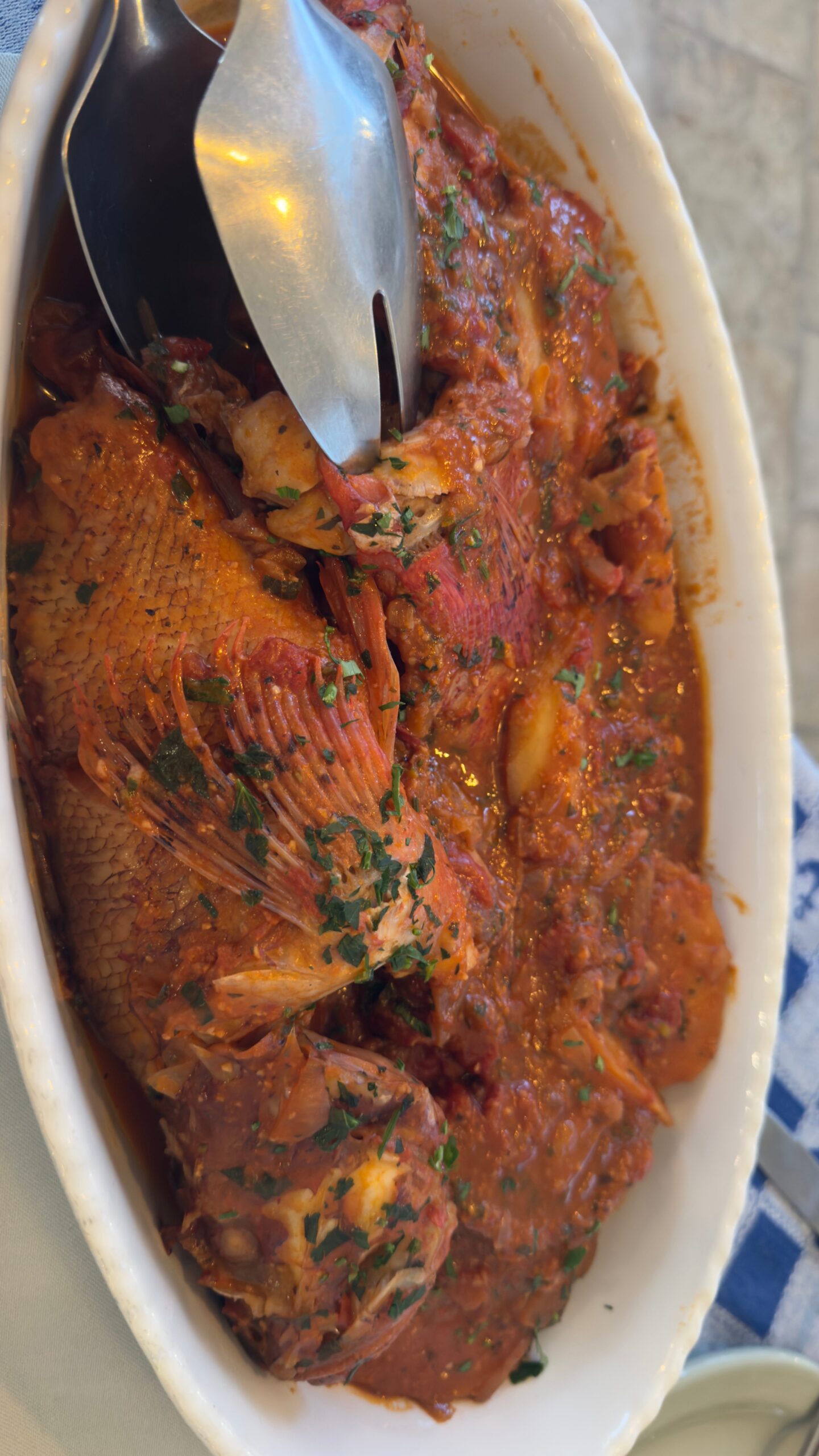
And with it came an extraordinary dish of skorpines bourdetto, scorpionfish cooked in that wonderful spicy red traditional Corfu sauce, without any tomato.
Karen has been talking about that dish ever since.
Two days later, I happened to be walking past the taverna when I heard the owner’s voice.
“Καλημέρα!”
Then:
“I got a fagri (red snapper). Shall I hold it for you?”
Of course she should hold it for us.
That little exchange probably explains the whole issue better than any tourism statistic.
There was a fisherman.
There was a boat.
There was weather.
And there was whatever the sea gave him that day.
Monday: nothing.
Tuesday: nothing.
Then skorpines.
Then, if you happened to be walking past at the right moment, a fagri with your name on it.
That is what local actually means.
The romantic version is that the fish comes straight from the sea and jumps into your plate.
The part we forget is that sometimes the sea says no.
And it isn’t just the sea.
The same thing happens with the tomato we imagine came from the garden behind the restaurant.
The cheese made somewhere up the hill.
The bread from the village bakery.
The water coming out of the tap.
We arrive with perfectly well-intended expectations.
Fresh local fish.
Perfect tomatoes.
Local cheese.
A quiet beach.
Plenty of water.
Easy parking.
The Greece we saw in the photograph that made us book the trip.
All perfectly reasonable expectations.
Until you multiply them by several thousand people.
Imagine a small island community built around the needs of 900 permanent residents suddenly trying to feed and support 7,000 or 10,000 people for 30 or 60 days.
It is almost like dropping a massive corporate event into a village and saying:
“Okay. Take care of everybody.”
Except the event lasts all summer.
The fishing fleet does not multiply by eleven because the ferry arrived.
The tomato crop does not multiply by eleven.
The water supply does not multiply by eleven.
And none of them suddenly expand because a giant Royal Caribbean cruise ship decides to stop for the day.
The visitors arrive. The infrastructure doesn’t change.
Neither does the water supply.
And that is where the postcard starts colliding with the plumbing.
Tourism doesn’t simply require hotel rooms.
People need water.
Electricity.
Sewage.
Garbage collection.
Roads.
Parking.
Food.
Emergency services.
Hotels wash sheets.
Restaurants wash dishes.
Swimming pools need water.
Gardens need water.
Agriculture needs water.
The people who actually live there need water.
And every visitor who wakes up in a beautiful whitewashed room and says:
“What a gorgeous morning. I’m going to take a shower and head to the beach.”
has just joined thousands of other people having exactly the same thought.
Infrastructure eventually meets arithmetic.
Case in point.
Kitries.
A tiny seaside village a stone’s throw from Kalamata.
Recently, its water was turned off for several hours every day.
For about a week.
That is infrastructure pressure in its least theoretical form.
It isn’t a graph.
It isn’t an argument about tourism policy.
It isn’t somebody shouting about “overtourism.”
You walk into the kitchen.
You turn on the tap.
Nothing comes out.
There is your infrastructure discussion.
And Kitries is hardly alone.
Small communities all over Greece were built around relatively small permanent populations.
Their roads were not designed for thousands of rental cars.
Their beaches were not designed for thousands of towels.
Their water systems were not designed for thousands of showers.
Their farms were not designed to feed a population that multiplies several times over for six weeks every summer.
Even the sea has limits.
One of the more interesting things I learned recently is how misleading our idea of “local” can be.
Simply being on an island does not mean the fish on your plate came from the water directly in front of you.
During the summer, local fishing fleets often cannot possibly supply the demand created by the enormous increase in population.
The same is true of produce.
The little agricultural system that once fed a village cannot suddenly produce ten times as many tomatoes because August arrived.
And water may be the most unforgiving limit of all.
Pools.
Gardens.
Daily linen changes.
Restaurants.
Agriculture.
Thousands of additional people.
They all draw from the same finite resource.
This is why places that become extraordinarily popular eventually start doing things visitors don’t particularly like.
Limits.
Reservations.
Timed entry.
Restrictions.
Balos in Crete is a good example.
It is spectacular.
Which is precisely why everybody wants to see it.
Santorini has the same problem on a much larger scale.
Millions of people want to experience a relatively small island because it is extraordinary.
That sentence contains both the attraction and the problem.
Nobody is necessarily doing anything wrong.
The couple on their dream vacation isn’t doing anything wrong.
The cruise passenger isn’t doing anything wrong.
The hotel owner isn’t wrong for wanting guests.
The restaurant owner isn’t wrong for wanting customers.
The island isn’t wrong for depending on tourism.
But thousands upon thousands of individually reasonable decisions can produce a collectively unreasonable result.
Sometimes there isn’t a villain.
Sometimes there are simply too many people wanting the same finite thing at the same time.
And this isn’t particularly Greek.
Barcelona knows this.
Venice knows this.
Amsterdam knows this.
Museums require reservations.
Historic sites limit admissions.
Protected beaches consider visitor caps.
Cities try to manage crowds.
Popular places around the world keep discovering the same uncomfortable truth:
Popularity has infrastructure.
And infrastructure has limits.
What makes the Greek version interesting is the mythology we bring with us.
We imagine the island as an endlessly self-sufficient little world.
The fisherman fishes.
The farmer farms.
The yiayia makes cheese.
The tomatoes grow behind the house.
The octopus hangs beside the harbor.
Everything is fresh.
Everything is local.
Everything has apparently been waiting patiently for our arrival.
But these communities were built first for the people who actually lived there.
The village you fell in love with was not designed for everybody who fell in love with it at the same time.
When the population multiplies, something has to give.
The fish comes from somewhere else.
The tomato comes from somewhere else.
More food arrives by ferry.
More garbage has to leave.
More water has to be found.
And sometimes the tap gets turned off for a few hours.
None of this means:
Don’t go.
That would be ridiculous.
And hypocritical.
I live in Greece and travel around it every chance I get.
I contribute to traffic.
I occupy chairs in tavernas.
I use water on islands.
I have undoubtedly stood somewhere taking a photograph while a local person behind me thought:
Could this man please move? I’m trying to get to work.
We are all part of it.
The point isn’t guilt.
The point is expectations.
If you go to one of Greece’s most popular destinations in August, there will probably be people.
Lots of them.
If the restaurant says the fresh local fish is finished, it may actually be finished.
If your tomato came from somewhere else, civilization has not collapsed.
If the fisherman didn’t go out because the weather was bad, there isn’t another fisherman hidden behind the taverna waiting for tourists.
If the water pressure drops, remember where you are standing.
On a small piece of land.
With thousands of other people.
All expecting paradise.
At exactly the same time.
Maybe the most respectful way to travel isn’t to demand that every destination deliver the fantasy we brought with us.
Maybe it is to arrive curious enough to discover what the place can actually give us.
Eat what is available.
Eat what is in season.
Ask what came in today.
If the answer is nothing, eat something else.
Go to the beach nobody put on Instagram.
Visit in June.
Come back in October.
Take the road that doesn’t end in a reel.
And occasionally accept that the perfect little village is perfect precisely because it was never designed to accommodate the entire world.
Paradise exists.
It just has plumbing.
And apparently, in August, everybody flushes at once.
See you February 19th in Anafi.
I hear the fish is fresh.

Discussion
Pull up a chair. Add a memory, a correction, a laugh, or something the story brought to mind.
No comments yet. We have been waiting for you...