

[Note: Part 2 of a loose series on repair, reuse, and the Greek refusal to throw things away.]
When I wrote recently about seamstresses, alterations, and my heroic zipper drama, I realized that story was never really just about clothes.
It was about something bigger.
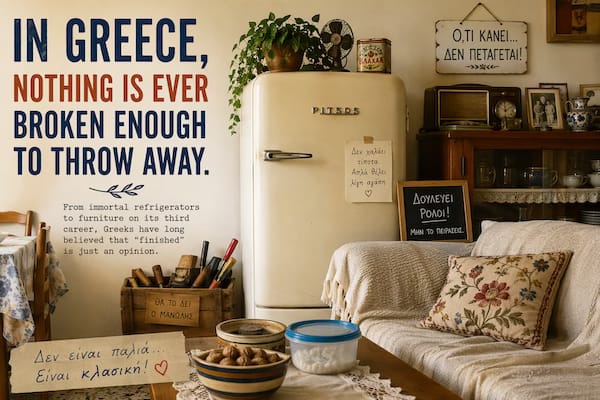
Because in Greece, nothing is ever truly broken enough to throw away.
It may be bent. Wobbly. Missing a handle. Slightly dangerous. Held together by string, determination, and one screw that clearly belongs to something else.
But thrown away?
Let’s not be irrational.
Greeks, especially older Greeks, were raised with a very different relationship to things. You did not replace something simply because it stopped working properly. You inspected it. You tapped it. You unplugged it and plugged it back in with deep seriousness. Only then did the discussion begin.
And this goes far beyond clothes.
We are talking about refrigerators from another geological period still humming away in garages, basements, and country houses as if they have unfinished business. True story: the first refrigerator my parents bought when they got married in 1955, before I was even a bad idea, is still alive and working at my brother’s country house.
Not displayed.
Working.
Cooling.
Serving.
At this point it is no longer an appliance. It is a decorated veteran.
In the United States, a refrigerator from 1955 is not “old.” It is vintage. Or antique. Or “a rare mid-century statement piece” with a price tag so high you start wondering whether it cools food or also manages your investments.
Which is when I realized I may have just discovered a brilliant business idea: The Greek Antiquity Megastore.
We gather all the things Greeks have kept, repurposed, and stubbornly refused to throw away over the last two centuries, ship them abroad, and sell them for serious money. Not cheap modern junk. The real machinery. The dependable old guard. British, German, and glorious Greek brands like Izola and Pitsos. In Greece they are “still perfectly fine.” In America they are “curated heritage objects.”
That old fridge does not get replaced in Greece. It gets promoted.
First it is the main fridge.
Then the second fridge.
Then the summer fridge.
Then the village fridge.
Then the “leave it there, it still works perfectly” fridge.
And that is how an object survives long enough to outlive the people who bought it.
The same thing happens with furniture.
A piece bought in the 1980s does not go out of style. It changes career.
A cabinet becomes balcony storage.
A dining table moves to the country house.
A chair becomes the official holder of clothes, bags, and things that, for now, have nowhere else to go.
A bookshelf missing a door is not broken. It is more practical.
A scratched table is not ruined. It is solid wood.
A chest of drawers with one stubborn handle is not on its way out. It is fine.
Walk into almost any Greek home and sooner or later you will find a throw draped over a sofa. Not decoration. Protection. Longevity. A defensive system. The sofa is not there to be enjoyed recklessly by the public. It is there to survive.
True story: my sister-in-law once asked me to pick up some new pillows from the upholsterer. I assumed one quick trip. Wrong. I needed two trips in my big-size-for-Europe SUV. These were not a couple of decorative cushions. They were pillows for three sofas. Fifteen pieces in total. Cost: 400 euro.
For that price, you do not even buy one mini sofa at IKEA, built in China and accompanied by instructions that can end a marriage. In Greece, for the same money, you revive the old one and keep your dignity.
For generations, Greeks did not have the luxury of replacing things every few years because they were bored, redecorating, or had been informed by a catalog that a new shade of beige had entered the market. You bought carefully. You maintained what you bought. You repaired it. You passed it down.
Not new, obviously.
Greek new.
Which is its own category.
Greek new means it works, mostly. It looks respectable from the correct angle. And it probably has another ten years in it, provided nobody starts yanking doors, forcing drawers, or asking too many questions.
There is also something emotional in all this.
Greeks do not only keep things because they are useful. They keep them because things absorb life.
That armchair is where your father sat.
That table hosted Easter, coffee, arguments, unpaid bills, and six thousand slices of watermelon in August.
That old cabinet may no longer match anything, but it has survived three moves, one renovation, and at least two dramatic declarations of “This has to go,” followed by absolutely no action.
Things stay because they have earned their place.
Even plastic containers in Greece enjoy multiple reincarnations. You open the freezer looking for ice cream and find beans. You open a butter tub and discover feta. You open a cookie tin and, naturally, it contains sewing supplies.
Nothing retires in Greece.
It is simply reassigned.
Elsewhere, replacement is automatic. Slight inconvenience? Replace it. Tiny flaw? Replace it. New model out? Replace it.
In Greece, replacement used to feel almost offensive. What do you mean it is broken? Did you check the fuse? Did you try again? Did you turn it off and on properly this time?
There was always one more chance.
Of course, sometimes this mentality goes too far. Sometimes an object is no longer functioning so much as participating. Sometimes the chair has been repaired so many times that the repairs themselves now need repair.
But even then, there is something admirable in the attempt.
A refusal to discard.
A belief that usefulness can be extended.
That wear is not failure.
That age does not automatically mean irrelevance.
There is wisdom in a culture that looks at something worn, tired, and unfashionable and says:
No, no.
It still has life in it.
And in Greece, that applies to refrigerators, furniture, plastic containers, half the garage, and occasionally the government.
Nothing is broken enough to throw away.
Not yet.
What is the one immortal object in your family that no Greek would ever throw away? The fridge, the table, the sewing machine, the mystery container, the radio that still works if you hit it once on the side? Tell me in the comments.
Siga, siga 💙
Nick in Kalamata