

The other day, while writing about Christos, the man who looked at the damage to our car and calmly announced that he would simply fix it, I found myself using a very Greek word.
Μαστοράκι — mastoráki.
Little master craftsman.
Except Christos is not particularly little.
And I certainly wasn’t commenting on his height or his posture.
I was using mastoráki the way Greeks use words like this all the time.
Affectionately.
Approvingly.
Almost as if to say:
This guy. He knows what he’s doing.
Which got me thinking.
Greek words come in sizes.
Like shirts.
Large. Medium. Small.
And, when necessary:
Extra Small.
There is an actual grammatical term for this:
Υποκοριστικό — ypokoristikó.
Diminutive.
English does it too.
Dog becomes doggie.
John becomes Johnny.
But Greek seems to have turned the whole thing into a sizing department.
Take a table.
Τραπέζι — trapézi.
Regular table.
Then:
Τραπεζάκι — trapezáki.
Little table.
Perfectly logical.
Large table.
Small table.
Language functioning normally.
But Greek does not stop with things that are actually smaller.
Coffee is kafés.
Yet somebody will suggest:
Ένα καφεδάκι; — éna kafedáki?
A little coffee?
The coffee may be exactly the same size it was yesterday.
Nobody has brought out a miniature cup from a dollhouse.
It is just…
kafedáki.
Warmer.
Friendlier.
A come on, sit down, we’ll have a little coffee coffee.
Wine becomes krasáki.
Ouzo becomes ouzáki.
A house becomes spitáki.
A dog becomes skyláki.
A child becomes paidáki.
Sometimes the thing is actually small.
Sometimes it isn’t.
Sometimes Greek simply wants to make it more affectionate.
And then we get to my favorite example.
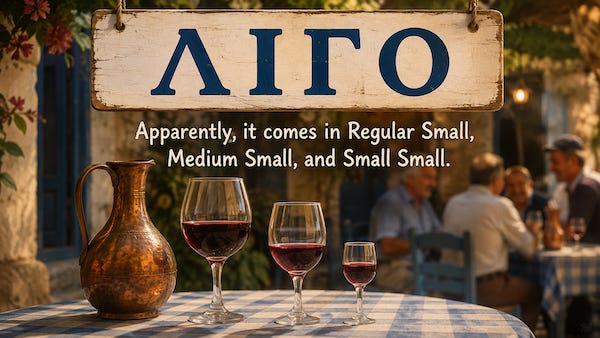
Λίγο — lígo.
A little.
The word already means:
a little.
You would think the job was done.
Apparently not.
Because Greek can resize it.
Large: lígo.
Medium: ligáki.
Small: ligouláki.
We have now made little smaller.
Twice.
At this point, Greek is no longer merely using diminutives.
It has a full range of sizes.
And once you start listening for them, you hear them everywhere.
Which brings me to the credit card.
When I am shopping in Athens and reach the cash register, I usually hear:
Κάρτα; — kárta?
Card?
Straightforward.
Full-size word.
Which makes sense.
Athens is a full-size city.
Then I come home to Kalamata.
Same routine.
Store.
Cash register.
Wallet out.
And quite often:
Καρτούλα; — kartoúla?
Little card?
Suddenly it all makes sense.
Athens:
Kárta.
Kalamata:
Kartoúla.
Big city.
Smaller city.
Full-size card.
Smaller card.
The Greek language apparently comes with geographic sizing.
I am now slightly worried about what happens if I drive into a village.
Perhaps by the time I reach a hamlet in Arcadia, Visa will have been reduced to something I need tweezers to remove from my wallet.
Kartoulitsa?
Of course, this is what makes diminutives in Greek so much fun.
They are not really about size.
Or at least not always.
They can suggest affection.
Familiarity.
Friendliness.
Sometimes they soften something.
Sometimes they make something sound more inviting.
Sometimes they simply make a perfectly normal object sound as though someone would like to pinch its cheeks.
A coffee becomes kafedáki.
A drink becomes potáki.
A walk becomes voltúla.
And a very competent body-shop owner becomes:
mastoráki.
The word gets smaller.
The meaning gets warmer.
Which reminds me of an old Greek joke.
And if you grew up in Greece, you probably already know the star.
Τοτός — Totós.
Totos is the eternal Greek schoolboy.
The kid who misunderstands the assignment, says exactly the wrong thing, and drives his teacher insane.
In this particular joke, Totos had developed a serious diminutive problem.
Everything became an -áki.
Little this.
Little that.
Every essay.
Every day.
Finally his teacher could take no more.
“Enough, Totos! You’re a big boy now. Stop putting -áki on everything.”
Understood.
No more -áki.
The next day, the teacher asked the children what they had eaten at home.
Eventually she reached Totos.
“And you? What did you eat yesterday?”
He had eaten spinach.
Σπανάκι — spanáki.
But Totos remembered the rule.
No more -áki.
So he proudly answered:
Spaní.
And somewhere, I imagine, his teacher simply put her head down on the desk.
Which may have been the only reasonable response.
Me?
I’m going to think about all this a little more.
Not much.
Just:
ligouláki.

Discussion
Pull up a chair. Add a memory, a correction, a laugh, or something the story brought to mind.
No comments yet. We have been waiting for you...