

There are many dangerous conversations in Greece.
Politics.
Football.
Whether Athens or Thessaloniki has better food.
And then there is the most dangerous one of all.
How do you pronounce “gyro”?
This is where innocent tourists enter a Greek restaurant full of confidence and leave with emotional damage.
“Can I have a jai-ro?”
Silence.
“Yee-ro?”
Slight nod.
“Guy-ro?”
The waiter looks at the floor, questions the future of civilization, and writes down one pork gyro with tzatziki.
In America, I heard everything.
Gyro.
Jai-ro.
Guy-ro.
Hero.
Year-oh.
One man in Florida once called it a “Greek taco,” and honestly, I still have not fully recovered.
The funny thing is, the word is not mysterious at all.
Γύρος (gyros) means something that turns.
That’s it.
The meat turns.
The cook shaves it.
You eat it too fast.
Then you say, “I probably should not have ordered the second one.”
This is the full Greek life cycle.
But pronouncing it is only the first test.
Then you have to order.
People think ordering coffee at Starbucks is complicated.
Please.
At Starbucks, you choose size, milk, temperature, foam, syrup, emotional support, and whether your name will be spelled correctly.
At a Greek souvlaki place, you enter a philosophical labyrinth.
Do you want gyro?
Kalamaki?
Pork?
Chicken?
Kebab?
Loukaniko?
In pita?
As a sandwich?
As a skepasti, which is basically Greece looking at a pita and saying, “What if we made this more dangerous?”
As a merida, because apparently you are not here for a snack, you are here to rebuild after a war?
With tzatziki?
Without onion?
With fries inside?
Fries on the side?
Double meat?
Mustard sauce?
Yogurt sauce?
House sauce?
A little spicy cheese dip on the side, because your original bad decision was not ambitious enough?
This is not fast food.
This is a constitution.
The menu at our local souvlaki place in Vroniville — okay, technically a Kalamata neighborhood called Vroniville, but in our house it has become Vroniville — is not a menu.
It is a decision tree.
Pork gyro in pita.
Chicken kalamaki in pita.
Kebab in pita.
Village sausage in pita.
Beef burger in pita.
Vegetable burger in pita, for the person trying to behave while standing in front of a vertical mountain of rotating pork.
Then the same things appear again as sandwiches.
Then as skepastes.
Then as portions.
Then grilled.
Then by the kilo, because Greece understands that sometimes dinner is not enough and you need to make a commitment.
At some point, the poor person behind the counter is waiting patiently while I stare at the screen like I am defusing a bomb.
Karen asks, “What are you getting?”
I say, “I don’t know yet. I’m still in the pita section.”
It is not like I never ordered souvlaki in Greece before.
I am Greek.
I have credentials.
But I was gone for thirty years.
And within thirty years, things changed.
Back in the day, there were two basic roads to happiness.
Souvlaki pita.
Or souvlaki kalamaki.
That was it.
If you ordered pita, the big decision was ap’ ola — από όλα — with everything.
And “everything” did not require a spreadsheet.
Onion.
Tzatziki.
Tomato always.
Done.
No twenty-seven sauces.
No protein journey.
No skepasti negotiations.
No “would you like that as a sandwich, a portion, a kilo, or a small architectural project?”
And fries?
What fries?
This was souvlaki.
Not a Big Mac.
French fries were something other people did in other places, usually near a clown.
Now the fries are inside the pita, outside the pita, next to the pita, under the skepasti, marching across the plate like they own the business.
Apparently, Greece looked at bread, meat, and tzatziki and said:
“Good. But what if we added potatoes?”
Of course we did.
Somewhere, an old souvlaki man is rolling his eyes so hard the gyro stopped turning.
But like most things in Greece, the story is more complicated than the wrapper suggests.
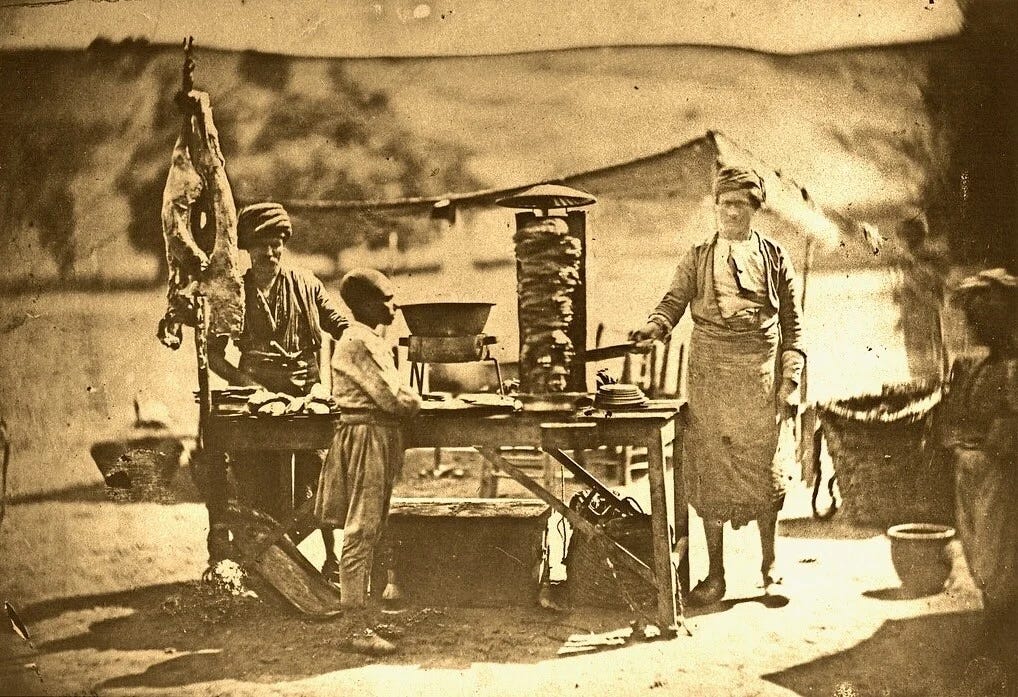
We like to think the gyro was born one sunny afternoon in Athens, probably by a man named Kostas, who looked at a pile of pork, a pita, some tzatziki, and said:
“Children, today we invent civilization.”
Not exactly.
The roots go back to Ottoman doner kebab, to roasted meat, to the old food roads of the Eastern Mediterranean, to refugees, cities, migration, adaptation, and probably at least one argument over garlic.
The doner came first.
Then it travelled.
Then Greece looked at it, adjusted it, renamed it, wrapped it in pita, leaned heavily into pork, and said:
“Now it is ours.”
This, by the way, is also how many things become Greek.
We inherit.
We argue.
We improve.
We rename.
Then we defend it with the intensity of a constitutional crisis.
The old doner was mostly lamb.
The Greek gyro became mostly pork.
That one change did a lot of work.
It separated the Greek version from the Turkish version.
It made it cheaper, more available, more familiar, and eventually more Greek in the everyday sense.
Not ancient Greek.
Not marble column Greek.
Not “Socrates ate this after discussing democracy” Greek.
Modern Greek.
After school Greek.
After beach Greek.
After drinking Greek.
Standing on the sidewalk at midnight Greek.
Students counting coins Greek.
Tourists taking pictures before making a complete mess of themselves Greek.
Greeks abroad missing it with suspicious intensity Greek.
Paper wrapper leaking down your hand Greek.
“Without onion, because I have to speak to another human being later” Greek.
The smell outside a neighborhood shop when you were not hungry five seconds ago, but suddenly you are ready to make life choices Greek.
This is the Greece I understand.
The gyro may not have been invented in the clean, national-museum way people sometimes want.
But food does not usually work like that.
Food travels with people.
It survives wars, borders, poverty, migration, politics, habit, hunger, nostalgia, and late-night bad decisions.
Then one day everyone agrees it belongs to them.
The Greeks did not invent meat on a rotating spit.
But they did invent the Greek gyro.
And that is not a small thing.
Because a Greek gyro is not just meat turning in front of heat.
It is memory wrapped in paper.
It is identity with grease on its hands.
It is the one-euro meal that became three euros, then four, then “are we financing the construction of the Parthenon?”
It is the first thing tourists learn to order and the last thing they learn to pronounce.
And yes, somewhere out there, someone is still saying “tzairos.”
Let them.
They are trying.
Besides, in Greece the important thing is not how you pronounce it.
The important thing is whether you ordered one.
Or two.
Discussion
Pull up a chair. Add a memory, a correction, a laugh, or something the story brought to mind.
No comments yet. We have been waiting for you...