

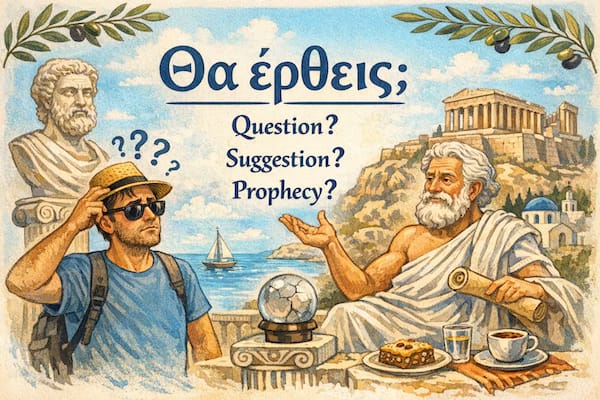
“Θα έρθεις (Tha ertheis).” Is that a question, a suggestion, or a prophecy carved in marble? Yes.
This morning in Kalamata, I sat at a small café near the waterfront, pretending to read while actually eavesdropping on the next table. The waiter leaned in and asked the couple, “Θέλετε κάτι; (Thelete kati?)” — Do you want something? It sounded like a question, but also like destiny knocking politely. The couple answered with a long discussion about life, the weather, and a cousin in Canada. No one mentioned coffee. Five minutes later, two freddos arrived anyway.
That’s when it hit me again.
Greek questions are not requests for data.
They are emotional choreography.
You don’t answer them.
You participate in them.
After two years back in Greece, I’ve learned something important.
Correction: I was reminded of something important.
Karen, meanwhile, is learning it from scratch — somewhere between Kindergarten Greek and First Grade Survival.
Take the classic: “Θα έρθεις (Tha ertheis).” — You will come! or Will you come?
Is that a question?
A suggestion?
A prediction carved in marble?
Yes.
In Greek, a question mark can feel optional. Tone does the heavy lifting. Grammar just watches from the sidelines eating πασατεμπο (sunflower seeds).
Then there is the national Swiss Army knife of expressions: “Εντάξει; (Endaxi?)”
It can mean:
• Are you okay?
• Do you agree?
• Have you accepted your fate?
• Why are you still talking?
The correct answer is always:
“Εντάξει (Endaxi).”
Even when nothing is εντάξει.
Especially then.
Another dangerous one is: “Να ρωτήσω κάτι; (Na rotiso kati?)” — Can I ask you something?
This is not a question. It’s a warning siren before:
• unsolicited life advice
• a comparison to your cousin in Australia
• a medical diagnosis based on your face
You cannot escape. The asking has already begun.
And of course the hospitality classic: “Θα φας; (Tha fas?)” — Will you eat?
This is not about hunger. It’s a moral exam.
If you say no, you have insulted:
• the cook
• the family
• three generations of olive trees
• possibly the Orthodox calendar
Correct response:
“Λίγο μόνο (Ligo mono).”
Translation:
Enough to feed a small village.
Scheduling in Greece deserves its own chapter.
“Τι ώρα θα συναντηθούμε; (Ti ora tha sinantithoume?)”
The answer will be:
“Κατά τις έξι (Kata tis exi).” — Around six.
Meaning:
Between 6:00 and the Second Coming.
My personal favorite remains:
“Να σου πω την αλήθεια; (Na sou po tin alithia?)” — Shall I tell you the truth?
This implies:
Up until now, fiction.
Brace yourself.
You will not enjoy the truth.
Living here again, I’ve realized Greek questions don’t collect information. They organize relationships, expectations, and snacks. They check whether you belong in the circle or just wandered in looking for directions.
And if you’re ever unsure what was asked, just reply:
“Ό,τι πεις (O,ti peis).” — Whatever you say.
It works 92% of the time.
The other 8% you’ll be fed anyway.
If Greek questions have interrogated your soul too, subscribe for free.
It’s cheaper than therapy and comes with better snacks.
Siga, siga. 💙
Nick in Kalamata