

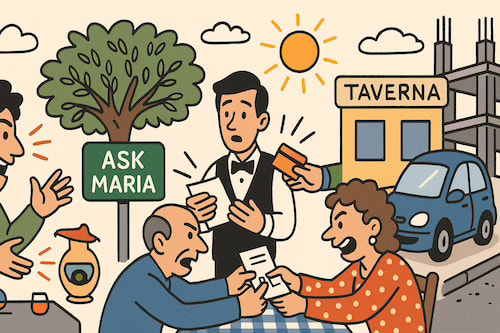
Greece isn’t a country—it’s a parallel universe where the GPS lies, the bill becomes a sport, and “two minutes” is an emotional concept.
If you’ve ever set foot in Greece, you know it immediately:
This isn’t just a country.
It’s a parallel universe.
The clocks tick differently. Rules are interpreted creatively. Daily life follows an unspoken choreography, completely baffling to outsiders and perfectly logical to Greeks.
Take conversation. Greeks don’t talk. They perform.
Two men shouting across the street? Not a fight, just an urgent update on Panathinaikos’ chances this season. A woman waving her arms like she’s guiding a plane onto the runway? She’s simply explaining her recipe for bean soup (fasolada). In Greece, volume isn’t aggression.
It’s affection.
Navigation follows its own logic too. GPS is more of a suggestion than a system. Real directions sound like:
“Turn right after the olive tree. No—the other one. Keep going until you pass the bakery that used to be a butcher. Then ask Maria.”
And somehow, miraculously, you arrive exactly where you’re supposed to.
Parking is its own art form. Sidewalks, corners, crosswalks, everything is a potential spot. Double-parking isn’t frowned upon. It’s practically a constitutional right. Turn on the hazard lights and you become legally invisible.
“Just two minutes” means twenty.
Sometimes an hour.
Sometimes a small part of your life.
Meals are never just meals. They’re extended operas of food, laughter, negotiation, and strategy. And when the bill comes, prepare for an Olympic-level contest of stealth and honor.
Someone will fake a bathroom break to pay.
Someone else will threaten lifelong feuds if their card isn’t accepted.
And the waiter—poor, innocent man—will be trapped in the middle of a family drama worthy of Evripides.
The weather is also a performance.
Winter: “It’s freezing. We’re dying.”
Summer: “It’s boiling. We’re dying.”
Spring and fall: “The allergies are killing us.”
No matter the season, you’ll receive passionate updates about the end of times.
And somehow, every dinner table circles back to philosophy. Soccer, politics, tomatoes—doesn’t matter. Someone will eventually invoke Socrates. Greeks never stopped being philosophers.
They just added feta.
But the quirks don’t stop there.
Bureaucracy is its own labyrinth, where one form requires a stamp that needs another paper that must be signed by someone who’s “on break” until tomorrow. Patience isn’t a virtue here.
It’s survival.
Architecture has its mysteries too: half-finished apartment buildings with steel rods sticking out like modern art installations. They’ve been “under construction” since 1983, but don’t worry, they also function as pigeon hotels and long-term family investments.
Superstition thrives as well. Compliment a baby without spitting “ftou, ftou, ftou” (symbolically, of course), and the evil eye might strike. Step on someone’s foot by accident? They’ll step on yours immediately, just to reset the universe.
So when you come to Greece, surrender.
Forget your watch. Silence your GPS. Accept the parking chaos. Don’t dream of paying your share without a fight.
You’re not just visiting a place.
You’re stepping into a lifestyle where time bends, arguments end in laughter, bureaucracy becomes folklore, and somehow, thanks to a stranger and that olive tree, you always find your way.
Want more stories from this parallel universe where logic takes naps and Maria knows everything?
Subscribe — I’ll meet you here again.

Discussion
Pull up a chair. Add a memory, a correction, a laugh, or something the story brought to mind.
No comments yet. We have been waiting for you...