

Coming back from Methoni, my brain was still full of Athanasiou bakeries.
Athanasiou in Kalamata.
Athanasiou in Methoni.
Athanasiou here.
Athanasiou there.
Athanasiou everywhere.
At this point, I was beginning to suspect that Messinia was not actually a prefecture, but a bakery franchise with olive trees.
Naturally, after all this deep investigative work, I had to walk into town for supplies.
Not bread.
Not coffee.
Not something practical.
My beloved smyrneika koulourakia.
There are errands, and then there are missions.
This was a mission.
I entered the bakery with the seriousness of a man securing provisions before a long voyage. The long voyage, in this case, was the walk back home. But still. One must be prepared.
Mission accomplished.
The koulourakia were acquired.
Civilization was preserved.
I said goodbye to Vassiliki and turned around to leave.
That is when I saw them.
Out of the corner of my eye.
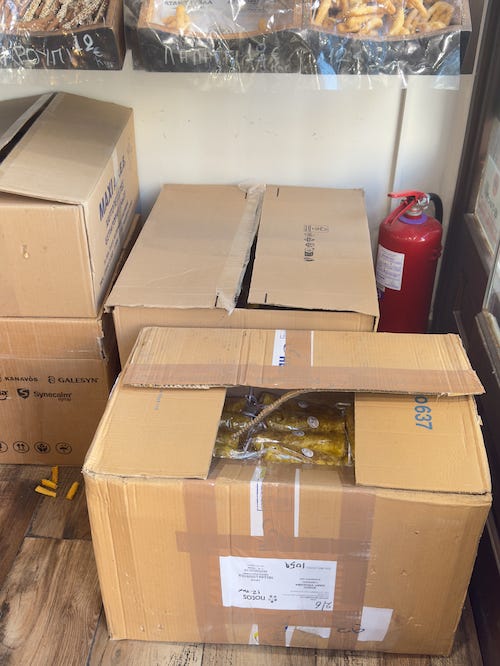
Rows of carton boxes.
Piled high.
Ordinary-looking boxes, actually. Not theatrical. Not screaming for attention. Just stacked there quietly, which in Greece usually means something important is happening.
One box was still half open.
And inside it, like treasure, were little individually wrapped boxes with ribbons.
Diples.
Ahhhh.
The national dessert of the Southern Peloponnese.
Yes, yes, I know. Every region has its claims. Every grandmother has her version. Every village believes its local bakery has achieved pastry immortality.
But in Messinia and Laconia, diples are not just dessert.
They are an announcement.
A celebration.
A golden, honey-soaked declaration that something important is happening and people are expected to eat accordingly.
There is the good dipla.
There is a good dipla.
And then there is the eternal Greek question:
Where is the best dipla?
This is not a question.
It is a trap.
Ask it in the wrong room and you may start a family feud that lasts until the next name day.
So, naturally, I asked.
“What’s with all the boxes? Are they heading out?”
Vassiliki chuckled.
“Oh yes.”
Then she pointed behind the counter.
“Plus all of these.”
I looked.
More boxes.
More ribbons.
More delights.
Fancy boxes. Wedding boxes. Boxes that were not going to someone’s house for afternoon coffee.
A whole diplomatic shipment of honey and pastry.
“Where to?” I asked.
I was waiting to hear something familiar.
Areopoli, maybe.
Gytheio.
Sparta.
A village near Valyra.
Somewhere in the great dipla corridor of Messinia and Laconia, where bakeries in Kalamata send boxes of sweets as if maintaining ancient trade routes.
But Vassiliki said:
“Psara.”
I paused.
“Wait. What?”
Because in Greece, this is a dangerous moment.
There is always the possibility that a village you have never heard of is hiding five kilometers away behind a hill, next to another village you have also never heard of, and everyone else knows it except you.
So I asked carefully.
“Where is the village of Psara?”
Vassiliki looked at me as if I had just asked where Athens was.
“No,” she said. “The island of Psara.”
The island.
As in, the island of Psara.
The small Aegean island near Chios.
The island that is very much not next to Valyra.
That stopped me in my tracks.
You have to understand the geography here.
We were standing in Kalamata, in the southern Peloponnese, looking at boxes of diples that were about to travel to a small island in the North Aegean.
This was not dessert.
This was logistics.
This was maritime pastry strategy.
This was a wedding operation involving honey, ribbons, ferry schedules, and nerves of steel.
Because Psara is not exactly around the corner.
The straight-line distance from Kalamata to Psara is about 275 kilometers.
That sounds innocent enough until you remember that straight lines are for birds, airplanes, and people who do not live in Greece.
For everyone else, there is the actual route.
First, the diples have to leave Kalamata.
By car, that means about two and a half hours to the Port of Piraeus, assuming Athens behaves itself, which is a bold assumption.
By bus, they would have to go from Kalamata to Kifisos, then somehow make their way across Athens to the port, which is already more urban stress than any honey-soaked pastry should be asked to endure.
Then comes the ferry.
Piraeus to Psara.
A conventional ferry.
About six hours and forty minutes.
And not every hour, either.
No, no, no.
This is Psara.
The ferry goes a few times a week, usually in the evening, because apparently even the Aegean likes to keep things dramatic.
So now imagine the mission.
Boxes of diples leaving Kalamata.
Packed carefully.
Stacked carefully.
Carried carefully.
Protected from heat, bumps, sudden braking, impatient drivers, ferry ramps, luggage, elbows, and that one relative who always says, “Just put them here, they’ll be fine.”
They will not be fine.
They are diples.
They are beautiful, delicate, honeyed architecture.
One wrong move and the groom does not arrive with a gift.
He arrives with a box of golden Peloponnesian crumbs.
“The bride is from Psara,” Vassiliki explained. “The wedding is happening there.”
“And the groom is from Kalamata?” I asked, already shaking my head because of course he was.
“Yes,” she said.
Then came the sentence that explained everything.
“He cannot go with empty hands.”
Άδεια χέρια.
Empty hands.
There it was.
The full weight of Greek civilization in two words.
Because a Greek person can travel with many things.
A suitcase.
A bag.
A jacket they do not need.
A plastic container from their mother.
A second plastic container from their aunt.
A third plastic container from someone who is not technically related but has known the family since 1973.
But one thing a Greek person cannot do is arrive empty-handed.
Especially not at a wedding.
Especially not if he is the groom.
Especially not if he is from Kalamata.
No, no, no.
A Kalamata groom cannot simply board a ferry and appear on Psara with a nice shirt and good intentions.
He must arrive with evidence.
Proof of origin.
A sweet passport.
A honey-soaked declaration:
I come from the Peloponnese, and we have brought reinforcements.
Because diples are not just sweets.
They are edible diplomacy.
They say:
We respect your island.
We honor your daughter.
We acknowledge your family.
We bring sugar, honey, walnuts, ribbons, and the full emotional weight of Messinian bakery culture.
Also, please notice the boxes.
This is Greece at its best.
A wedding on an island.
A groom from Kalamata.
A bakery preparing diples like cargo for an expedition.
Somewhere, a ferry schedule was involved.
Somewhere, someone had asked, “Will they survive the trip?”
And somewhere, someone else had answered with complete Greek confidence:
“Of course they will survive. They are diples.”
When those boxes are opened on Psara, someone will ask the question every Greek baker wants to hear:
“Where did these come from?”
“Kalamata.”
“Ahhh.”
And that will be enough.
The groom will not have arrived casually.
He will not have arrived empty-handed.
He will have arrived with ribbons, honey, walnuts, and the unmistakable message that his people know how to show up.
I left the bakery with my smyrneika koulourakia, but they suddenly felt modest.
They were for me.
The diples were for history.
They were crossing the sea, carrying the honor of Kalamata in a box.
Because in Greece, dessert does not always stay where you buy it.
Sometimes it becomes luggage.
Sometimes it becomes diplomacy.
Sometimes it becomes family memory.
And sometimes it travels all the way to Psara just to prove the first rule of Greek life:
You may cross the Aegean.
You may marry across regions.
You may go far from home.
But you do not arrive with empty hands.
Να ζήσετε!
Siga, siga 💙
Nick in Kalamata