

In Greece, even cars don’t die. They retire to a field, wait for a miracle bumper, and hope the next government program remembers them.
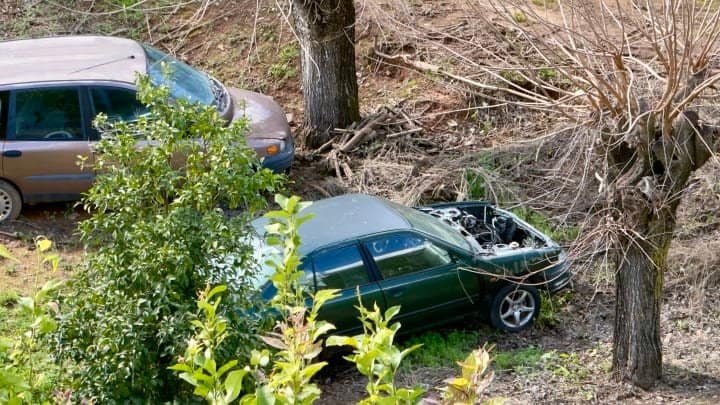
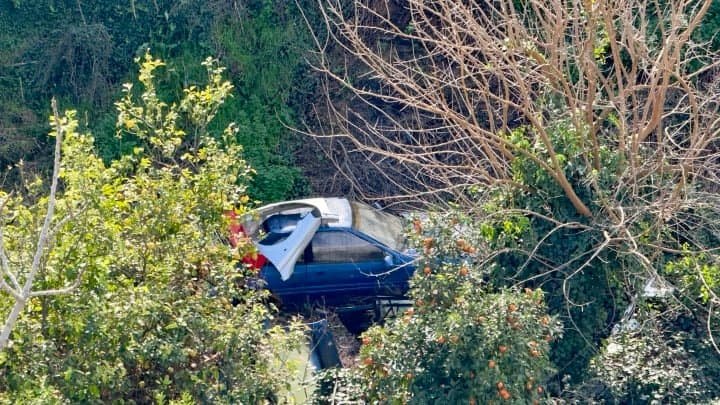
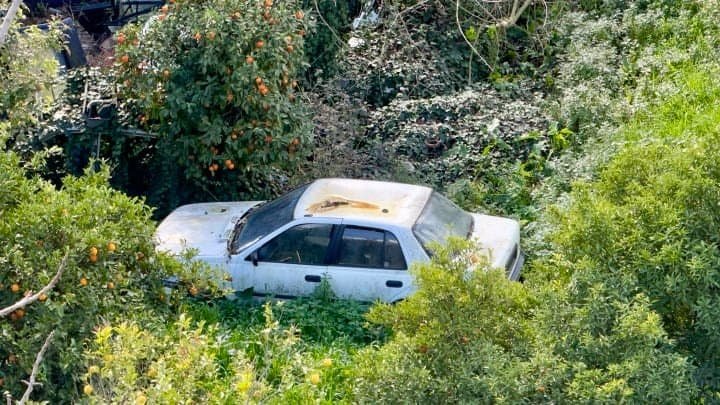
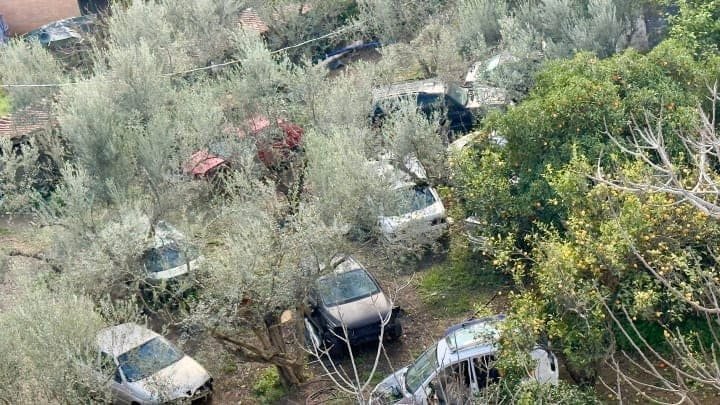
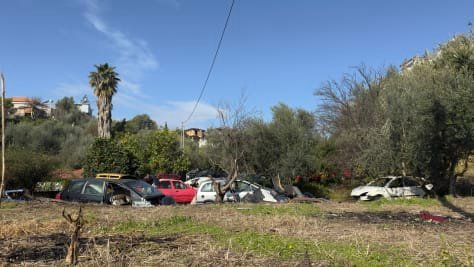
From our balcony in Kalamata, the 37 cars below don’t look dead at all.
They look useful.
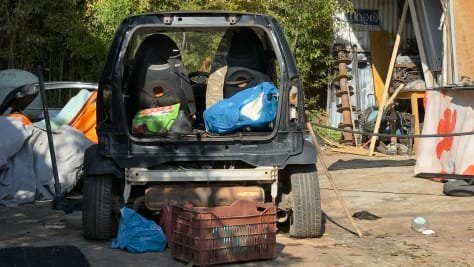
One might become a chicken palace.
Another a heroic donor of a left door from 1987.
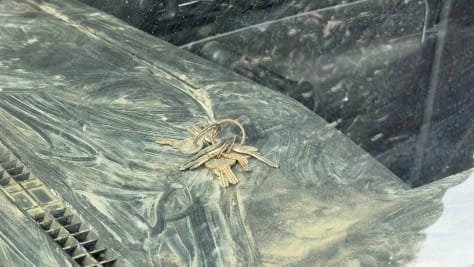
And one—with the keys still on the dashboard—dreams of a final escape to the seaside.
This is our neighborhood view: an accidental museum of metal, hope, and postponed decisions.
If archaeologists of the future ever dig through modern Greece, they won’t just find amphorae and marble columns.
They’ll find Hyundais with no doors, Opels with no hoods, and a brave 1992 Nissan Sunny still waiting for its big comeback.
Car graveyards are everywhere.
They occupy empty lots, olive fields, the cousin’s yard, and the space where a house might be built someday if the permit ever arrives. Some are stacked like tired animals. Others look as if they simply gave up mid-conversation.
And then there are the street relics.
Walk any Athens neighborhood and within a few blocks you’ll find a small museum of abandonment:
cars with no license plates, flat tires melting into the asphalt, missing mirrors, missing doors—sometimes missing half the car, as if someone started eating it and got full.
The obvious question: why don’t these things disappear?
The Economics of the Afterlife
Part of the answer lies in Greece’s on-again, off-again scrappage incentives.
Over the years, various programs offered modest bonuses to withdraw old polluting cars—usually a few hundred euros just to deregister them, with additional support of roughly €1,500–€8,000 if you replaced the vehicle with a cleaner or electric model.
The newest green-transition plans sound even more dramatic. Officials talk about packages where the total support for a new low-emission car could reach up to €30,000—but that figure includes loans and targeted benefits, not a suitcase of cash handed to every driver.
So reality took a more creative path.
If you didn’t want—or couldn’t afford—a new car, the logical move was to sell the old one to a “junkyard.” And in Greece a junkyard can mean anything from a licensed dismantler to a man with a field, a tractor, and an optimistic personality.
He pays the scrappage value, parks the car next to 36 others, and hopes to recover the money one bumper at a time.
Second Careers
Some of these cars have achieved a second life.
One really has become a chicken coop with better ventilation than most Airbnbs.
Another serves as storage for olive nets.
A third is basically a balcony extension where someone keeps paint cans, a broken ladder, and a mysterious blue hose that clearly belongs to nobody.
And then there are the brave ones.
The cars with keys still resting on the dashboard, daring a stranger to take them for one last wild ride—just to remember the good old days when they had four matching tires and a reason to exist.
A Scene from the Neighborhood
True story.
One afternoon our neighbor fired up his tiny tractor, drove into the field, and dragged a car into the middle like a wounded buffalo so a potential buyer could inspect the bumper. The man circled it, nodded wisely, measured something with his eyes, and finally declared:
«Δεν κάνει.»
Doesn’t fit.
The car was gently returned to its eternal resting place.
Every neighborhood has at least one vehicle that looks less abandoned and more… paused.
Paused for a decade.
With the radio probably still tuned to a station that no longer exists.
My Modest Proposal
Imagine if the state not only paid to retire old cars but actually removed the abandoned ones already clogging the streets.
We would solve the parking problem in one day.
Maybe two, if there’s a coffee break and a debate about whose cousin owns which wreck.
Until someone figures it out, Greece will remain the only country where a car can have three lives:
first as transportation,
then as spare parts,
and finally as real estate for chickens.
And from our balcony in Kalamata, the national fleet rests peacefully—
engines silent, dreams idling.
If this made you smile, subscribe for free.
No emissions, no paperwork, and absolutely no spare bumpers required.
Siga, Siga 💙
Nick in Kalamata
P.S. Seen a car graveyard in your neighborhood? Tell me where it is, or better yet, send a photo.