

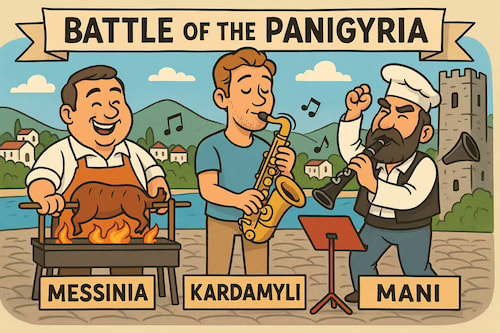
Greek summer doesn’t arrive quietly. It announces itself with roasted lamb, exhausted clarinetists, and villages determined to outlast each other until sunrise.
Summers are not counted in days—but in lambs roasted, clarinet battles survived, and villages determined to outlast each other until dawn.
In Greece, summer isn’t measured in weeks or tourist arrivals.
It’s measured in πανηγύρια (panigyria), village festivals that sprout like wild oregano across the countryside.
But don’t be fooled. These are not innocent gatherings of music and souvlaki.
They are annual contests of culinary firepower, musical endurance, and municipal pride.
Every village insists its festival is superior.
“Our bouzouki player makes even the mountains weep,” declares one.
Another replies, “We roast real lamb, not supermarket imports.”
A third smirks, “We have fireworks. And not the legal kind.”1
Messinia: Olives, Castles, and Retsina
Take St. Elias in Kalamata, where the festival perches on a hill above the city, making tsipouro taste better and dancing last longer. Locals from Thouria scoff:
“We have more lambs on the spit than Kalamata has traffic lights.”
Androusa pours wine straight from the barrel, daring visitors to survive both the drink and the clarinet. Down south, Methoni and Koroni add a dose of history—souvlaki beneath Venetian castles. Neighboring villages grumble that castles are “cheating.”
And then there’s Pylos, whose πανηγύρι feels like a reenactment of the Battle of Navarino—cannon fire replaced by tsipouro bottles.2
Kardamyli: The Sophisticated Middle Child
Exactly where Messinia gives way to Mani, Kardamyli hosts its own festivals. Yes, there’s lamb and souvlaki—but also poetry readings and the ghost of Patrick Leigh Fermor drifting between tables.3
And just when Kalamata and Mani argue over whose clarinetist plays louder, Kardamyli shrugs:
“We have an international jazz festival.”
Saxophones under the Taygetos sky. Bass lines echoing off stone houses. Trumpet notes drifting out to sea.
Try competing with that on a spit.
Kardamyli doesn’t need to boast.
It simply raises an eyebrow: “We have culture. Also, our sea view is better than yours.”
Mani & Laconia: Pride Sharper Than Stone
Cross into Mani and the tone hardens.
Areopoli doesn’t just host a festival—it stages a clarinet war. One solo answers another until dancers spin like tops and tables quake under stomping feet. Survival, not harmony, wins applause.⁴
In Gytheio, the harbor festival boasts seafood over lamb:
“Why chew on mutton when you can have octopus fresh from the sea?”
Inland villages like Kotronas and Kitta bring out stone towers and gunfire. Fireworks blend seamlessly with rifles. Nobody blinks.
And of course, the rivalry with Messinia.
Maniates proclaim:
“We are stone. You are olive oil. We last forever; you go rancid.”
Laconia, with Sparta in its veins, sneers at Kalamata’s castle festivals:
“Tourism. We dance under blood and marble.”
Messinians retort:
“At least we know how to cook lamb without shooting the neighbor.”
The Panigyri Olympics
The calendar is carefully negotiated. No two villages within twenty kilometers dare schedule their πανηγύρι on the same night. That would be civil war. Instead, dates are staggered like beads on a komboloi.
July and August become a traveling circus of grilled lamb, plastic chairs, and raffle tickets nobody ever wins.4
Numbers matter. The mayor personally counts parked cars, grinning as if they were his own flock.
“Six rows deep! Twice as many as last year!”
Meanwhile, cousins from Athens brag to cousins from Kalamata about whose village attracted more Germans. Attendance is prestige, measured in souvlaki plates and liters of retsina spilled.
And then comes the ultimate contest: who lasted longest.
Some festivals end at 3 a.m.
Others serve breakfast souvlaki at 7.
The true champions never stop—they roll straight into Sunday liturgy, where the priest discreetly forgives sins of overeating, overdrinking, and deeply questionable dancing.
Because in Messinia and Mani, a πανηγύρι isn’t just a party.
It’s a declaration of cultural dominance.
Until next weekend—when another village arrives with one extra lamb, a louder clarinet, and fireworks that make the fire department sweat.
OPA!
Siga, siga 💙
Nick in Kalamata
“Not the legal kind” varies by village and year. Sometimes by hour.
No actual cannons were fired. The tsipouro bottles, however, suffered heavy losses.
Patrick Leigh Fermor has not officially been seen at a panigyri, but multiple witnesses insist he “would have loved this table.”
Statistically, someone always wins the raffle. No one ever knows who.

Discussion
Pull up a chair. Add a memory, a correction, a laugh, or something the story brought to mind.
No comments yet. We have been waiting for you...