

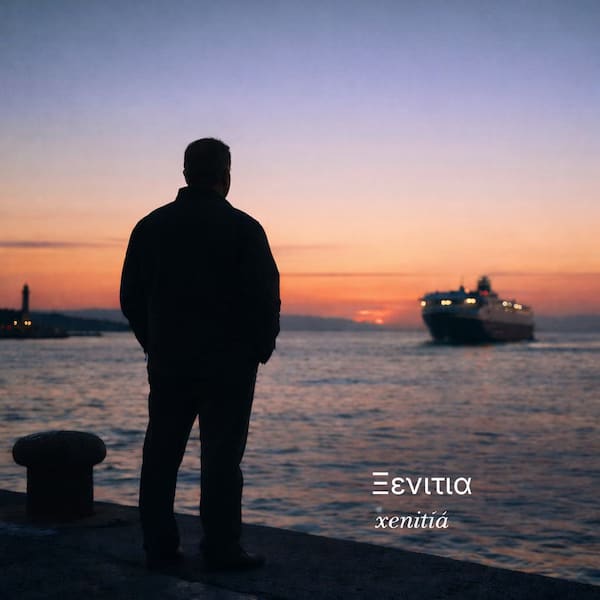
There are English words for it.
Expat.
Immigrant.
Relocation.
Diaspora.
They all describe movement.
Ξενιτιά (xenitiá) does not.
It describes what happens after.
It’s not the act of leaving.
It’s the condition of living away — while emotionally never quite leaving.
In English, you move abroad.
In Greek, you enter ξενιτιά (xenitiá) — literally, “foreign-land-ness,” the state of being in a foreign place.
It’s not logistics.
It’s identity.
You can build a career.
Raise children.
Buy a house.
Master systems that function.
And still,
A bouzouki song in a random restaurant stops you mid-sentence.
You calculate time zones before calling your mother.
You feel something tighten when someone says, “Back home…”
Because “back home” is never just a place.
It’s a version of you that still lives there.
When I left Greece 30 years ago, I wasn’t chasing adventure (maybe a little…).
I was escaping exhaustion.
I was tired of γραφειοκρατία (grafeiokratía) — bureaucracy.
Tired of inefficiency.
Tired of losing entire days to stamps and signatures.
I chose order over chaos.
Predictability over θα δούμε (tha doúme) — “we’ll see.”
Structure over έλα μωρέ (éla moré) — roughly, “oh come on,” depending entirely on tone.
I thought I was leaving a country.
I didn’t realize I was carrying it with me.
Xenitia (Ξενιτιά) doesn’t expire.
It matures.
At first, it feels like freedom.
Then ambition.
Then adaptation.
Then one day, you catch yourself defending Greece to Americans.
“No, dinner is supposed to last four hours.”
“Yes, coffee is meant to take time.”
“No, not everything that looks disorganized is broken.”
You become the ambassador of the place you once left.
That’s when it hits you:
Xenitia (Ξενιτιά) isn’t about distance.
It’s about tension.
Between who you were
and who you became.
Our grandparents knew ξενιτιά differently.
Ellis Island
Ships.
Letters that took weeks.
Black-and-white photographs.
Suitcases tied with rope.
Their xenitia (ξενιτιά) was survival.
Ours?
Wi-Fi.
FaceTime.
Direct flights.
And yet the ache feels surprisingly familiar.
Here’s the part no one tells you.
You can go back.
You can move home.
You can live in Kalamata and walk to town and complain about the same bureaucracy that made you leave in the first place.
And still…
You will never fully belong to only one place again.
Because once you’ve lived elsewhere, your identity splits.
You become hyphenated.
Greek-American.
Here-but-there.
There-but-here.
You defend Greece in America.
You defend America in Greece.
And both sides occasionally look at you like you’re slightly confused.
They’re not wrong.
Xenitia (Ξενιτιά) is loving two countries
and feeling slightly foreign in both.
It’s answering the question
“So where are you really from?”
with a paragraph instead of a sentence.
It’s carrying two rhythms in your head.
Efficiency and elasticity.
Schedules and σιγά σιγά (sigá sigá) — “slowly, slowly.”
But here’s the twist.
Xenitia (Ξενιτιά) stretches you.
It gives you perspective.
It sharpens observation.
It builds humor.
It teaches comparison without bitterness.
(Well. Most of the time.)
Maybe xenitia (ξενιτιά) isn’t exile.
Maybe it’s expansion.
But expansion leaves a small tear where the original shape used to be.
That tear?
That’s the ache.
That’s the quiet Sunday moment.
That’s why Greek music hits differently at night.
That’s why even after returning, part of you still feels like a visitor.
Xenitia (Ξενιτιά) doesn’t mean you left home.
It means you carry more than one.
And that is both privilege and burden.
💬 Your turn
Have you lived away from where you were born?
Do you feel fully “back” anywhere, or slightly in-between everywhere?
Tell me where your xenitia (ξενιτιά) lives.
If this resonated, share it with someone who carries two homes in their chest.
Σιγά σιγά (sigá sigá) 💙
Nick in Kalamata