

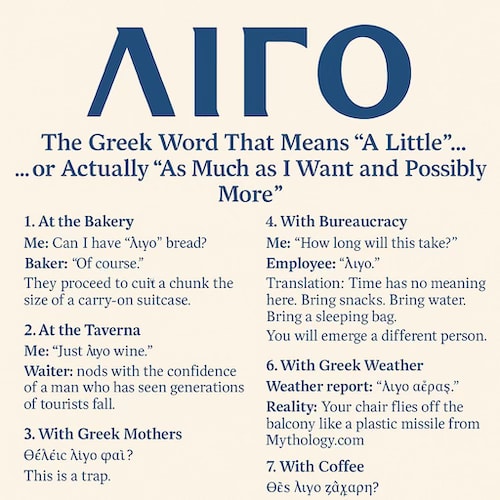
There are many complicated words in the Greek language. Some have ancient roots. Some have philosophical depth. Some require interpretive dance to explain to Americans.
And then there is lee-go (λίγο).
A simple, four-letter word that looks harmless. Innocent, even.
But do not be fooled.
Lee-go (Λίγο) is the linguistic equivalent of a Trojan horse: small on the outside, chaos inside.
Because in Greece, λίγο (lee-go) absolutely does not mean “a little.”
Oh no.
It means whatever the speaker emotionally needs it to mean at that moment, anywhere from “half a teaspoon” to “bring me the whole damn tray, Stamatis.”
Let us explore.
At the Bakery
Me: Can I have lee-go (“λίγο”) bread?
Baker: “Of course.”
They proceed to cut a chunk the size of a carry-on suitcase.
Me: “That’s… that’s not lee-go”
Baker: “You’re right, let me fix it.”
Adds another carry-on sorry slice.
At the Taverna
Me: “Just lee-go wine.”
Waiter: nods with the confidence of a man who has seen generations of tourists fall.
He pours until the glass is structurally unsound.
In Greece, lee-go wine means:
I am now responsible for your happiness, hydration, and psychological well-being.
With Greek Mothers
“Θέλεις λίγο φαΐ;”
(Do you want a little food?)
This is a trap.
If you say yes, they feed you until you question your life choices.
If you say no, they feed you more, because clearly you’re starving, dramatic, or confused.
With Bureaucracy
Me: “How long will this take?”
Employee: “lee-go”.
Translation:
Time has no meaning here.
Bring snacks. Bring water. Bring a sleeping bag.
You will emerge a different person.
With Friends
Friend: “I’ll be there se lee-go (σε λίγο).”
Translation:
In Athens: 15–45 minutes
In Thessaloniki: whenever the universe decides
In Crete: next week, maybe, who knows, relax
With Greek Weather
Weather report: lee-go areas (“Λίγο αέρας”) – a little windy.
Reality:
Your white plastic chair flies off the balcony like a missile during Hurricane Irma and your hanging cloths end up at the top of Taygetos.
With Coffee
Theleis lee-go zachari? (“Θες λίγο ζάχαρη;”) – do you want a little sugar?
You say yes.
They shovel in enough sugar to summon the ghost of your childhood dentist.
With Yiayia’s Cooking
Yiayia: “Put lee-go salt (λίγο αλάτι).”
Me: carefully sprinkles three grains.
Yiayia: “Τι κάνεις παιδάκι μου; What are you doing, my child?”
She grabs the salt like an Olympic weightlifter and pours until my great-grandfather materializes just to say, “Έτσι μπράβο,” which loosely translates to “well done, finally.”
Then:
“Also add lee-go oil.” (of course Messinia olive oil)
Which, in Yiayia units, means half a bottle.
Minimum.
And the best part?
When you ask for the recipe she says:
“It’s simple! Just lee-go of this, and lee-go of that…”
Yes, Yiayia.
A little.
Meaning:
25 ingredients, 3 hours, emotional damage, and 2 pans that no longer exist.
And yet… Greeks understand each other perfectly.
Because lee-go (λίγο) isn’t a quantity,
it’s a feeling.
A vibe.
A cultural pulse.
It means:
“I know what you mean, I know what I’m doing, don’t worry, sit down, eat something, life is short, have some more.”
And honestly?
It’s one of the reasons I love living here.
If this made you laugh even λίγο, subscribe to My Big Fat Funny Life for free.
I’ll send you stories, culture shocks, and linguistic crises—all delivered… σε λίγο (se lee-go). 😄

Discussion
Pull up a chair. Add a memory, a correction, a laugh, or something the story brought to mind.
No comments yet. We have been waiting for you...