

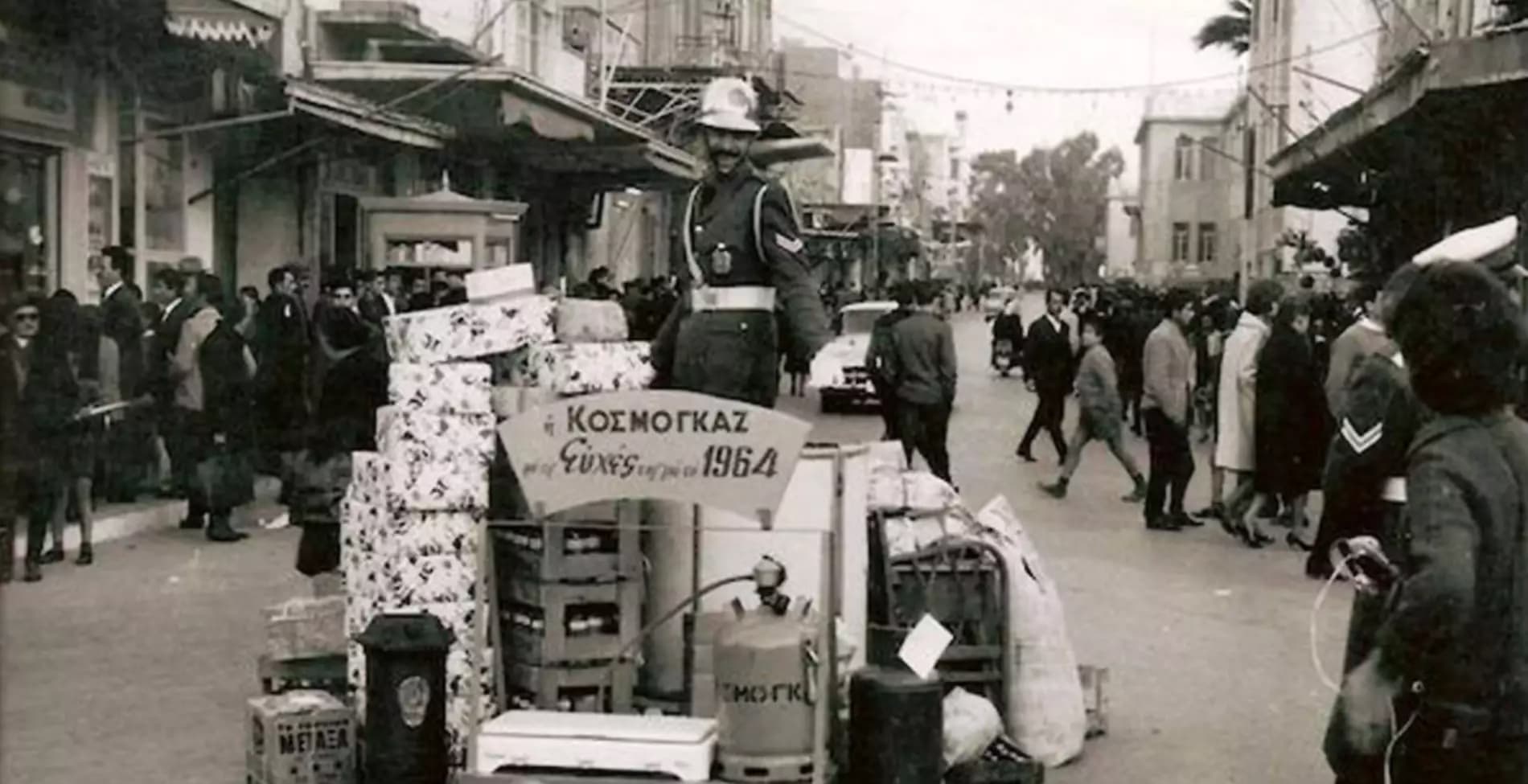
There was a time in Athens when traffic didn’t run on electricity.
It ran on a man—and later, on a woman.
The τροχονόμος (trochonomos)—traffic policeman or policewoman—stood in the middle of the road, elevated on a platform. Sometimes a simple circle, sometimes the famous “βαρέλι (varéli)”—a barrel—conducting chaos with hands, whistle, and an authority no traffic light has ever managed to replicate.
Rain, heat, cold… they were there.
And somehow—it worked.
But here’s the part people misunderstand.
The platform was always there.
The gifts were not.
Because this wasn’t a daily exchange.
It wasn’t transactional.
And it definitely wasn’t what it might sound like today.
It was seasonal.
During Christmas and New Year, something shifted.
Athenians would slow down and leave something at the base of the τροχονόμος.
A bottle of olive oil.
Fruit.
Sweets.
Whatever they had.
Quietly. Naturally. Without announcement.
Not “take this so I can pass.”
But:
“You’ve been standing here all year. This is for that.”
And like most Greek things, it didn’t begin with a plan.
It began with a gesture.
New Year’s Eve, 1936.
King Γεώργιος Β’ (Georgios II) is driving down Vasilissis Sofias. It’s cold. It’s raining. He stops at Rigillis Square, walks up to a traffic officer standing in the elements, wishes him “Χρόνια Πολλά” (many happy returns), and leaves behind a box of wine and sweets.
That was it.
No announcement. No decree.
Just one moment.
And the city saw it.
And copied it.
In the decades that followed—especially after the war—the custom exploded.
The “βαρέλι” became part of the holidays.
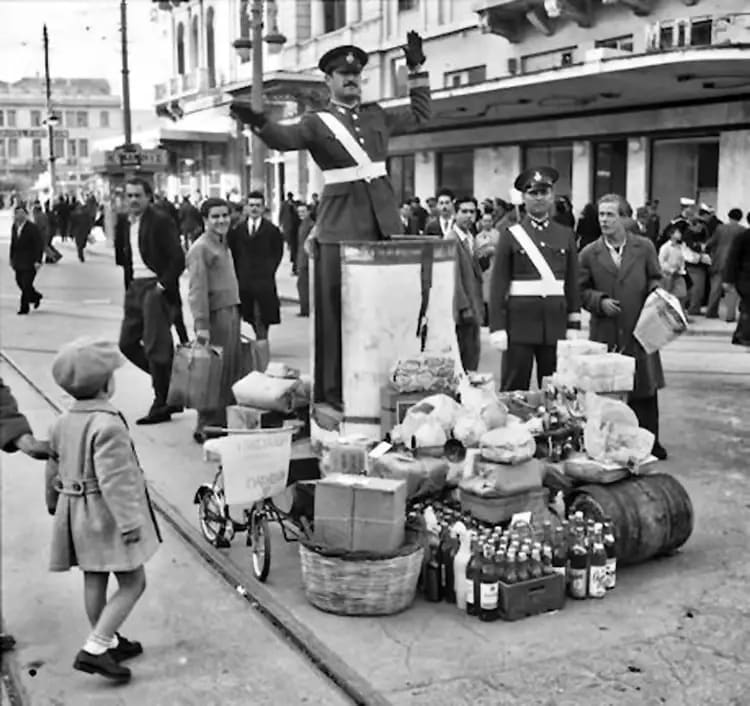
In places like Κηφισιά (Kifisia) and Σύνταγμα (Syntagma), the gifts didn’t just appear.
They piled up.
Not symbolic gifts.
Real ones.
Turkeys.
Crates of food.
Fabric.
Even appliances—refrigerators, stoves, washing machines.
Entire mountains of appreciation.
So much so that sometimes you could barely see the τροχονόμος behind them.
I remember, to this day, driving with my entire family to Kifisia to deposit our little gifts. And then it was a visit to Varsos bakery for galaktompoureko my favorite dessert. The legendary Versos that still defies time.
And then, the most Greek detail of all:
Everything was collected… and later distributed among the traffic police.
Fairly.
By lottery.
Think about that for a second.
A whole city saying thank you—
and a system that made sure the thank you was shared.
Then came the traffic lights.
Cold. Efficient. Immune to gratitude.
They don’t recognize holidays.
They don’t accept gifts.
They don’t care if it’s raining.
They just blink.
And slowly, the τροχονόμος faded.
The platforms disappeared.
The barrels emptied.
The mountains became memories.
But the idea didn’t vanish.
Even today, in places like Kifisia, the gesture survives—smaller, symbolic, but still there.
A quiet reminder.
Because in Greece, appreciation was never automated.
It was personal.
👉 In Greece, even traffic had its own way of saying ευχαριστώ (efcharistó).
If you remember the “βαρέλι”—what did your family bring?
Siga, siga 💙
Nick in Kalamata