

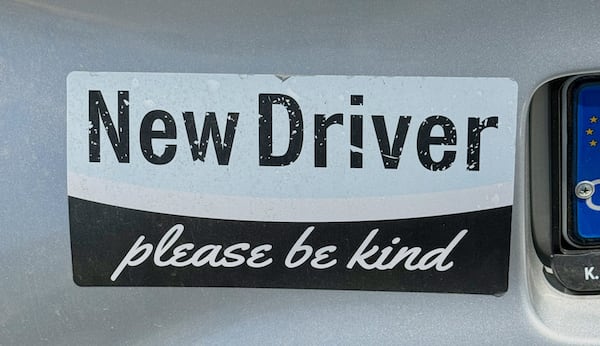
In Greece, there is a famous letter you see on the back of cars.
Ν.
Not “N” exactly.
Ν.
Greek capital ni.
It stands for:
νέος οδηγός
(neos odigos)
Translation:
new driver.
Beginner.
Freshly licensed.
Recently released into traffic.
By law, new drivers have to display the Ν on the back of the car for one year after getting their license.
This is the official explanation.
The unofficial explanation is that Greece believes every new driver should begin life on the road with public shame attached to the rear window.
In other countries, beginner drivers are gently introduced to the road.
In Greece, we mark them.
There it is.
Officially, it is supposed to be a white Ν inside a blue square.1
Unofficially?
You may see almost anything, as long as it is visible to other human beings and communicates the essential message:
Danger ahead.
On the back glass.
Crooked.
Faded.
Upside down.
Possibly homemade.
Like a small warning label from the Ministry of Anxiety.
Ν.
Proceed with caution.
This person may stop at a green light, turn left from the right lane, panic near a roundabout, or discover the clutch in real time.
But the Ν is not just a sign.
No, no, no.
This is Greece.
The Ν has personality.
You see it on the right side of the back window.
You see it on the left side.
You see it in the middle, slightly crooked, like it was installed during an earthquake.
You see it upside down.
You see it hanging halfway off, bravely surviving the sun, the dust, the rain, and three car washes that never quite happened.
And then there is my favorite.
The reversed Ν.
This happens when someone sticks it on the inside of the rear window with the letter facing the driver.
From inside the car, it looks perfect.
Beautiful.
Correct.
A proud Greek Ν.
But from outside the car, where every other driver on earth is supposed to see it, it becomes a mirror image.
A backwards warning.
A visual confession.
It says:
I am a new driver.
Also, I may not fully understand glass or the Greek alphabet..
There is something very Greek about this.
The law says display the sign.
It does not say the sign has to be emotionally stable.
In most countries, new drivers are usually between 16 and 18.
Our older son was the exception in the United States. He decided to get his license when he was 19, which by American standards made him practically a transportation philosopher.
Nineteen?
In America, people start wondering what happened.
Was there trauma?
Was there a protest?
Was he making a statement against parking lots?
But in Greece?
In Greece, you see “new” drivers in their 50s.
Their 60s.
Sometimes even their 70s.
A car passes you with the Ν on the back window, and the driver looks like he may have personally witnessed the introduction of the traffic light.
And you wonder.
What happened?
Maybe the family donkey died after a century of service and could not be replaced.
Maybe someone finally got the memo that cars have been invented.
Maybe they spent 67 years gathering every drachmoula, euro, coin, favor, and cousinly promise needed to buy a beaten-up used car with one working mirror and a radio permanently tuned to 1984.
Who knows?
This is Greece.
Every car has a story.
Every driver has a backstory.
And every backstory includes at least one uncle.
The Ν is supposed to make experienced drivers more patient.
That is adorable.
Because Greek drivers are famous for patience.
A Greek driver sees the Ν and thinks:
Ah, a new driver. I must give him space.
For exactly half a second.
Then the light turns green.
Then the horn begins.
Not a little toot.
A full declaration.
A civic announcement.
A musical emergency.
MOVE.
MOVE NOW.
YOU HAD YOUR CHANCE.
THE LIGHT HAS BEEN GREEN FOR 0.7 SECONDS.
This is how new drivers learn in Greece.
Not from instructors.
Not from manuals.
Not from road signs, which may or may not be hidden behind an olive tree.
They learn from the horn.
The horn is the real driving school.
One beep means:
Go.
Two beeps mean:
Go faster.
A long beep means:
I have lost faith in your family.
Several beeps mean:
I am now personally involved in your development as a driver.
And if you are really unlucky, someone will pull next to you, lower the window, and offer verbal coaching.
Not useful coaching.
Greek coaching.
“Πού πας έτσι;”
(Pou pas etsi?)
Translation:
“Where are you going like that?”
Which is not really a question.
It is a full Greek traffic diagnosis.
It means:
I disagree with your driving.
I disagree with your timing.
I disagree with your lane choice.
I may also disagree with the person who taught you.
Back in the day, when I was growing up in Athens, there was another line.
A classic.
A masterpiece.
If someone was driving badly, especially a new driver, people would say:
“Πού το πήρες το δίπλωμα; Στο Μινιόν με δόσεις;”
(Pou to pires to diploma? Sto Minion me doseis?)
Translation:
“Where did you get your license? At Minion, on installment payments?”
For those who did not grow up in Athens, Minion was the great department store of old Athens.
You could buy everything there.
Clothes.
Toys.
Household things.
Christmas magic.
And apparently, according to Greek traffic philosophy, a driver’s license.
With monthly payments.
No interest.
Free gift wrapping.
This was not a real thing, of course.
But it was a perfect Greek insult.
Because a Greek insult is never just an insult.
It needs architecture.
It needs history.
It needs a department store.
It needs an accusation about your competence, your family, your finances, and the decline of civilization.
“Where did you get your license? At Minion, on installment payments?”
I still love that line.
It belongs to a vanished Athens.
The Athens of trolley buses, department-store windows, paper bags, narrow streets, cigarette smoke, and men who could insult your driving while double-parked in front of a kiosk.
Minion itself became part of Athens mythology.
Before malls.
Before everything became branded and air-conditioned and exactly the same everywhere.
Minion was an event.
Then it burned.
And Athens lost more than a store.
It lost a reference point.
But the insult survived.
That is very Greek too.
Buildings disappear.
Expressions remain.
Today, the young driver still has the Ν.
The department-store insult may not be as common as it once was, but the spirit is alive and well.
Because Greece does not just judge how you drive.
Greece judges the entire story of how you became a driver.
The moment you hesitate at an intersection, Greece wants to know:
Who taught you?
Who signed the papers?
Was there a test?
Was there a witness?
Was your instructor awake?
Did your uncle know somebody?
Did you get this license from an actual office, or was there a sale at Minion?
The Ν is supposed to protect the new driver.
Instead, it turns the new driver into a public character.
People see the Ν and immediately create a biography.
First month with the license.
Mother is nervous.
Father is pretending not to be nervous.
Grandmother made the sign of the cross before the car left the house.
Some cousin said, “Don’t worry, everyone learns.”
This was a lie.
Nobody learns.
They just become more confident while doing the same things.
And eventually, the Ν comes off.
That is the beautiful part.
One year passes.
The driver removes the sticker.
The car is clean.
The shame is gone.
The driver is now officially experienced.
Which means what?
In Greece, it means you may now honk at the next person with the Ν.
Siga, siga 💙
Nick in Kalamata
Στην Ελλάδα, το σήμα του νέου οδηγού είναι ένα λευκό γράμμα «Ν» — από τη λέξη «Νέος» — μέσα σε ένα μπλε τετράγωνο πλαίσιο. Πρέπει να είναι τοποθετημένο στο πίσω μέρος του αυτοκινήτου, συνήθως στο πίσω παρμπρίζ, για τους πρώτους 12 μήνες από την απόκτηση του διπλώματος.
In Greece, the new-driver sign is a white letter “Ν” — from the Greek word Neos, meaning “new” — inside a blue square. It must be displayed at the back of the car, usually on the rear windshield, for the first 12 months after getting a driver’s license.