

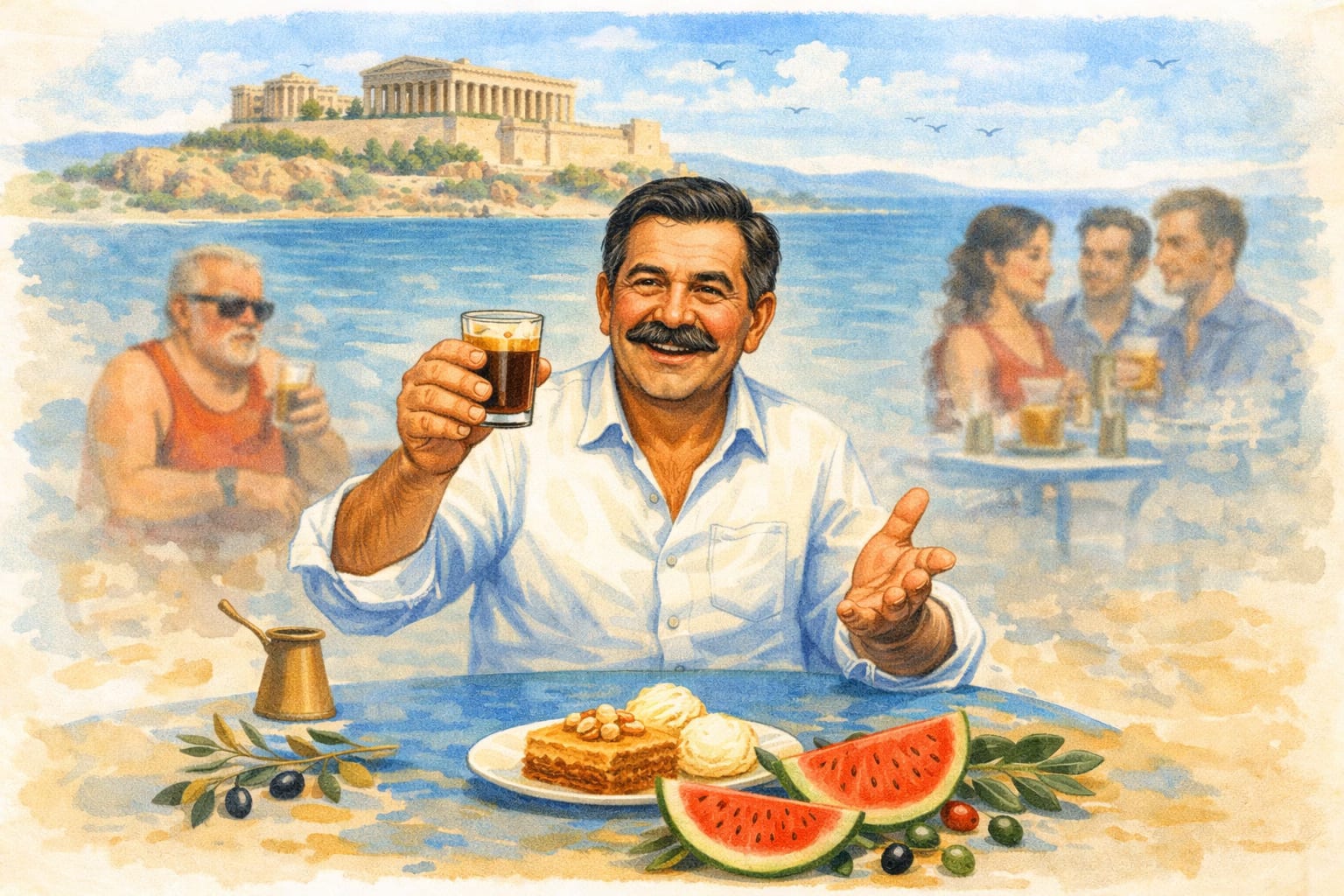
Where everyone is slightly wrong about everyone else—and somehow also right.
Spend enough time in a Greek café and you’ll hear it: opinions about “the Europeans.”
Not the Brussels kind, no budgets, no parliaments, no acronyms that sound like failed Wi-Fi passwords.
The real Europeans.
The ones who sit next to us, order coffee, and reveal themselves within five minutes.
And of course… they have opinions about us too.
Take the Germans.
To us, they are apostles of rules and timetables—people who can organize a sausage the way we organize a wedding: with structure, precision, and a printed schedule.
To them, we are… allergic to clocks.
If a ferry leaves three hours late, we don’t panic.
We order another coffee.
“The island isn’t going anywhere,” we shrug.
(And if it does, honestly, we had bigger problems.)
The Italians? Ah… cousins.
Loud, dramatic, expressive—people who talk with their hands so much you’re not sure if it’s a conversation or a small orchestra.
We admire their fashion.
They admire our food.
“Your moussaka,” they admit, “commands respect.”
In return, we’d happily swap recipes.
Not for the food—for the shoes.
The British are another story.
They arrive pale… and leave lobster-red, clutching a freddo espresso like it’s a survival tool.
To them, we are professional loungers, capable of sitting in a café for six straight hours.
We gently point out:
that’s because they order one sad teabag or a lukewarm beer…
while we order coffee, water, dessert, conversation, philosophy, and possibly a small life crisis.
We don’t sit.
We commit.
The French, of course, are elegant, stylish… and just a little bit convinced they invented elegance itself.
They see us as noisy but charming, like a musical that never ends.
We see them as quiet but intense, like a film where nothing happens… but somehow everything happens.
We smile… and pass the tzatziki.
Diplomacy.
Scandinavians are the polite ghosts of Europe. They are so white we barely even see them.
So quiet they apologize when the sun sets too early.
They look at us and wonder:
“How can your economy function if you’re always at the beach?”
Simple.
The sun does the work.
We supervise.
(With iced coffee. Very serious supervision.)
The Dutch live on bicycles.
Rain, wind, existential crisis, doesn’t matter. They pedal.
They marvel at how we use a car to go 200 meters for bread.
What they don’t understand…
is that bread is never just bread.
It becomes tomatoes, feta, olives, maybe watermelon…
and suddenly you’re transporting a small agricultural economy.
You need the car. This is logistics.
The Spaniards feel like honorary Greeks.
Late dinners, naps, music, life happening after midnight.
But even they draw the line somewhere.
“We invented the siesta,” they say,
“but you people invented staying awake for three days straight at Easter.”
Fair.
Someone has to keep the lamb rotating.
This is a sacred responsibility.
The Portuguese carry a quiet melancholy.
We think of them as our reflective cousins, espresso in hand, a little poetry in the air.
They see us as the relatives who arrive loud, hug everyone, move the furniture… and start singing before anyone agrees.
Both approaches are valid.
One is introspection.
The other is… volume.
The Swiss are… precise.
Their trains arrive on time.
Their watches are perfect.
Even their chocolate feels punctual.
To them, our church bells ringing at random hours is not charming—it’s chaos with sound effects.
To us, it’s music.
And also a reminder that time exists…
but is open to interpretation.
The Austrians?
We think of them as Germans with better desserts.
They think of us as Balkans with better beaches.
Honestly… both sides are making solid points.
The Belgians have waffles, chocolate, and beer.
We admire their neat, orderly cities.
They admire… our ability to turn a five-minute errand into a three-hour social event.
“How?” they wonder.
We don’t know either.
It just… unfolds.
The Poles are hardworking, disciplined, focused.
We see them as people who come to Greece to get things done.
They see us as people who invite them for coffee…
when there are clearly things left to do.
Both sides are confused.
The Irish are philosophers disguised as pub-goers.
Warm, witty, always ready for a story, or a drink.
We see them as our northern twins.
They see us as their Mediterranean version.
Same spirit.
Different weather.
Swap Guinness for ouzo…
and rain for sunshine.
Everything else stays.
And then… the Americans.
Not European, technically—but somehow present in every conversation.
“My yiayia was from Kalamata,” they say, within three minutes.
To them, we are philosophers who stopped writing things down after 400 BC.
Not true.
We just moved the discussion to cafés…
and eventually… Wi-Fi.
And us?
We are not innocent in all this.
We think everyone is a little too serious, a little too scheduled, a little too quiet.
Meanwhile… we are late, loud, emotional, and capable of turning a simple coffee into a full-day event.
We call it culture.
Others call it… confusing.
In the end, we all look at each other with equal parts admiration and confusion.
But without these quirks—
without Germans checking watches, Brits chasing shade, Dutch cycling through storms, Spaniards negotiating sleep, or Greeks casually renegotiating time itself—
Europe wouldn’t be Europe.
And worse…
the cafés would be quiet.
So let’s raise a glass.
To the punctual.
The stylish.
The melancholic.
The sunburned.
The cyclists.
The night singers.
The eternal coffee drinkers.
To a continent with 1,137 different faces—
and somehow, one shared table.
Yamas! 🍷
Siga, siga 💙
Nick in Kalamata
And as Mr. Portokalos would remind us:
“Stereotype? From the Greek στερεότυπα (stereotipa).
Solid + impression. Greek word!” 🇬🇷😉

Discussion
Pull up a chair. Add a memory, a correction, a laugh, or something the story brought to mind.
No comments yet. We have been waiting for you...