

For twenty-five years, Karen thought I had a problem.
Not a serious problem.
Not the kind where someone quietly prints an article and leaves it on your desk.
Just a normal marital problem.
The kind where your wife says, “You remember Susan, right?” and you stare back with the calm, empty expression of a goat watching a ferry leave.
“Susan,” Karen would say.
I would nod.
“Susan from work.”
More nodding.
“My close friend Susan.”
Still nodding.
“The Susan I have told you about thirty-seven times.”
This is where I usually made my mistake.
“Of course,” I would say.
This was a lie.
I did not know Susan.
I had no idea who Susan was.
Susan could have been a colleague, a neighbor, a dental hygienist, a Supreme Court justice, or someone we once met near a cheese platter in 2009.
Nothing stuck.
Karen found this alarming.
Also irritating.
Also, over time, possibly evidence that I had not been listening for most of our marriage.
Which, to be fair, is not entirely false.
But that was not the whole story.
Because then we moved to Greece.
And suddenly I know everybody.
The butcher.
The baker.
The woman at the pharmacy.
The man at the market who has the good peaches.
The mailman.
The neighbor with the dog.
The other neighbor with the louder dog.
The woman at the bakery who no longer asks what I want because apparently my koulourakia habits are now part of the municipal archive.
Karen has watched this transformation with increasing suspicion.
For twenty-five years, she was married to a man who stood at the edge of the room.
Quiet.
Contained.
Careful.
Restrained.
In America, Karen was the one in the middle of the room.
Karen made the introductions.
Karen worked the room.
Karen remembered names.
I stood nearby holding a drink, trying to remember if the man in front of me was Bill, Bob, or somebody Karen had already explained to me seven times in the car.
And I resented the whole shenanigan.
Not the people.
The format.
The polite introductions.
The expectation that “Bill from work” should mean something to my Greek brain.
The floating names.
The invisible American name tags.
Because even when no one was wearing one, the whole room felt like it needed them.
In Greece, nobody needs a name tag.
Give it three minutes and someone will identify you by village, cousin, accent, wife, apartment building, and where to eat the best moussaka.
I also had another habit that did not help my case.
In America, when I introduced my wife, I rarely said, “This is Karen.”
I would say, “This is my wife.”
Or sometimes I would simply gesture in her direction, as if presenting supporting documentation.
Karen noticed.
Of course she noticed.
After years of watching me forget Susan, Linda, Barbara, and possibly three different Bills, she began to suspect I could not remember her name either.
And honestly, who could blame her?
Then we moved to Greece.
And something terrible happened.
I became Karen.
Not completely.
I do not have her hair.
Or her patience.
Or her ability to remember every birthday, appointment, medical detail, family connection, and the full name of every woman who has ever worked with her, even briefly, within a 6,000-mile radius.
But socially?
Something shifted.
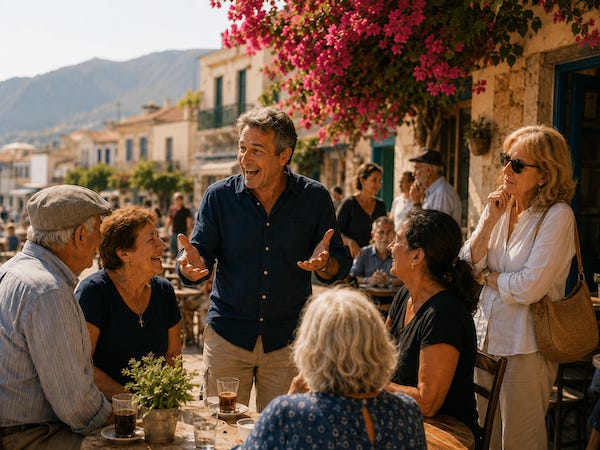
In Greece, I am in the middle of the room.
And loud.
Not loud by Greek standards, obviously.
Let’s not exaggerate.
By Greek standards, I am merely participating.
But by the standards of the man Karen lived with in America, I am a public disturbance.
I talk to everyone.
I ask questions.
I wave across streets.
I remember names.
I remember who has a daughter in Thessaloniki, who is renovating the apartment upstairs, who had surgery, who hates the new traffic pattern, and who believes the price of kolokythakia (zucchini) is proof that civilization is collapsing.
My Greek database is updating in real time.
And now, when I introduce my wife, it is always Karen.
“This is Karen.”
“Karen likes this.”
“Karen said that.”
“Karen wants to know.”
“Karen is from New York.”
“Karen is my wife.”
Karen, Karen, Karen.
Suddenly her name is everywhere.
Stamped into every conversation.
Attached to every introduction.
Part of the public record.
Because here, somehow, the name has weight.
Here, she is not floating beside me in a room full of disconnected people.
She is Karen.
My Karen.
Karen from New York.
Karen who moved to Kalamata.
Karen who is watching her quiet American husband become the loud Greek man in the middle of the room.
After twenty-five years of marriage, she is finally getting a glimpse of the original operating system.
And I think a few things have become clear.
I was not antisocial.
I was context-deprived.
I was not bad with names.
I was connecting to the wrong database.
I was not quiet.
I was buffering.
In America, people were introduced to me as isolated facts.
“This is Susan.”
Fine.
But who is Susan?
Where is she from?
Who is her mother?
What does she eat for lunch?
Does she have a cousin in a village in Peloponnese?
Has anyone in her family had a dispute involving land, inheritance, balconies, parking, or olive trees?
Without this information, my Greek brain had nothing to hold on to.
A name alone is not enough.
A name needs scaffolding.
A person is not simply “Susan.”
A person must come with coordinates.
A mother.
A bakery preference.
A medical complaint.
A son studying somewhere.
A husband who may or may not be useful in an emergency.
Then the name sticks.
Dimitris is not Dimitris.
Dimitris is the man from the market whose cousin lives near the old bus station, whose wife makes the good spanakopita, whose brother had a problem with the municipality, and whose nephew may or may not be the guy who fixed the thing that broke the other day.
That I remember.
Susan from work?
Gone.
Vanished.
Lost forever in the American fog.
This is why Greece works for my brain.
America had small talk.
Greece has full-body contact conversation.
In America, you enter a room and behave.
You wait your turn.
You speak at a reasonable volume.
You ask polite questions.
You do not immediately inquire about someone’s lineage, blood pressure, family property, or opinion about the mayor.
In Greece, these are opening remarks.
Here, conversations do not begin politely and proceed in an orderly fashion.
They begin anywhere.
In the elevator.
On the sidewalk.
Across traffic.
From a balcony.
While someone is double-parked with hazard lights on, because apparently hazard lights create a temporary diplomatic zone.
You do not “network” in Greece.
You collide.
You ask one question and suddenly you know three generations, two medical histories, one unresolved property dispute, and somebody’s opinion about your shoes.
This is my natural environment.
Karen says I am a completely different person here.
She is right.
But also, I am not.
I am the same person.
The room changed.
In America, I was at the edge of the room because I did not know where the center was.
In Greece, the center moves constantly.
Sometimes it is the bakery.
Sometimes it is the market.
Sometimes it is the line at the bank, which is not actually a line but a loose philosophical gathering of people who all claim to be next.
Sometimes it is the sidewalk, where three people standing near a parked car can become a town meeting.
Somehow, I know how to enter that.
I know the rhythm.
I know when to interrupt.
I know when to nod.
I know when to say, “Έλα τώρα.”
I know when to pretend I am outraged.
I know when to become genuinely outraged.
I know when a conversation is over, which in Greece means it will continue for another twelve minutes.
Karen watches this with fascination.
And maybe a little concern.
Because the roles have reversed.
In America, she was the mayor.
I was the quiet husband beside her.
The one smiling politely.
The one who would later ask, “Who was that again?”
In Greece, I have apparently opened a campaign office.
I know names.
I know stories.
I know whose cousin did what.
I know who is from where.
I know who not to mention to whom.
Karen is now the one standing slightly to the side while I conduct diplomatic relations over tomatoes.
This is not what she signed up for.
For twenty-five years, she dragged me into conversations.
Now she watches me start them.
For twenty-five years, she explained people to me.
Now I explain people to her.
And I can see the thought crossing her face.
So he was capable of this the whole time?
Yes.
Apparently.
But only in the correct climate.
Like basil.
Or bureaucracy.
Or certain types of mold.
I needed Greece.
I needed volume.
I needed interruption.
I needed context.
I needed people who do not simply say, “Nice to meet you,” and leave it there.
I needed someone to say, “Where are you from?” and mean not only city, but region, family, history, accent, politics, food, trauma, and whether your grandmother made proper gemista.
Then I wake up.
Then the files open.
Then the name attaches itself to a story.
There is one exception.
Expats.
Whenever we meet up with expats, my American behavior returns immediately.
It is almost biological.
We sit down with other people who have moved to Greece, and suddenly I am back at the edge of the room.
Polite.
Quiet.
Measured.
Nodding.
The conversation turns to residency permits, tax forms, shipping containers, Medicare, dentists, accountants, and “how long have you been here,” and my Greek operating system shuts down.
The old American software reboots.
Karen notices.
Of course she notices.
She looks at me as if to say:
There he is.
The man from America.
The one who cannot remember Susan.
And she is not wrong.
Put me with Greeks in Greece, and I become a social butterfly.
Put me with non Greeks in Greece, and suddenly I am standing near the cheese platter again, hoping nobody asks me a follow-up question.
Maybe this is the final proof that identity is not one thing.
We think we know who we are.
Quiet.
Loud.
Social.
Reserved.
Good with names.
Bad with names.
Middle of the room.
Edge of the room.
But sometimes the room matters.
Sometimes the country matters.
Sometimes the language matters.
Sometimes the person you have been for twenty-five years was not the whole person.
Just the version that could survive where you were.
Karen sees me here now.
Louder.
Looser.
More animated.
More familiar with strangers.
More myself in ways I had almost forgotten.
And maybe she understands something she could not fully see in America.
I was always Greek.
Even when I was trying to behave.
Especially then.
Karen looks at me.
I look at Karen.
And somewhere, Susan is still waiting for me to remember why I should know her.
Siga, siga 💙
Nick in Kalamata