

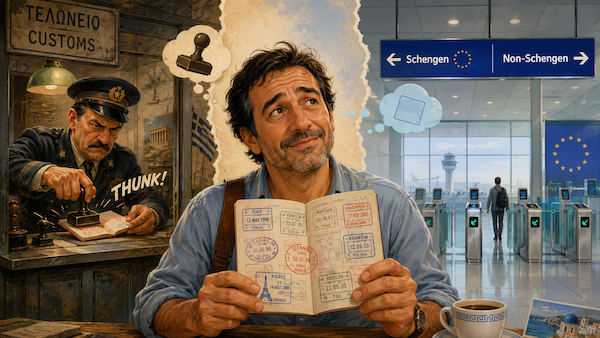
I was chatting online with a friend.
Let’s call her Suzan.
She lives in Switzerland and may be coming to Greece, so I said, “When they stamp your passport, let me know so we can get together.”
Then I stopped.
No stamps.
Not anymore.
Not inside the EU.
Or more accurately, not inside Schengen.
Which is not the same thing as the EU.
Of course it is not.
Why would Europe make this easy?
There is the European Union.
There is Schengen.
There are countries inside the EU and inside Schengen.
There are countries inside the EU but outside Schengen.
There are countries outside the EU but inside Schengen.
There are countries that sound like they should be in both, countries that feel like they are in neither, and countries where you need a lawyer, a map, and a glass of wine before you understand what line you just crossed.
So when I said “no stamps in the EU,” somewhere in Brussels a committee probably fainted.
The correct answer is Schengen.
Inside Schengen, you glide.
Outside Schengen, you may still get the look.
The serious look.
The international look.
The look that says, “Your vacation has now entered paperwork.”
And for some reason, this made me sad.
Oh, the good old days.
Back then, every border crossing felt like an event.
You handed over your passport.
A grumpy man in uniform looked at you.
Then he looked at the passport.
Then he looked back at you, because apparently your face was already under investigation.
Then came the stamp.
Thunk!
Proof.
You had been somewhere.
The passport with many stamps was not just a document.
It was a treasure.
You showed it with pride.
“Look. Italy. Austria. Germany. France. Turkey. London.”
Yes, London was not a country.
But to Greeks of a certain generation, London was basically a separate civilization.
Then came customs.
“Τι έχετε να δηλώσετε;” (ti ehete na dilosete?)
What do you have to declare?
Back in the day, I wanted to be funny.
So I would answer:
“Είμαι πολύ ευτυχισμένος που επιστρέφω στην πατρίδα.” (eimai poli efharistimenos pou epistrefo stin patrida)
I am very happy to return to my homeland.
This was not the answer they wanted.
Customs officers are not famous for rewarding poetry.
They wanted cigarettes.
Whiskey.
Perfume.
Electronics.
Leather goods.
Maybe a suspicious number of sweaters from England.
Not feelings.
But those were the days.
There were borders.
There were stamps.
There were questions.
There was a sense that places were different from each other.
England meant something.
Made in England meant quality.
In Greek slang, we had “μέγκλα.” (megla)
The good stuff.
Proper.
Solid.
Worth bragging about.
Made in Japan, once upon a time, meant something else entirely.
“Τζάμπα.” (tzamba)
Cheap.
Low quality.
Disposable.
Of course, Japan eventually had the last laugh and started making half the world’s best electronics while the rest of us were still trying to fix the antenna on the television.
But the point is not who won.
The point is that things had identity.
Places had identity.
Products had identity.
Travel had identity.
Upper-class Athenian ladies went to London for shopping.
That was a thing.
A pilgrimage with better shoes.
I cannot judge too much.
I was not immune.
I took my own trips to Rome for clothes and shoes.
Because you went to Rome for Italian clothes.
You went to London for English things.
You went to Vienna for schnitzel.
You went to Budapest for goulash.
You went to Napoli for pizza.
You went to Japan for sushi.
Now?
Everything is everywhere.
The world became flat.
I know Thomas Friedman announced this to the world as if it was good news.
The World Is Flat: A Brief History of the Twenty-first Century is a 2005 book by American political commentator Thomas L. Friedman.
The world is flat!
Well, I object.
I do not come from the Netherlands.
I come from mountainous Greece.
I do not want a flat world.
I want hills.
I want borders.
Not the ugly kind.
Not the kind that keeps people apart or makes life cruel.
I mean the beautiful borders.
The cultural borders.
The invisible line where coffee changes.
Where bread changes.
Where the cheese changes.
Where the police officer becomes grumpier in a different language.
Where the soup has a new name.
Where the pastry looks familiar but suddenly has walnuts instead of cream.
Where you know you have crossed into another place because the signs look different, the air smells different, and someone is serving you something you cannot pronounce.
Now I can get sushi in Kalamata.
Why???
I do not want sushi in Kalamata.
You want sushi?
Go to Japan.
You want lasagna?
Go to Venice.
You want schnitzel?
Go to Vienna.
You want Greek salad in Budapest?
Please!!!
Stick with the goulash.
I know this makes me sound old.
Fine.
I am old enough to remember when a passport was not just a booklet full of promises and warnings.
It was a travel diary written by governments.
Each stamp said:
You were here.
You crossed.
You arrived.
You returned.
You collected a little proof that the world was not one smooth international airport terminal with the same coffee chain, the same duty-free perfume, the same sad sandwich, and the same rolling suitcase wheels clicking across the same polished floor.
I miss the stamp.
I miss the little ceremony.
I miss the suspicion.
I miss the officer asking what I had to declare.
And I miss being young enough, foolish enough, and Greek enough to answer:
“I am very happy to return to my homeland.”
Which, honestly, was probably the most suspicious thing I could have said.
Anyone wants to join me for Indian food tonight?
Siga, siga 💙
Nick in Kalamata