

From noon to noon.
Just another day in my homeland.
It began with a notification from Airbnb.
Upcoming charge.
Rental in Athens.
A place I had set up for a friend.
X amount of dollars.
I looked at the message and thought, wait a minute.
This is Greece.
The apartment is in Athens.
I am in Greece.
The air smells of oregano, diesel, and bureaucracy.
Why am I paying in dollars?
Let’s pay in euros.
This was my first mistake.
I logged into Airbnb, changed the card, and clicked Pay Now.
Nope.
Transaction blocked by your bank.
Please call the number on the back of your card.
Fine, I thought. Before I call, let me at least save the card.
Nope again.
Saving the card was also blocked.
Then came the message.
Please call this number.
So I called.
I explained.
Then I was transferred.
Then I explained again.
Somewhere in a large building, possibly guarded by a man named Kostas and three broken printers, a system had decided I was committing fraud.
“Ah, yes,” the woman said. “There was a security alert for possible fraud.”
“No fraud,” I said. “I am trying to pay Airbnb.”
“Yes,” she said.
Good, I thought.
But no.
Because in banking language, yes does not always mean yes.
Sometimes yes means, “I understand.”
Sometimes yes means, “The computer has spoken.”
And sometimes yes means, “Your life is about to become a small documentary.”
Because of the security alert, and because I had tried to save the card, they had to cancel my card.
“Wait,” I said. “What?”
“I am sorry,” she said. “There is nothing I can do.”
Nothing I can do.
One of the great international phrases.
It means the human has surrendered, the computer has won, and you are now standing outside the castle walls holding a dead debit card.
“You will receive your new card in seven to ten business days.”
Seven to ten business days.
In the meantime, apparently, I was not supposed to eat, buy gas, pay tolls, purchase groceries, or participate in the modern economy.
I could always go to a branch to get cash, she said.
Of course.
A branch.
The sacred temple of “take a number and lose your will to live.”
Maybe, if the stars aligned, if the window was open, if the teller was working, and if there were fewer than a gazillion people waiting for that one teller, I could get some cash.
Enough for coffee.
Maybe two coffees, if I did not get fancy.
Or I could make an appointment.
So I checked.
There were openings.
In three weeks.
Unless I wanted to drive 187 kilometers, take a ferry to an island, and visit a branch where the local teller might have an opening in four days.
This is when Greece reminds you that geography is not only a subject in school.
It is also customer service.
Now, I have written before about the Greek system of knowing someone who knows someone.
In America, this sounds suspicious.
In Greece, it is infrastructure.
You may have electricity, water, internet, and garbage pickup.
But the most important utility is still:
Do you know someone?
As it happened, someone of someone worked at this bank in Kalamata.
Message sent.
Candle lit.
Prayers activated.
In the meantime, I decided to use my backup bank.
Because I am responsible.
Because I am prepared.
Because I believe in backup systems.
Well, not so fast, buttercup, came the thundering voice from Mount Olympus.
The debit card from the backup bank needed verification.
But of course.
No problem.
Except verification was “not available.”
Not available today?
No.
Not available for a few months.
So I called the backup bank.
Another conversation began.
What phone are you using?
What computer?
What browser?
What operating system?
Are you on Wi-Fi?
Are you using the app?
Have you tried the website?
Have you logged out?
Have you logged in?
Have you considered moving to a monastery and paying only in olives?
After twenty-seven minutes, the bank opened a ticket.
A ticket.
This is modern progress.
In the old days, they shrugged.
Now the shrug has a reference number.
It is now three days later.
They are still investigating.
The next morning, the prayers were answered.
The someone of someone called.
Appointment made.
New debit card issued.
New PIN, of course, because life had not offered enough opportunities for mental collapse.
I took a picture of the PIN so I would not screw it up.
Yes, I know.
Somewhere, a security expert just fainted.
But at this point, between the canceled card, the backup card, the ticket, the appointment, and the new PIN, my brain had become overcooked hilopites.
“Can I change the PIN?” I asked.
“Yes,” they said. “Only at an ATM.”
Of course.
Why change the PIN where they hand you the card, when you can stand outside at an ATM behind a football team’s worth of people trying to get petty cash?
That would be too simple.
That would disturb the natural order.
New debit card also meant another small Greek errand.
E-Pass.
The toll pass.
Because if the balance gets low, the toll system needs to replenish it from the card.
And the old card was now dead, buried, and possibly under investigation.
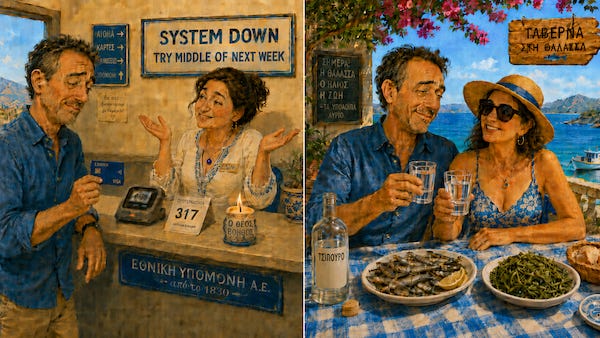
“Hey hon,” I said to Karen, “how about taking a little forty-kilometer drive to Arfara and back so we can visit the Moreas Customer Service office?”
This sentence sounds ridiculous unless you live in Greece.
Then it sounds like Tuesday.
I have been to the Moreas office several times.
They know me.
I know them.
At this point, we are practically extended family.
One too many “frauds” on my debit card, and here I was again, returning to the toll office like a man visiting his ancestral village.
I walked in smiling.
Pleasantries exchanged.
Everything was going beautifully.
I explained the official reason for my visit, beyond simply stopping by to see my extended toll-road family.
Then my friend behind the counter looked at me and said:
“Well, we cannot change the card today.”
I laughed.
I thought she was joking.
Hahaha. Very funny. Greece being Greece.
But she was serious.
Two words that can contain an entire civilization.
“All our systems are down,” she said.
Of course they were.
“There has been a fire at the Nova substation in Tripoli. We have no connectivity.”
A fire.
At the Nova substation.
In Tripoli.
Because why should my debit card problem remain between me, Airbnb, and the bank?
No.
Telecommunications infrastructure in the Peloponnese had now entered the chat.
“We have no idea when service will be restored,” she said. “Headquarters has no idea either. Do not come back tomorrow. Try middle of next week.”
And there it was.
Noon to noon.
One ordinary day in Greece.
Airbnb notification.
Bank fraud alert.
Card canceled.
Branch appointments in the next geological era.
Someone who knows someone.
Backup bank verification unavailable.
Ticket opened.
New card issued.
New PIN photographed like state secrets.
E-Pass errand.
Forty-kilometer drive.
Systems down.
Fire in Tripoli.
Try middle of next week.
At some point, a person has to stop fighting the day.
You cannot defeat Greece.
You can only learn when to surrender gracefully.
So I looked at Karen.
“Hey hon,” I said, “how about some gavros, some vlita, and a bottle of tsipouro at the beach?”
Because this is also Greece.
The same place where paying for an apartment in Athens can cancel your debit card and somehow involve a burned telecom substation in Tripoli.
But also the place where, after all of that, you can sit by the sea with fried little fish, boiled greens, cold tsipouro, and the afternoon light bouncing off the water.
The bank can investigate.
The ticket can remain open.
The toll pass can wait.
The system can be down.
We have gavros.
We have vlita.
We have tsipouro.
And for the moment, that is enough.
Siga, siga 💙
Nick in Kalamata