

[Note: Part 3 of a loose series on repair, reuse, and the Greek refusal to throw things away.]
By now, the pattern should be clear: in Greece, things are rarely finished just because they are torn, worn, old, or slightly malfunctioning.
But that mentality does not survive on philosophy alone.
It survives because Greece still has the people who make it possible.
The seamstress.
The shoe repairer.
The upholsterer.
The eyeglass repair guy.
The cabinet maker.
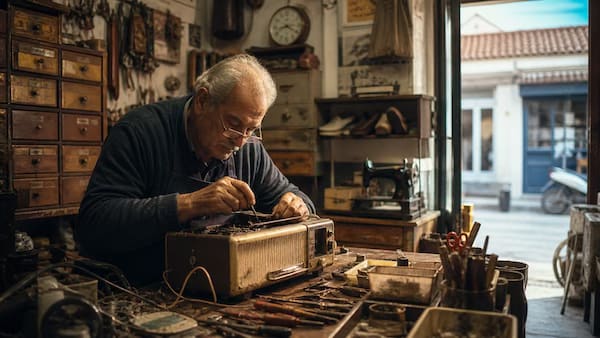
The little technician with drawers full of screws and old knowledge.
That is the real story.
In many places, the culture of fixing things disappeared because the people who knew how to fix them disappeared first. Once the cobbler closed, the tailor retired, the upholsterer became a luxury service, and the radio repairman vanished into legend, “repair culture” became a lovely idea with nowhere to go.
But in Greece, and especially in places like Kalamata, the system still breathes.
You still feel that density here. Around the center, in those practical little pockets of town, these shops still cluster together the way they used to. A seamstress here. A shoe repairer there. An upholsterer a few doors down. A small technician sitting behind a counter full of tools and old knowledge.
Not as nostalgia.
As infrastructure.
These are not museum pieces. They are not “how charming” little relics for tourists to photograph. They are working shops. Real businesses. Somebody dropped off shoes this morning and is coming back at six. Somebody is shortening curtains. Somebody is fixing eyeglasses. Somebody is rebuilding kitchen cabinets better than half the flat-pack furniture in Europe.
And that is why, in Greece, when something breaks, the first question is often not:
Should we replace it?
It is:
Who’s the guy?
Not is it too old.
Not wouldn’t it be easier to order a new one online and have it arrive by Tuesday.
No.
Someone knows a guy.
Someone knows a guy.
A guy for the shoes.
A guy for the zipper.
A guy for the glasses.
A guy for the radio.
A guy for the chair with one suspicious leg.
A guy for the kitchen cabinet that has been “temporary” since 2004.
A guy for the clock your aunt refuses to throw away because “it just needs a look.”
And these are not abstract services. They are neighborhood fixtures. Local people. The kind who may not know your full life story, but definitely know your face and exactly why you are back.
“Again?” they ask, holding your item with the weary professionalism of a doctor dealing with a repeat patient.
There is also something deeply Greek in the social role of these professions.
In more digitized economies, repair has become sterile. You book online. You get a reference number. You mail the item to a service center in a town you have never heard of. Two weeks later you receive an email politely explaining that replacement is more economical.
In Greece, repair is still personal.
You walk in.
You explain.
You gesture more than necessary.
The repairman nods in a way that combines disappointment, experience, and confidence.
He tells you to come back Thursday.
You return Friday.
It is ready Saturday.
And somehow this feels normal, because civilization here has always included a little negotiation with time.
That intimacy matters. These shops are not just businesses. They are small stations of human competence. You go there not because the branding is strong, but because somebody has been doing one thing properly for thirty years.
And often for prices that make the modern world look slightly ridiculous.
In America, a refrigerator from 1955 is called vintage.
In Greece, it is called “working fine, but the rubber on the door needs changing.”
Of course, saying that is the easy part.
Changing it with what is the real question.
And this is where Greece becomes truly impressive.
You would be amazed what old parts can still be found here. And if the part no longer exists, someone finds a way to make one.
True story.
At my dentist recently, one screw on an old implant broke.
Not ideal.
The nurse called another nurse. Then Panos, the support doctor. Then the super-duper doctor himself appeared, and for a few moments the atmosphere suggested we were no longer dealing with a mouth but with a minor engineering failure at a submarine yard.
There was discussion. Inspection. Serious faces.
How do we remove the piece?
And then what?
Because the insert was no longer available.
The screw was no longer available.
In many places, that would have been the moment when everyone sighed, opened a catalog, and informed you that the original part was obsolete, the system was outdated, and the solution would now require a larger procedure and a larger invoice.
Not here.
Here the conclusion was almost comically calm:
We will manufacture a new insert.
And a new screw.
Think of it.
A state-of-the-art dental implant treated with the same Greek logic as an old refrigerator, a sofa spring, or a cabinet hinge:
If the part does not exist, we will make the part.
That, right there, is the entire difference in worldview.
One system romanticizes old things.
The other keeps using them.
Of course, this world is thinner than it used to be.
You can feel that too.
Many of the people holding up this repair economy started decades ago. They learned by doing, inherited skills, opened shops in the seventies and eighties, and stayed put. They are still there, still working, still surrounded by tools that look older than some governments.
But there is a quiet question hanging in the air: what happens when they stop?
Because this is where the story shifts from funny to slightly tender.
The next generation is not exactly lining up to become cobblers, upholsterers, sewing machine mechanics, or radio repairmen. And modern products are now built with all the warmth and generosity of a legal disclaimer. Open one up and it looks like it was designed specifically to insult the screwdriver.
So yes, the old repair Greece still exists. But you also sense the gap coming. The skills are here. The customers are here. The need is definitely here. The apprentices? Less so.
Which makes these shops feel even more valuable.
They are not relics.
They are living links to a different logic of daily life.
A logic where usefulness matters more than novelty.
Where skill matters more than packaging.
Where the answer is not “buy another one,” but “wait, I know someone.”
Maybe that is why these places feel so reassuring.
They remind you that a real city is not just coffee shops, delivery scooters, apps, and real estate signs. It also needs people who can mend, tighten, resole, rewire, restitch, rebuild, and quietly save the things modern life keeps trying to turn into trash.
Greece still has more of those people than many other places.
Not everywhere. Not forever, maybe. But still enough that you notice.
Still enough that in Kalamata, broken things do not feel abandoned.
They just feel like they are waiting their turn.
And maybe that is the most Greek part of all:
Even now, in a world obsessed with replacement, Greece still leaves a little room for rescue.
What is the best example you’ve seen of a Greek repair that should not have been possible, but somehow was? Tell me in the comments.

Discussion
Pull up a chair. Add a memory, a correction, a laugh, or something the story brought to mind.
No comments yet. We have been waiting for you...