

[Note: Part 1 of a loose series on how Greece keeps things going.]
In old Greece, a torn shirt was not a reason to throw it away.
It was a reason to say, “Take it to the seamstress.”
Or, if things were running properly, have the seamstress come by with her machine.
White-glove service, before anyone called it that.
That was the whole philosophy of the country, really.
Postwar Greece was poor, and poor people do not look at a perfectly usable piece of clothing with one small tear and decide it has completed its life’s mission. They look at it, sigh once, and send it for repair.
Nothing was wasted if it could still be worn, altered, or handed down.
I was the older brother, so some of my clothes naturally continued on to my younger brother. If there was no younger boy in the family, they moved sideways to a cousin.
Greek clothes did not retire.
They were reassigned.
A shirt started as “good,” then became “everyday,” then “for school,” then “for your brother,” then “for your cousin.” By the end, it was less an item of clothing and more a public servant.
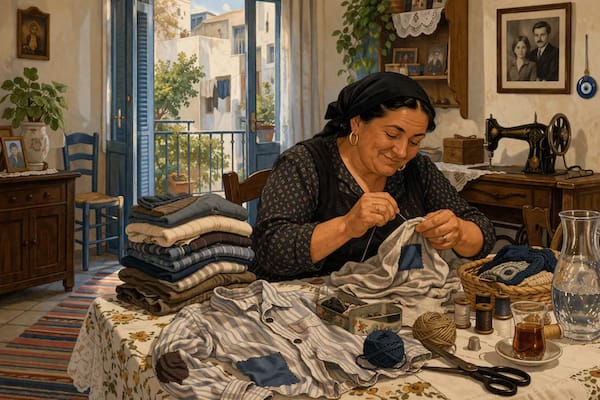
That is why there was always a neighborhood seamstress. Or a tailor. Or a woman in the building with a sewing machine, sharp eyes, and the authority of a field surgeon.
You didn’t throw clothes away. You took them to be shortened, tightened, adjusted, patched, and sent back into circulation.
A tear was not an existential crisis.
It was a small errand.
Families stretched everything. Sweaters were patched. Socks were darned. School trousers were let out, taken in, and passed down depending on who had grown and who was next in line.
Nothing had to be perfect.
It just had to last.
You entered the seamstress’s shop carrying something folded over your arm like a patient with a private but manageable condition.
She would hold it up.
Squint.
Pinch the fabric between two fingers.
Maybe click her tongue once, just to establish professional seriousness.
Then she would say:
“Άστο.”
Leave it.
Which in Greece never simply means leave it.
It means:
I’ve seen worse.
This can be fixed.
Please stop talking.
And usually, it could be fixed.
These women were not simply doing alterations.
They were keeping the household economy alive.
School uniforms.
Sunday clothes.
Curtains.
Aprons.
Jackets.
Children’s trousers on their third owner.
Men’s pants that had mysteriously become tighter after Easter and Christmas.
Entire households passed through those hands.
And naturally, the service did not come without commentary.
“Why did you buy it so long?”
“Who cut this?”
“This fabric is terrible.”
“You’ve put on weight.”
“No, no, don’t worry. I’ll fix it.”
Half seamstress, half prosecutor.
And then there were the neighborhood stories.
Because in Greece no profession, however innocent, was ever allowed to remain untouched by rumor.
True story. Or possibly neighborhood fiction with excellent distribution.
There were whispers that a few boys in our neighborhood lost their virginity in the process of handing over torn shorts for repair.
Nobody knew exactly who.
Nobody ever produced proof.
No names. No statements. No official archive.
But the rumor circulated with the quiet authority of fact.
And that too was old Greece: even a simple errand could become folklore if repeated often enough by the right people on the right balconies.
You went in with torn shorts.
You came out with a repaired hem and a legend attached to your name.
And yet, in places like Kalamata, that world never disappeared completely.
Kalamata smells and feels like old Greece in many ways. Seamstresses are still everywhere. Maybe they are not doing exactly what they used to do before, but they are still part of the city’s fabric. And busy. Really busy. You wait. Sometimes longer than it takes to get blood test results back in an hour.
Here you can alter one pair of trousers for five euros. Two pairs for eight. Compare that to Florida, where an alteration can cost thirty-five dollars, which is sometimes more than the trousers themselves and starts to feel less like tailoring and more like a ransom demand.
True story.
I was in New York in November. Cold. I mean cold-cold. Wind-chill cold. Thank God for my GAP puffy jacket: heavy-duty, hooded, with a zipper that looked like it meant business. On top of that, it had buttons too. A serious winter operation.
I felt warm and secure until the zipper got stuck halfway.
Not just stuck. Catastrophically stuck. The teeth split apart at the bottom and the top. My son tried. I tried. Nothing. Back at the hotel, I tried again. Still nothing.
Eventually I took the jacket off by pulling it over my head like a man trying to escape his own decisions.
Then, in one final act of desperation, I pulled upward with all my might.
The zipper pull came off in my hand.
Into the pocket it went, like a casualty.
That night I relied on the buttons alone, with a cold breeze entering my chest and my dignity leaving by other means. Better than nothing, but not ideal for a New York November.
So I came back to Kalamata carrying the puffy jacket and the broken zipper pull like a trophy from war.
I took it to a seamstress.
She gave it one not-encouraging look.
Then a second one.
From the back, a yiayia shouted:
“Take it to Giorgos around the corner.”
Around the corner I went.
The shop was nondescript and full of women’s items I could neither identify nor pronounce. I was the only male in the establishment.
I asked for Giorgos.
I showed him the puffy jacket and the zipper-pull trophy, already feeling slightly defeated.
He looked over his glasses, made a thoughtful “hmmm” sound, and disappeared.
He came back holding what looked to me like the same pair of pliers I keep in my toolbox.
Thirty seconds later, it was fixed.
Not patched.
Not “good enough.”
Fixed.
Better than new. Before, the zipper had always stuck a little. Now it moved up and down like it was on railway tracks. Smooth. Confident. Reborn.
Cost?
Zero.
Just a “kali synécheia”
And that is when I realized the old mentality had not vanished.
It had simply rebooted.
Now a button falls off and many people look at a shirt as if it has entered its final spiritual chapter. A seam opens and suddenly the garment is one inconvenience away from landfill.
Old Greece was less dramatic.
People had known scarcity, and scarcity teaches you not to throw away what still has life in it.
That may have been poverty.
It may also have been wisdom.
Probably both.
And maybe the idea never disappeared completely.
It just changed clothes.
When our son was 19 or 20, he loved shopping for second-hand clothes at Goodwill. Not because he had to. Because he liked the hunt, the style, the idea that someone else’s old jacket could become his new favorite thing.
Now he’s 23, a financial analyst on Wall Street, and yes, he shops in other places. Long gone are the days of Goodwill.
Still, I like the continuity.
Old Greece called it survival.
Now it’s vintage.
Either way, the instinct is familiar: why waste something that still has life in it?
Maybe that is why the neighborhood seamstress still makes sense to me.
She was not some charming extra from a nostalgic film.
She was essential.
She kept fabric, money, and dignity going a little longer.
One hem, one button, one suspiciously torn pair of shorts at a time.
Did your family also pass clothes down from brother to brother, cousin to cousin? And do you remember the seamstress, tailor, or aunt who kept the whole system going?

Discussion
Pull up a chair. Add a memory, a correction, a laugh, or something the story brought to mind.
No comments yet. We have been waiting for you...