

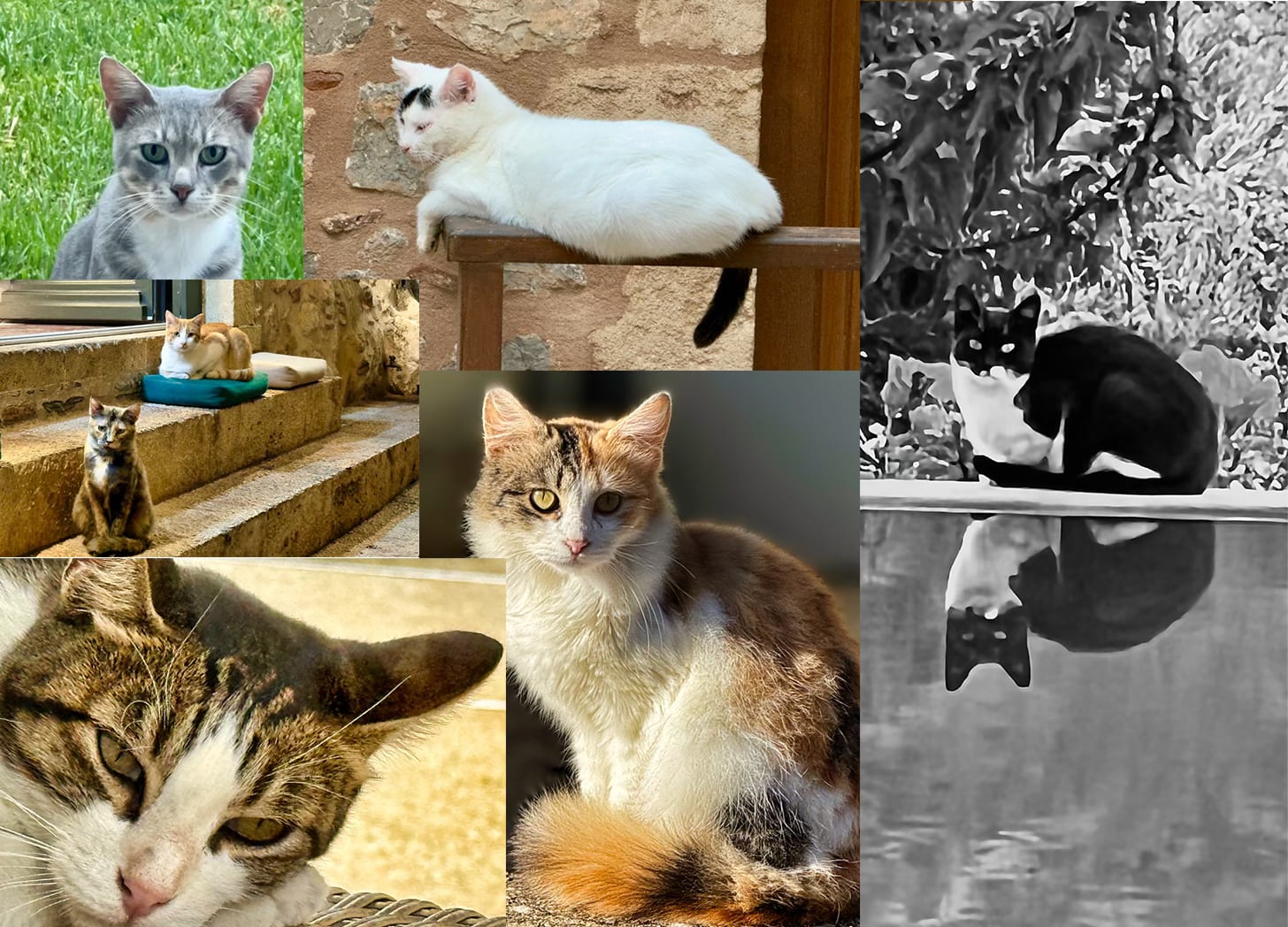
If you’ve ever stepped foot in Greece, you’ve probably noticed something immediately: the country is absolutely overrun by cats. Not in a scary, apocalyptic “they’re taking over” way—more in a “they already took over, and we’re just pretending otherwise” way. Tourists always ask me the same question while petting a cat that is clearly on its fifth lunch of the day: “Why are there so many cats here?”
And the answer is… complicated. Very complicated. So let’s break it down, siga siga, before one of them jumps onto your lap to supervise your reading.
First of all, Greece is the only place in the world where a cat can drape itself across a 2,500-year-old temple and everyone collectively agrees that it belongs there. Archaeologists take photos. Tourists whisper “wow.” Local guides shrug like, “Yes, that is Dionysios, the cat. He works mornings.” These cats don’t sit on fences like normal cats. They sit on civilization. And the strangest part? It makes perfect sense.
Every Greek neighborhood operates an unofficial but extremely efficient Cat Ministry. There’s always the one yiayia who feeds 14 cats at once with clinical precision. The one taverna owner who denies feeding them, while visibly slipping sardines under the table. And the one big, veteran tomcat who has seen some things, survived all of them, and now walks around with the swagger of a retired general collecting his pension. A tourist might call it chaos. Greeks call it community management.
And then there’s the deeper cultural layer: cats behave exactly the way Greeks respect most. Confident. No-nonsense. Slightly dramatic. Entirely self-governed. A Greek cat will walk into a café without hesitation, hop on a chair, and look at the barista like, “The usual, please.” They don’t just act like they own the place, they actually do. They’re basically furry civil servants, except they show up more consistently.
Tourists, for their part, are hopelessly codependent. They arrive in Greece prepared for the Acropolis and leave emotionally attached to a stray cat named Apollo who slept next to their sandals. I’ve seen people Google “adopt Greek street cat” while holding a gelato in one hand and a meowing furball in the other. Meanwhile, Apollo is planning dinner at three other tables and possibly a late-night visit to the fish tavern down the road. Greece is the only country where the cats have a busier social life than the travelers.
Restaurants play a big role too. Forget Michelin stars—Greece has something better: Miaou Stars. If there are five cats lounging outside your taverna, congratulations, you’re in the right place. If there are twelve, you’re in a religious experience. If there are none at all, leave immediately. Something is deeply wrong. Even the cats don’t trust the kitchen.
Cats also control tourism in ways we don’t openly discuss. People say they come for ancient sites, beaches, culture, sunsets… but I’ve seen your Instagram feeds. It’s 85% cats. The Parthenon appears only if a cat is sitting in front of it. Cats are the PR department of Greece; humans are simply the staff. Honestly, the Ministry of Tourism should start paying them, but they would refuse the paycheck and demand fish instead. True story: We’ve been here 18 months. We know the baker. The pharmacist knows our birthdays. We say “siga siga” unironically. And yet… between my wife and me, we’ve snapped 1,322 photos of cats. We’re not tourists anymore, but we are clearly owned by the street felines of Greece.
Another mystery: nobody, not a single person, has ever successfully shooed a Greek cat. You say “Sst!” and the cat interprets that as “Please come sit on my lap” You move your plate away, and the cat moves closer. You close the door, and the cat somehow appears behind you. Greek cats bend reality. They have the same respect for physical boundaries as Greek drivers. Which is to say… none.
So why are cats everywhere in Greece? Because the country is one giant sunbeam with endless snacks. Because Greeks are soft-hearted people who pretend to be tough but cannot resist a small creature staring at them. Because tourists feed them like they’re running a feline international aid program. Because tavernas drop food like confetti. But mostly because cats have unlocked the true Greek lifestyle: eat well, nap often, demand affection only when it suits you, and always look like you know something ancient and important.
In the end, when a cat in Greece looks at you—deep, knowing, slightly judgmental—just remember: he knows where you’re staying, he knows you packed snacks, and he absolutely expects tribute. And he will get it.
If this made you smile, subscribe for free. It feeds the writer’s spirits.
The cats, as you’ve already seen, are more than fine.
Siga, siga
Nick in Kalamata