

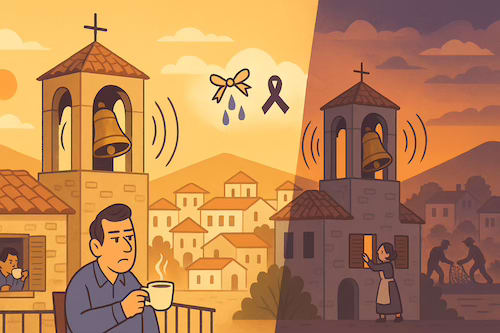
In Greece, church bells don’t just tell time. They announce births, deaths, baptisms, wars — and occasionally remind you that Swiss punctuality never made it this far south.
If you wake up in Kalamata at 7 a.m. to the clang of church bells, it’s not because the priest wants to ruin your sleep. It’s because bells are the traditional loudspeaker of Orthodoxy, calling the faithful to Orthros (morning prayers) or reminding everyone that the day belongs first to God, then to coffee.
Come 6:30 in the evening, the bells toll again for Esperinos (vespers, evening prayers). In older times, these prayers coincided with the end of the day’s work—farmers returning from the fields, fishermen hauling their nets, women finishing chores. The bells told people, “Drop what you’re doing, night is coming, give thanks.” In a way, they were the original “clock-out” siren.
But the bells don’t just mark time—they speak a language. Every rhythm carries a meaning, one instantly understood by villagers:
Funeral bells toll slowly, each strike hanging heavy in the air. You don’t need a death notice. The bell itself whispers: “Someone is gone.”
Baptisms are cheerful, rapid peals—metallic laughter announcing that somewhere a baby is being dunked into cold water while an entire village lines up for baklava.
Weddings? Bells ring fast and celebratory, though often drowned out by car horns, rifle shots, and the cousin who insists on singing a klephtiko ballad with seventeen verses.
Feast days? Bells don’t ring—they erupt. Competing towers clash so loudly the mountains echo, as if the whole sky has been turned into a percussion instrument.
And sometimes, bells ring not for ritual but for survival. They have been the emergency sirens of Greece. During the Ottoman years, they called people to worship in secret, their sound itself an act of resistance. In World War II, bells warned of Nazi advances or summoned villagers to fight.
And then there was July 1974.
Turkey invaded Cyprus, and suddenly the bells of Greece tolled with a sound that froze the marrow. They weren’t festive, they weren’t mournful — they were alarms, metallic and relentless, echoing through villages and cities alike. With every strike, men raced to military centers, mothers wept into their aprons, fathers stood silent with jaws locked and eyes fixed on the horizon.
That day carved itself into my memory. We were fishing with my father and brother on a little boat near our summer house in Nea Makri when the bells began to ring and ring. From the shore, someone shouted: “Turn on the radio! Turn on the radio! We are at war with Turkey!”
The sound filled everything — not just the air, but the chest, the bones, the silence between breaths. Those bells did not summon prayer. They summoned a nation to brace itself.
My father left us with hurried hugs and goodbyes, racing to the military calling center. Hours later he returned, deemed too old to serve. He was 42 at the time. Too old but ready to serve. But the moment had already marked us. The fear, the urgency, the weight of history pressing down — those bells never stopped ringing inside.
That’s the paradox of Greek bells: they are both timeless ritual and living history. They mark the ordinary (morning coffee, evening chores) and the extraordinary (death, birth, marriage, war). They’re woven into the fabric of Greek life in a way clocks and phone alarms can never be.
And yet, despite their gravitas, bells are also wonderfully human. They misfire. They ring late because the priest overslept. They clang wildly in strong winds, like gossipy neighbors who won’t stop talking. Sometimes they toll just because they always have, reminding us that life continues in rhythm, whether or not we’re listening.
Case in point: today in Kalamata, the bells had their own agenda. At 7 a.m., of course, they rang—Sunday, obligatory. At 8 a.m., fine, that’s the regular hourly one. But then: 8:07. Someone must have hit snooze. 8:11, 8:19, 8:23, 8:27, 8:31. At that point you wonder—are they signaling a fire drill, or just keeping the neighborhood guessing?
And then, at 10:02, the grand finale: the unmistakable ringing that can only mean one thing—a baptism. You could practically hear the poor baby being dunked in lukewarm water, with olive oil sliding down his forehead, the bells clanging happily in celebration.
Bells in Greece don’t run on Swiss time. They run on Greek time—which is to say, whenever the sexton wakes up, remembers, or simply feels like it. One day I read a post on Facebook in one of the expat groups. A Brit was complaining about the bells and suggesting that the Greek government regulate them—prohibit churches from ringing early in the morning or after certain hours. You should have seen the comments in response. Let’s just say, suggesting silence in Greece is like asking Italians to ban pasta or Americans to cancel Netflix. In other words: good luck, my friend.
So the next time you’re jolted awake at dawn by their metallic chorus, don’t think of it as noise. Think of it as a reminder: time is passing, life is happening, and your community is still here—praying, grieving, celebrating, enduring.
In Greece, the bells always know before we do.

Discussion
Pull up a chair. Add a memory, a correction, a laugh, or something the story brought to mind.
No comments yet. We have been waiting for you...