

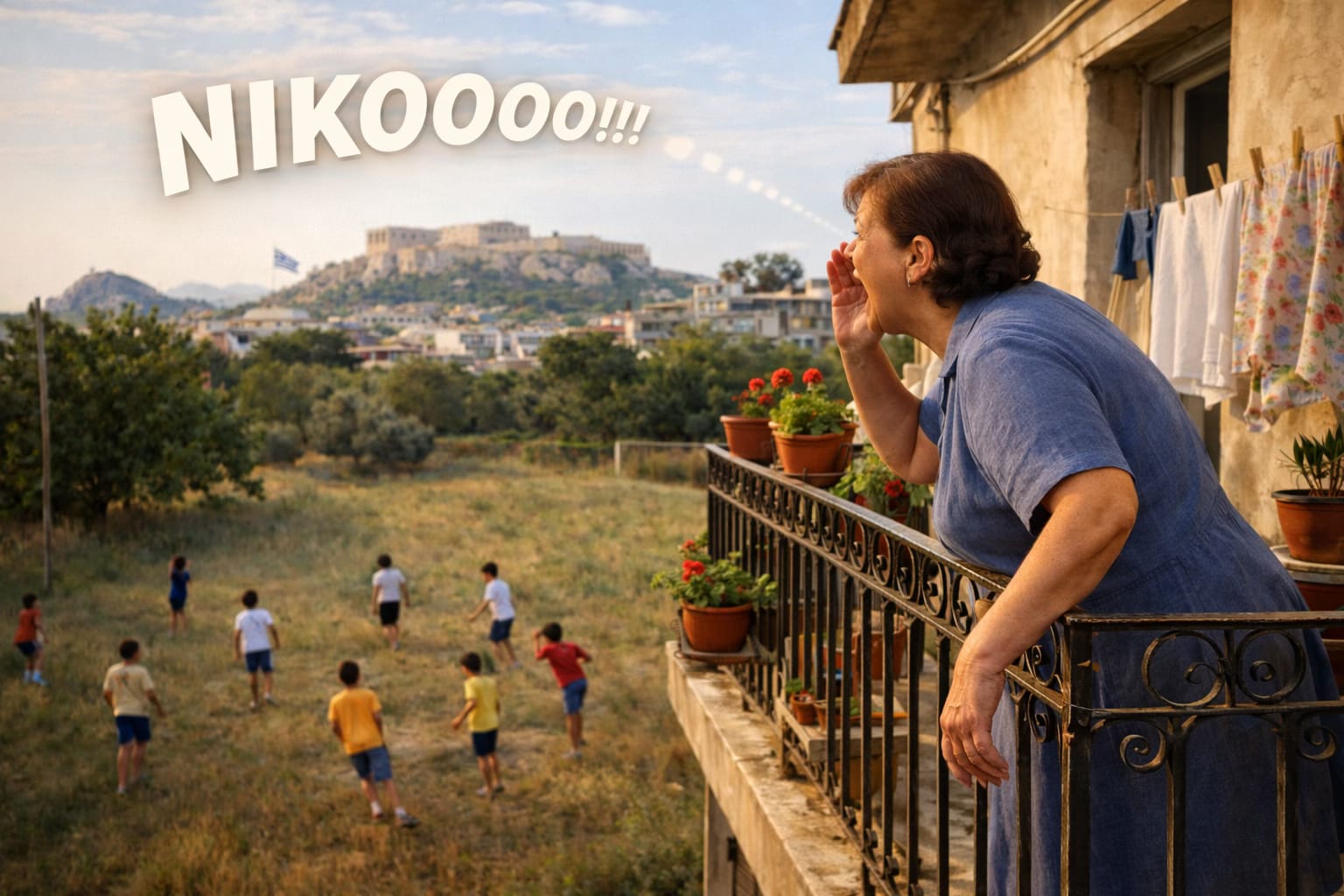
Before mobile phones and WhatsApp, Greek mothers had a perfect system: a powerful set of lungs and no intention of repeating themselves.
Instead of sending messages with enough question marks to suggest a criminal investigation, they leaned over the balcony and called you home.
You could be three streets away — somewhere between the plateía, the periptero, and a football game with no referee, no rules, and no ending. You could be trading stickers, riding your bike like minor injury was part of childhood, arguing about absolutely nothing, or doing what Greek children used to do best: disappearing outside for hours and still being somehow fully traceable by your mother.
And God forbid you came home with scrapes. The injury itself was manageable. Your mother finding out was the real danger.
And then it came.
Your name.
Not spoken. Not called. Released.
“ΝΙΚΟΟΟΟΟΟΟ!!!”
Sent through the neighborhood like a siren, a prayer, and a public warning all at once. And somehow, among 637 children making noise in the street, every single one of us knew exactly whose mother it was like in the movie “The March of the Penguins”.
Which, if you think about it, was an extraordinary system for Greece, where every second boy was named Niko, Yanni, or Giorgos. In America, you call “Brian” and maybe two children glance over. In Greece, you call “Νίκο!” and seventeen boys instinctively reconsider their life choices.
That was the real miracle.
Not that she found you.
That she could locate you without a phone, an app, or modern civilization.
And that she never had to come downstairs.
Greek motherhood in those years operated like state infrastructure. There was no soft reminder. No location sharing. No “just checking in.” No tender little “sweetie, where are you?”
There was only a woman leaning over a wrought-iron balcony in her house dress, one hand on the railing, scanning the street like a field commander.
Depending on the tone, it could mean:
Come upstairs now.
Your food is ready.
Your father is home.
I have already called once.
Do not embarrass me in front of the entire neighborhood.
And of course, that was the other thing.
This was never private.
Your friends heard it.
The neighbor across the street heard it.
The yiayia on the second floor heard it.
The kiosk guy heard it.
The woman hanging laundry heard it.
Half the block heard it.
Possibly people in the next postcode heard it.
Privacy, in Greece, was always a bit theoretical.
The balcony was not just part of the apartment. It was part of the parenting system. A lookout post. A communication tower. A disciplinary platform. Sometimes even a neighborhood control center, where mothers watered plants, shook rugs, exchanged news with the balcony across the street (apenanti balcony), and kept a casual eye on every child within visual range.
From there, they knew everything.
Who came home late.
Who was playing with whom.
Which child had torn his shorts.
Which father had parked badly.
Which aunt had arrived unexpectedly.
Which neighbor was making fasolakia.
And which child was pretending not to hear his name.
And God help you if your mother switched from your nickname to your full name.
That alone could freeze your blood.
Because in every Greek family, your full name was never just your name.
It was a final warning.
The affectionate version still left room for negotiation.
The full version meant negotiations were over.
And if the first call went unanswered, the second came louder, sharper, and now with layers. Not just volume, but memory. Judgment. Family history. Moral disappointment. By the third call, even children from other buildings started feeling they had done something wrong.
What’s funny is that it worked.
Perfectly.
No batteries.
No Wi-Fi.
No chargers.
No low signal.
No unread messages.
No plausible deniability.
When a Greek mother summoned you from the balcony, the message was delivered instantly, publicly, and with consequences.
Honestly, it may have been better technology.
Because today a mother texts, calls, sends a voice note, shares her location, asks for your location, then follows up again ten minutes later. She says “HELOOOOOO????”
Back then, one balcony call did the whole job.
And there was no pretending you hadn’t heard.
You went up.
Maybe that’s why the memory still feels so Greek.
The balconies. The voices. The plants in old tins. The laundry flapping above the street. The sound of somebody’s mother calling somebody home while the light started to fade and the neighborhood slowly folded back into itself for dinner.
You never thought of it as culture at the time.
It was just life.
But now, of course, it feels like one more small thing Greece used to do better than any app ever could.
Did your mother call you from the balcony too — or are there other disappearing neighborhood customs from Greece you still remember?
Tell me. I have a feeling this one will bring back a lot of voices.
Siga, siga 💙
Nick in Kalamata