

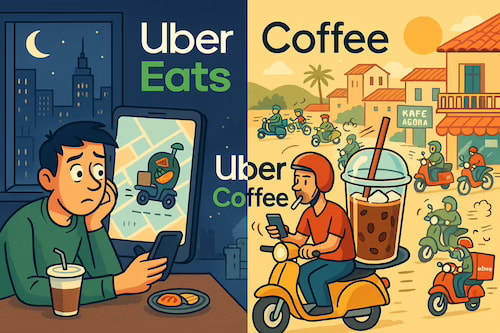
In America, if you don’t feel like cooking, you don’t panic. You don’t even open the fridge to cry at a half-empty jar of mustard and three pickles floating like survivors of a shipwreck. You open an app. Uber Eats, DoorDash, Grubhub, Seamless, Postmates, half the population doesn’t even know which one they’re using anymore. They just click something shiny, and thirty minutes later a stranger arrives with Thai curry, poke bowls, sushi burritos, or vegan tacos stuffed with ingredients no Greek grandmother has ever allowed in her kitchen.
In Manhattan, you can order from a gazillion restaurants without moving more than your thumb. Korean barbecue at 6 PM? Done. Ethiopian at 9 PM? Easy. A triple-shot oat milk matcha latte with turmeric foam at 6 a.m.? Coming right up. In Los Angeles, it’s the same story, though your burger might arrive lukewarm because the driver was stuck on the 405 and stopped to audition for a Netflix pilot on the way.
And the best part? You don’t just order food. You track it like it’s an Olympic event. The app shows you your driver on a tiny map, zigzagging through traffic: “Yes! He’s at 54th Street! No! Why did he stop at CVS?!” It’s suspense, drama, and dinner all in one.
Now let’s talk about Greece. Let’s talk about Kalamata.
Here, delivery culture is not about global cuisines, poke bowls, or turmeric foams. It’s about scooters, an entire army of scooters, buzzing through town like angry bees from dawn until daybreak (and yes, I mean the next morning). Some look professional, with boxy delivery packs advertising WOLT or eFood. Others look… experimental. A kid with one hand on the phone for coordinates on Google maps as there are no street names or numbers, the other hand holding a cigarette, balancing Styrofoam cups of something precious on the seat while narrowly avoiding a roundabout sheep dog. There have been cases where a scooter stopped by our door and casually asked: “Is this where Giannis lives”?
What do they carry? You might think food. Logical, right? Wrong.
The cargo of choice is Greece’s national liquid: coffee.
Freddo espresso, freddo cappuccino, frappé, Greek coffee, double Greek coffee with extra foam. Day, night, midnight, sunrise, it doesn’t matter. If aliens ever invade Greece, their first report back to the mothership will be: “Planet entirely powered by brown liquid delivered by small motorized two wheel contraptions.”
Yes, sometimes there is food, souvlaki, yiayia’s stuffed tomatoes from the local taverna, maybe a pizza at 2 a.m. But nine out of ten deliveries are coffee. Always coffee.
Join the newsletter. It’s like a plate of loukoumades … but digital and free.
Take my sister-in-law’s factory just outside Athens. The management, in a bold act of workplace generosity, installed a super-sleek coffee machine, the kind you see in upscale cafés in Zurich. It makes espressos, cappuccinos, lattes, macchiatos, foamed milk that looks like cloud formations over Olympus. It’s convenient, it’s free, and it’s available to all employees.
Employees, mind you, who are underpaid, or as they say in Greece, paid in psihoula (breadcrumbs).
And yet, every day, you hear the call:
“Delivery!”
“Kosta, did you order this freddo?”
Not one. Not two. The majority. Instead of walking ten meters to make their own cappuccino for free, workers spend a few euros a day from their precious little money they make to have coffee delivered from a barista across town.
Is it laziness? No. It’s cultural DNA. For Greeks, coffee isn’t just caffeine. It’s ritual, identity, status. You cannot compare free factory cappuccino to a freddo cappuccino made by the guy at the café who knows exactly how much foam you like. One is a drink. The other is life.
So yes, Americans get sushi burritos and gluten-free poke bowls delivered to their doorsteps. They track them on apps with military precision, staring at their phones like NASA engineers waiting for a rocket to land.
Greeks? Greeks get their coffee delivered, sometimes while literally standing next to a free coffee machine. No app needed. No map. Just a scooter buzzing through Kalamata at 9 a.m., 3 p.m., or 2 in the morning, carrying two plastic cups of freddo cappuccino like they’re Olympic torches.
Insanity? Maybe. But this is Greece. Here, Uber Eats could change its name to Uber Coffee, and nobody would notice the difference.

Discussion
Pull up a chair. Add a memory, a correction, a laugh, or something the story brought to mind.
No comments yet. We have been waiting for you...