

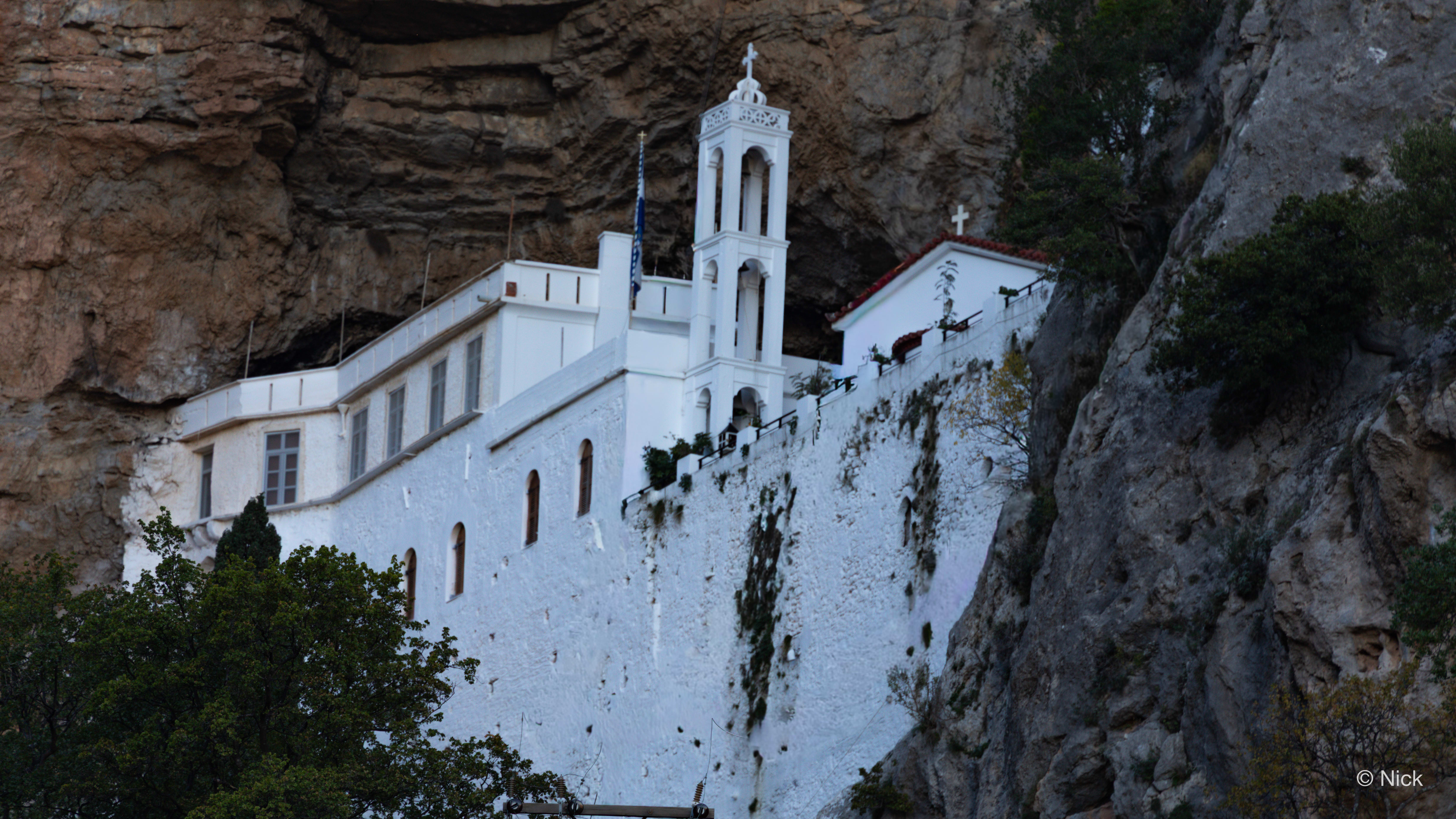
In Greece, even a wrong turn can become a spiritual experience. Sometimes the quiet places find you first.
I never plan to visit Greek monasteries.
They happen to me.
Usually after a wrong turn. Or after Google Maps confidently sends me down a road that slowly transforms into a conversation between my tires and God. A faded sign appears—hand-painted, misspelled, possibly older than electricity—pointing uphill. No distance. No explanation. Just faith.
What amazes me isn’t the number of monasteries Greece has.
It’s how many still exist with nobody officially living in them.
Or anyone officially responsible for them.
And yet… they’re standing.
Swept.
Quietly cared for.
Lit.
Somehow.
Saint Nicholas of Sintza is one of those places. Tucked deep into the mountains, it feels less like a destination and more like a pause in the world. There is one nun there. Sister Lavrentia. She is over ninety years old. She moves slowly, as if time itself has agreed to stop bothering her.
In winter, she relocates to another monastery down the mountain—“on the plains”—taking with her the holy icon of Saint Nicholas, as if even the saints understand seasonal practicality.
The monastery waits.
Patiently.
Like stone knows how.
Iera Moni Dimiovis is similar, though slightly less solitary. Maybe six nuns live there. Maybe fewer. Numbers feel inappropriate in these places. You don’t count people. You count candles. Silence. The echo of footsteps that may or may not be yours.
But the places that stay with me most are the ones where even that has faded.
In Altomira, in Avia, Messinia, there’s the Church of Agios Georgios. No nuns anymore. The last one passed away in 1972. Her bones rest in a simple box inside the chapel. No explanation. No plaque. Just presence.
You won’t find it on Google Maps. Or Apple Maps. Or any map, for that matter. And if you didn’t drop a pin when you stumbled upon it by accident, good luck finding it again.
The church is cared for by a local family now. Not as an assignment. Not as a duty. Simply because someone has to unlock the door. Someone has to sweep. Someone has to make sure this place doesn’t quietly disappear just because no one lives here anymore.
That’s when you start noticing a pattern.
Across Greece, there are monasteries and hermitages carved directly into rock, tucked inside caves, or pressed under overhanging cliffs. Places you don’t arrive at, you discover them.
In Corinthia, Agios Nikolaos Varson hides inside a gorge, half swallowed by stone. The rock forms the walls. Water drips somewhere nearby. You don’t hear much else. It feels less like entering a building and more like being accepted into the mountain.
In Mani, Agios Ioannis Prodromos Kapsas clings to a cliff above the sea. The monastery is built directly into the rock face, as if gravity lost interest halfway through. The stone isn’t decoration. It’s structure. The cliff didn’t host the monastery, it became it.
In Meteora, before ropes and stairs and visitors, monks lived inside holes in the rock. Actual caves. Some still exist, unmarked, scattered across the landscape. You’re walking, you look up, and you realize someone once lived there. Alone. By choice. With nothing but birds and God and an opinion about worldly distractions.
On Andros, small cave chapels appear only if you’re not looking for them. On Nisyros, Panagia Spiliani exists inside a volcanic cave, the chapel literally carved into the island. Faith negotiated directly with geology.
Many of these places are unlocked. Some are not. All of them feel maintained just enough. Not preserved. Not restored. Maintained.
That’s the miracle.
In Greece, when institutions fade, responsibility doesn’t vanish, it quietly transfers. To a family. To a shepherd. To an old nun. To someone who simply knows where the key is.
There’s no announcement when this happens. No handover ceremony. Just an unspoken agreement: This stays.
Standing in these monasteries, I never feel like a tourist. I feel like an interruption. A polite one, hopefully. The stones don’t explain themselves. The icons don’t perform. Nothing is asking for attention.
They’re just still here.
Held together by habit, memory, and the stubborn Greek refusal to let things disappear just because no one is officially assigned to them anymore.
You don’t visit these monasteries.
You stumble into them.
And somehow, they’ve been expecting you.
Some faith survives without crowds.
Without likes.
Without anyone watching.
It doesn’t need attention to be real.
It just keeps going.
If you enjoy stories like this; gentle, strange, and unexpectedly human,
subscribe and come along 💙

Discussion
Pull up a chair. Add a memory, a correction, a laugh, or something the story brought to mind.
No comments yet. We have been waiting for you...