

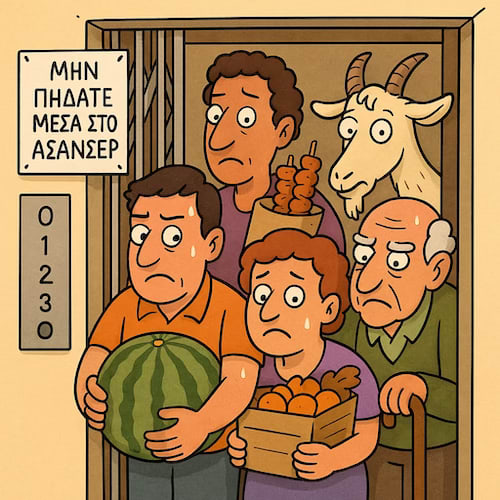
In Greece, even elevators refuse to behave logically, and somehow, that’s part of the charm.
In America, an elevator is a smooth little ride. A polite ding, maybe some background music, and voilà, you’re at your floor. The doors open on cue, nobody makes eye contact, and the experience is immediately forgotten.
In Greece, stepping into an elevator is less “convenience” and more social experiment with moving parts.
First, the size. Most Greek elevators are designed for approximately one human and half a koulouri. Yet somehow, you and three neighbors squeeze in, along with a bag of souvlakia, two crates of oranges from someone’s χωριό (village), and one pappou leaning confidently on his cane.
When the doors close, you’re no longer strangers.
You’re practically engaged.
Then comes the optimism. A third passenger arrives, peeks inside, and confidently announces the magic phrase:
“Χωράμε όλοι.” (horame oloi)
(We all fit.)
You know you don’t fit.
Physics knows you don’t fit.
The elevator definitely knows you don’t fit.
But Greek faith in improvisation always wins.
You shuffle. Someone turns sideways. Someone else holds their breath. Suddenly your nose is pressed against a stranger’s shopping bag that smells suspiciously like goat cheese and oregano. You briefly consider asking where it’s from, then decide this is not the time.
And the signs. Ahhh, the signs.
Every πολυκατοικία (polikatikia) elevator has them, written in bold letters that suggest history.
Μην πηδάτε μέσα στο ασανσέρ (min pidate mesa sto asanser)
(Do not jump inside the elevator.)
Who, exactly, was practicing gymnastics between floors, and how many times before this sign became necessary?
Κλείστε την πόρτα (kliste tin porta)
(Close the door.)
Not a suggestion. A rule.
If you don’t close it, the elevator simply will not move. A leftover from the old days, when elevators had a metal inner gate and then a second door. Miss one, and the elevator refuses to cooperate.
And, of course:
Χαλασμένο (halasmeno)
(Out of order.)
No explanation. No timeline. No apology. Just destiny taped to the door with yellowing tape, edges curling slightly, like it’s aging along with the building. The sign doesn’t say when it broke, why it broke, or if it will ever be fixed. It simply is.
In Greece, χαλασμένο doesn’t necessarily mean broken. It can also mean “being fixed,” “waiting for a cousin,” or “working perfectly fine—just not today.” Sometimes the elevator is truly dead. Other times, it’s operational but offended. You press the button anyway, just in case. Occasionally, it works, proving the sign was more of a mood than a diagnosis.
Subscribe for free. It’s the only button here that actually works.
Now let’s talk about the numbers.
Greek elevators start with 0 for the ground floor. Logical enough—until you realize that the first floor actually becomes the second, and the second floor is really the third.
Let me introduce you to the infamous ημιόροφος (imiorofos), half-floor.
The ημιόροφος is a uniquely Greek invention: a floor that exist physically, but only acknowledges itself if you take the stairs. Elevators glide past it without comment, as if it were an embarrassing family secret. It has doors, offices, sometimes even people waiting inside, but no proper number and no official recognition.
And this is how confusion becomes cardio.
You decide to walk up to a doctor’s office clearly marked “2nd floor” at the entrance. You feel energetic. Responsible. You choose the stairs.
Surprise.
You’ve climbed two.
No doctor.
You hesitate.
Down one… or up one?
You go up.
Your knees are on fire.
You find your doctor.
But now you need another one.
An orthopedist. Not a dentist.
Your math teacher owes you an apology.
And just when you think you’ve understood Greek floor logic, along comes the hospital.
In the U.S., you sometimes see a B for basement. Simple. Reassuring. One letter. One idea.
In Athens, we were visiting a hospital and spent the afternoon moving between the cashier, the X-ray department, and the doctor’s office. My wife finally burst out laughing and asked me to repeat our route.
I said:
First 0. Then -2. Then -1. Then back to 0.
She looked at me like I’d just recited coordinates from a submarine.
And yet, somehow, we arrived everywhere we needed to be. Eventually.
Greek buildings don’t just go up and down.
They negotiate with reality.
And of course, reliability.
In older buildings, the elevator works like a Greek government: three weeks of service, sudden collapse, and then a cousin of the building president appears with duct tape and confidence, declaring it fixed.
During downtime, everyone over sixty takes the stairs effortlessly and reminds you it’s καλό για την υγεία (good for your health). Meanwhile, you’re hauling three watermelons to the fifth floor, stopping twice to rethink your life choices and once to question your loyalty to fresh produce.
But here’s the thing.
A Greek elevator is not just transportation.
It’s a neighborhood confessional.
In the time it takes to reach the third floor, you’ll hear gossip, football analysis, medical updates, and at least one conspiracy theory. By the time the doors open, you don’t just know your neighbors—you know their cholesterol levels, their cousin’s wedding date, and their very strong opinion on whether Kalamata olives are better than Amfissa ones.
So yes, Greek elevators are tiny, unpredictable, numerically confusing, and mildly terrifying.
But without them, how else would we bond?
On the stairs?
Please.
Give me a break.

Discussion
Pull up a chair. Add a memory, a correction, a laugh, or something the story brought to mind.
No comments yet. We have been waiting for you...