

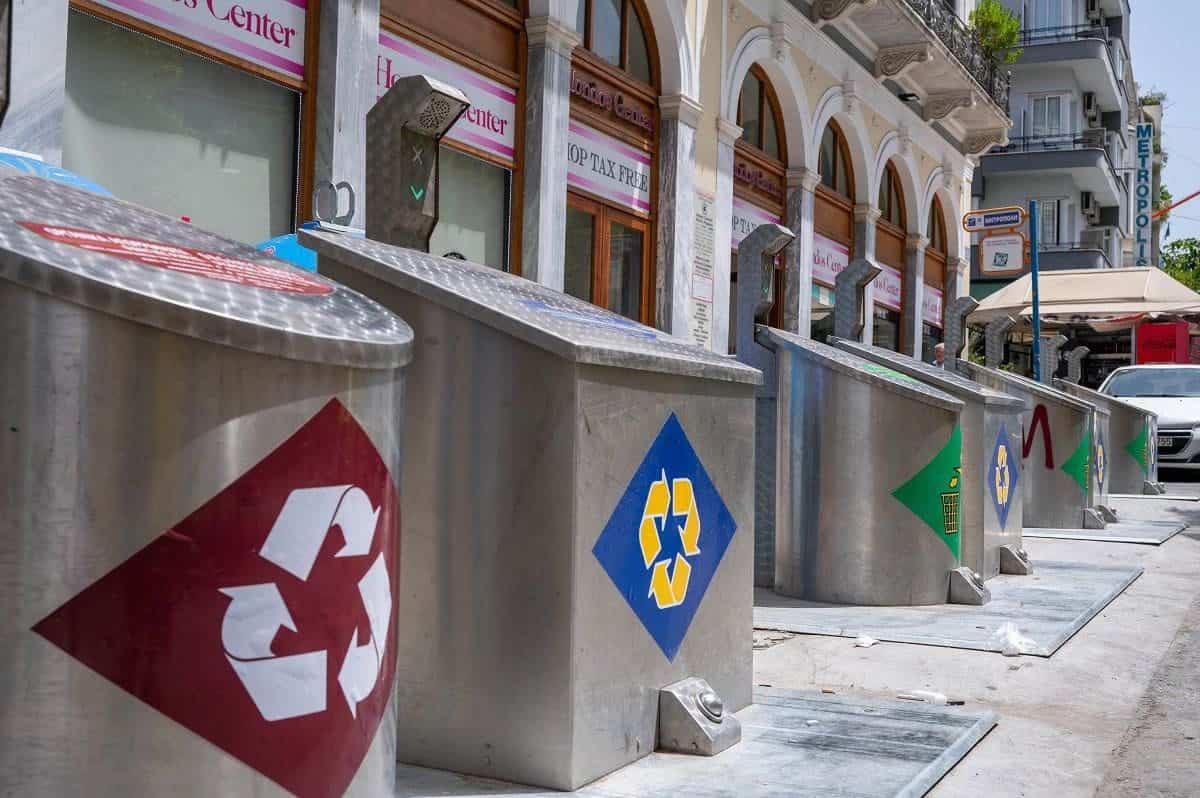
One of the first cultural adjustments you make in Greece isn’t the coffee, the hours, or the fact that nothing starts when it says it will.
It’s the trash.
There is a moment, usually within your first week, when you stand in your kitchen holding a small bag of garbage and realize something unsettling:
There is no bin outside your door.
No wheelie bin.
No neatly labeled container waiting politely for Tuesday morning.
Instead, you are expected to join society.
You tie the bag, step outside, and walk, sometimes half a block, sometimes farther, until you find it: a large green communal garbage bin sitting on the street corner like a civic altar. You lift the lid (with confidence, hesitation, or a deep breath), deposit your offering, and walk away hoping you did everything correctly.
Congratulations. You have just participated in Greek municipal life.
In Greece, communal garbage bins aren’t a backup system. They’re the system. Apartment buildings don’t get individual bins. Neighborhoods share. Streets share. Everyone contributes, and no one asks too many questions.
It’s strangely democratic. The banker, the pensioner, the bar owner, and the guy who definitely hasn’t recycled since 1987 all use the same bin. No labels. No assigned responsibility. No sense that anyone is really “in charge.”
And yet, somehow, it mostly works.
A moment of New York panic
The first time my New Yorker wife saw my mother taking out the trash, she panicked.
My mom was fully dressed, “dressed to kill”, (stin pena), as we say. Hair done. Outfit coordinated. Make-up. High heels. Carrying a small, carefully tied bag of garbage like it was a Chanel purse. She walked out of her apartment building, crossed the street, and gently placed the bag into the communal bin near her building.
My wife froze.
Her mind immediately jumped to Manhattan. To her favorite grandmother, Freda, about the same size as my mom, always impeccably dressed, attempting the same thing on a New York street corner.
High heels. Trash bag. Open curb.
In her imagination, this was not a charming cultural moment.
This was the opening scene of a crime documentary.
She whispered something along the lines of,
“Is she… okay?”
“Is this… allowed?”
“Should we stop her?”
In New York, a well-dressed older woman taking out her own trash would trigger concern, intervention, and possibly a 911 call. Someone would assume something had gone wrong. A system had failed. Help was needed.
In Greece, it meant exactly the opposite.
Nothing had gone wrong.
Everything was working as intended.
Is Greece the only place that does this?
Not at all.
Spain and Italy use similar street bins, especially in dense cities. In Spain, the bins are often sleek and modern, sometimes underground, as if trash were something to be embarrassed about. In Italy, the bins exist but are accompanied by more hand gestures, louder opinions, and occasional existential despair.
France has communal bins too, but usually at the building level, with stricter rules and a quiet sense that someone is watching. Germany and Switzerland also rely on shared bins, but there the system comes with color codes, schedules, instructions, and a low-grade fear of doing it wrong. You don’t take out trash in Germany, you submit paperwork.
Japan technically has communal trash points, but no permanent bins. Trash appears at exactly the right moment and disappears shortly after, like a well-rehearsed magic trick. The sorting rules require discipline, precision, and probably a certification.
The United States, by contrast, prefers individual responsibility. One household, one bin. Miss pickup day and you suffer alone, staring at your garbage like it personally betrayed you.
So yes, communal bins exist elsewhere. But Greece does them with a unique combination of universality, informality, and emotional detachment.
The Greek philosophy of trash
What makes Greece different isn’t the bins themselves. It’s the attitude.
In Greece, the communal bin operates on an unspoken agreement:
- Someone will empty it.
- Eventually.
- Probably.
Overflow doesn’t trigger panic. It triggers adaptation. Bags are placed nearby with optimism. Lids remain symbolic. Odors are acknowledged only indirectly, usually by saying things like, “It’s hot today, eh?”
No one calls the city. No one files a complaint. The system assumes a level of collective tolerance that feels alarming at first—and then, oddly, comforting.
Because the bin isn’t yours.
It’s ours.
Which also means the problem isn’t yours either.
And to be fair, in our lovely city of Kalamata, trash is picked up even on Sundays.
Okay, sometimes Sundays.
Yes, the bins do overflow now and then, but let’s not forget an important civic detail: there are a gazillion cats to feed. Bowls appear. Bags multiply. Responsibility is… distributed.
Πολλά στόματα (many mouths), as we say.
Which, honestly, might be the most accurate explanation for half of Greek public life.
What the trash teaches you
Living with communal bins teaches you small lessons about Greece:
- That public space is shared, for better or worse
- That efficiency is less important than continuity
- That order exists, just not always on your timeline
It also teaches you something about yourself.
You learn to let go.
You learn that not everything needs immediate resolution.
You learn that civilization can continue even if a lid doesn’t close all the way.
And one day, without realizing it, you stop thinking about the bin at all.
You just take out the trash.
Like everyone else.
If this is making you smile, subscribe for free.
We take culture seriously here.
The trash, less so.

Discussion
Pull up a chair. Add a memory, a correction, a laugh, or something the story brought to mind.
No comments yet. We have been waiting for you...