

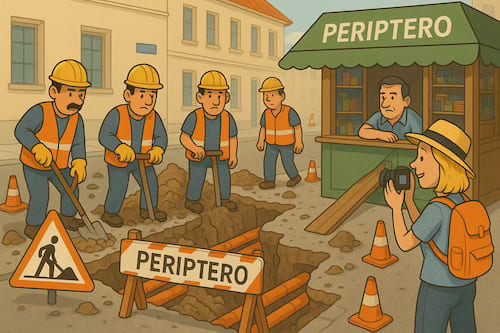
In most countries, public construction has a start date, an end date, and in between… a lot of orange cones.
In Greece, public construction isn’t a project — it’s a lifestyle. Welcome to “ράβε ξήλωνε”: dig, patch, disappear… repeat.
The Greek expression “ράβε ξήλωνε” (rave ksilone) literally means “sew, unravel.”
It describes the kind of situation where no real progress is made — where you keep doing and undoing the same work endlessly.
In English it’s something like: spin your wheels, go nowhere, back to square one, or the ultimate Greek translation: we’re very busy accomplishing absolutely nothing.
And nowhere is this more accurate than public construction in Greece.
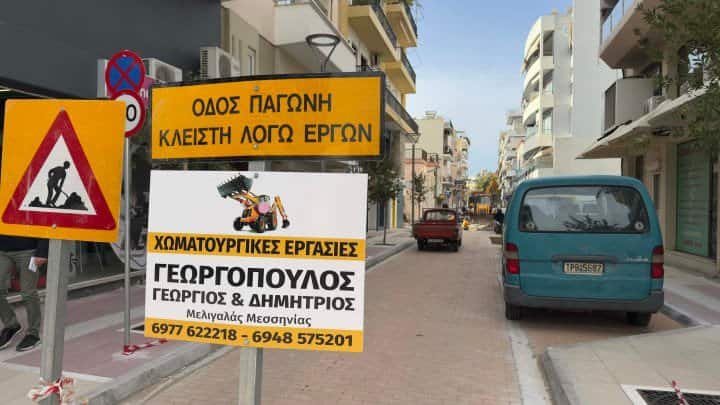
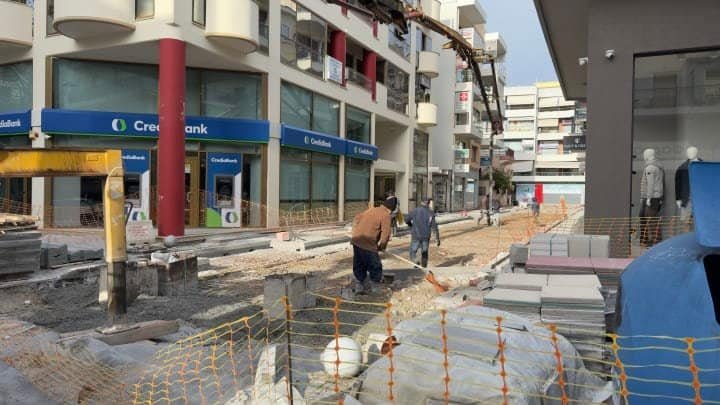
Take any road in Athens, Thessaloniki, Kalamata — you name it. The municipality proudly announces:
“We are modernizing your street.”
Out come the bulldozers.
They dig.
They patch.
They leave.
The tiles are crooked, the asphalt already cracking, but everyone insists it’s fine because it’s temporary.
And that’s when the domino effect begins.
Three weeks later, the electricity company (ΔΕΗ) arrives:
“We forgot to run a cable.”
They dig again.
They leave a trench.
They sprinkle in half a bag of cement like seasoning.
And vanish.
Two months later, the water company (ΕΥΔΑΠ) appears.
“Pipes from 1960? Unacceptable.”
Dig again.
Now the road looks like the Dakar Rally.
Then, just when you think it’s over, the telecom guys (ΟΤΕ) roll in with helmets and confidence:
“Oops. Fiber optic line. Sorry.”
And once more the road becomes an archaeological site — with pedestrians balancing on planks like circus acrobats just to reach the bakery.
At one point, the poor kiosk owner on the corner gave up waiting. Customers couldn’t reach him without risking a twisted ankle, so he built his own little wooden bridge from the sidewalk to his stand.
For three months, people crossed it like they were storming a medieval castle…
just to buy cigarettes and gum.
And then, of course, come the tourists.
They spot the open trench, the workers with shovels, and immediately whisper:
“Look… they’ve found ruins!”
Out come the cameras.
German tourists take photos of PVC water pipes, convinced they’re Roman aqueducts.
An American asks if the site is included in the museum ticket.
The foreman sighs, lights a cigarette, and mutters:
“Yes, madam… ancient cable from the time of Pericles.”
Case in Point: Sometime this past summer…
At 7:50 a.m. sharp, a “crew” arrived outside our house.
One man with a shovel stared at the electricity pole like it had personally insulted him.
Then more workers appeared.
Along with heavy equipment.
Someone climbed a second pole.
And then — click — the power was cut.
Enter the foreman: hero of the hour.
Coffee in one hand, cigarette in the other.
He began shouting at two apartment buildings and three houses:
“Anyone needs to leave? Move your cars now! The road is closing for an hour!”
Instant chaos.
Neighbors scrambled to rescue their cars, squeezing them through the narrow lane like contestants on a game show.
Our house alarm started wailing…
then slowly died when the backup batteries gave up.
“Will we get electricity back?” my wife asked.
“Of course,” I said.
“When?”
I shrugged. “That’s part of the surprise.”
Eventually, the municipality returns, proudly declaring:
“We will finish it properly this time.”
The cement dries for about three hours before another crew shows up with a jackhammer.
This is ράβε ξήλωνε in action.
A national art form.
Public works that look busy, sound expensive, and somehow manage to go nowhere.
If this were a Netflix show, the episodes would go like this:
Season 1: The Municipality Digs
Season 2: The Power Company Strikes Back
Season 3: Revenge of the Water Pipes
Season 4: The Fiber Awakens
Season 5: Return of the Jackhammer
Locals don’t ask, “When will it be finished?” anymore.
They ask:
“Which episode are we in?”
In Greece, public construction is like the weather.
Everyone talks about it, nobody controls it, and if you don’t like it…
just wait — it’ll change tomorrow when someone digs again.
Ράβε ξήλωνε isn’t just an expression.
It’s public policy.
If this made you laugh (or relive trauma), hit Subscribe. New stories arrive… on schedule (unlike Greek construction crews).

Discussion
Pull up a chair. Add a memory, a correction, a laugh, or something the story brought to mind.
No comments yet. We have been waiting for you...