

There’s a moment every Greek has.
You’re somewhere in Greece.
Conversation is flowing. You’re confident. You are Greek, after all.
And then someone says a word…
…and your brain just quietly logs out.
I had that moment recently.
Not with tourists. Not with foreigners.
With Greeks.
They said a word.
I nodded.
They said it again.
I nodded again… but this time with a slightly more philosophical expression. Like I was processing something deep.
I was not.
I was buffering.
Here’s the thing no one tells you:
Greece doesn’t have a language.
It has… versions.
Same Greek. Different universe.
As Athenians, we grow up believing we speak the “correct” version, the “normal” Greek.
Clean. Standard. Ministry-approved Greek.
Then one word from a village, an island, or a grandmother somewhere in the mountains…
…and suddenly we’re foreigners in our own country.
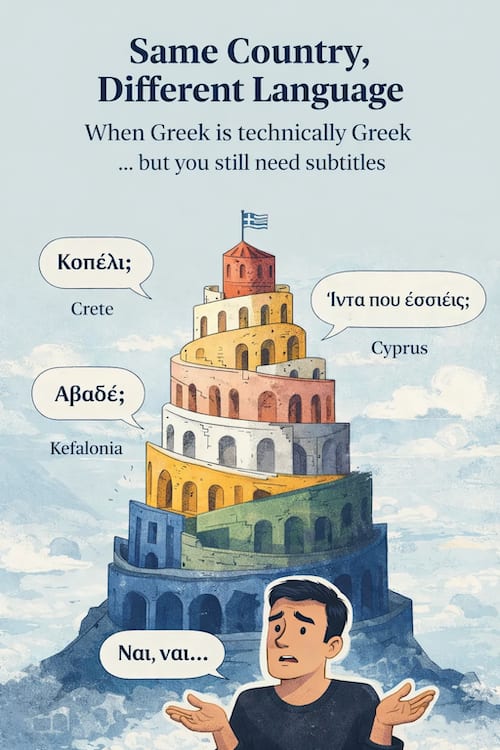
You go to Crete… and suddenly Greek becomes a contact sport.
Someone hits you with:
“Ίντα κάνεις;” (inda kanis)
And you freeze.
Because it sounds familiar… but also slightly illegal.
(It’s just: “How are you?” / “What are you doing?”)
Then:
“Το κοπέλι” (to kopeli)
Which sounds like a historical reference…
…but it just means: “the girl.”
Then Epirus.
Slower. Heavier. Like every word has walked uphill before reaching your ears.
Beautiful… but by the time the sentence ends, you’ve forgotten how it started.
Then Kefalonia quietly humbles you
You think you’ve adapted.
You survived Crete.
You’re ready.
Then Kefalonitika shows up… smiling.
And suddenly you’re hearing words like:
Αβαδέ (Avade)= ραντεβού (meeting)
Αβέρτα (Averta)= ελεύθερα, ανοιχτά (freely)
Μοντέζος (Montezos)= μπαλκόνι (balcony)
Μοργάρω (Morgaro)= αργοπορώ (to be late)
(there is a whole dictionary. I just picked few examples from A and M as teasers)1
And now it’s not even about understanding anymore.
It’s about accepting that somewhere in Greece… there’s a parallel dictionary you were never given.
And just when your confidence returns…
Cyprus.
“Ίντα που έσσιεις;” (inta pou essieis?)
Meaning: How are you? / What do you have?.
Now we’ve escalated.
Because this is no longer a variation.
This is a full system upgrade.
You catch maybe 37.3% of it…
and that’s on a good day.
The Greek survival instinct
Here’s what we do when we don’t understand:
We don’t say “What?”
Of course not.
We are Greeks.
We say:
“Ναι, ναι…” (Yes, yes…)
with a slight head tilt
—a universal signal that means:
“I have absolutely no idea what you just said, but I support you emotionally.”
The dangerous moment
The real danger is not the word you don’t understand.
It’s when they expect a response.
Now you’re trapped.
Because the possibilities are endless:
They asked you a question
They told you a story
They invited you somewhere
You just agreed to help them move a refrigerator
You don’t know.
You can’t know.
But it’s already too late.
You’ve nodded.
And yet…
That’s the magic.
Every region adds something.
A word, a rhythm, a way of saying things that carries history with it.
It’s not confusion.
It’s texture.
But still…
Next time someone says something you don’t understand…
Just remember the rule:
Smile. Nod. Say “Ναι, ναι…”
…and pray it wasn’t a question.
What’s the Greek word that made you completely freeze mid-conversation?
Drop it below 👇
(or the one you still pretend you understand)
Siga, siga 💙
Nick in Kalamata
Kefalonia Idioms: https://myfiscardo.gr/kefalonianwords.html