

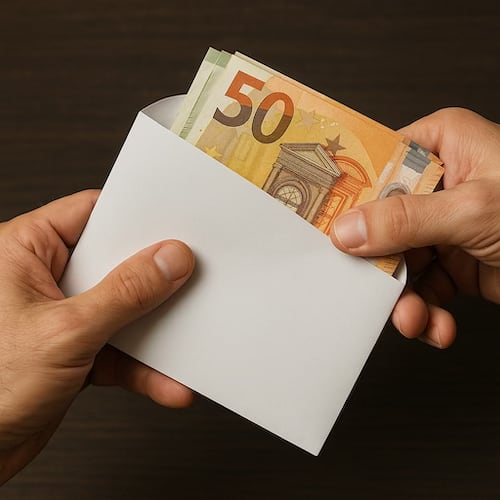
If you have lived in Greece long enough, you have heard of the “fakelaki” (little envelope). If you have really lived in Greece, you have probably delivered one. And if you have not, you have certainly been delayed because you didn’t.
I have written about baksisi before. Baksisi and fakelaki may sound similar, but they represent two very different practices in Greek life. Baksisi comes from the Ottoman Turkish word for gift and has survived in Greek as the word for tip. It is the small extra given to a waiter, a porter, or a delivery man as a gesture of thanks. It is not hidden, not illegal, and often expected. In earlier generations, baksisi was also a sign of generosity and social standing. To give freely was to appear respectable. Even today the word survives in everyday settings. At weddings, people speak of “ρίξε το μπαξίσι” when money is tossed to the musicians, and in tavernas a few coins left on the table may still carry that name.
Fakelaki is something altogether different. The word means little envelope and it refers to exactly that: a discreet packet of cash passed to a doctor, an official, or a bureaucrat. Its purpose is not to thank but to secure a favor, to speed up a process, or to guarantee special treatment. It is always under the table and larger in scale. The difference lies in intention. Baksisi is a cultural tip, part of the social fabric, a visible and accepted way of showing appreciation. Fakelaki is a bribe, part of the shadow economy, a hidden way of bending rules. Both words carry centuries of history, but one belongs in the open light and the other survives in the shadows.
The other day I posted a poll on Facebook about the price I paid without insurance for a minor surgery on my pinky finger. The guesses came in fast and furious. One person said one thousand. Another said one hundred. A third went all the way up to three thousand. But quite a few skipped the numbers entirely and asked the only question that really mattered in Greece: “And how much was the fakelaki?”
It has been Greece’s most infamous envelope, a humble paper sleeve carrying untraceable banknotes and a nation’s guilty conscience.
The health system gave the fakelaki its stage. Imagine waiting months for your surgery only to be told that there are no available slots. A neighbor leans over and whispers, “Don’t worry. Just bring a fakelaki.” You show up at the hospital with the envelope tucked discreetly among your X-rays. The doctor performs a sleight of hand worthy of a magician. One moment it is in your hand, the next it has vanished into a drawer. Suddenly your surgery is scheduled for Tuesday at nine in the morning. Was this a bribe or was it simply excellent service? Greeks still debate this over coffee.
Doctors did not have a monopoly. Fakelakia also smoothed the way through tax offices, municipal planning departments, and every ministry that invented a new χαρτόσημο (stamp). If your papers were lost, a fakelaki helped them resurface. If a building permit had been resting comfortably at the bottom of a drawer since 1993, a fakelaki could bring it to life faster than Saint Nicholas himself. Think of it as skipping the line, hurried across like a disabled passenger, only instead of an airport attendant it was someone in a suit, cigarette dangling from his lips, guiding your paperwork to the front.
In all cases, the ritual followed a familiar choreography. The giver slid the envelope forward as if it were simply another form. The receiver, with tragic modesty, murmured “Oh, you shouldn’t have.” Both pretended this had nothing to do with money but everything to do with respect, honor, and perhaps a small down payment on divine intervention.
The fakelaki became a symbol of what outsiders often call “Greek corruption.” Report after report from the EU, Transparency International, or angry economists points to it as proof that Greece is impossible to reform. But inside Greece, it has always been more complicated. Sometimes it felt like survival. When the system moved at glacial speed, or not at all, your little envelope sometimes made the difference between life and death.
Today the fakelaki is said to be in retreat. Electronic payments, digital portals, and mobile apps promise transparency. European Union reports cheer every time a new online service appears. The younger generation rolls its eyes at old stories of doctors conveniently “forgetting their glasses” until the envelope appeared. Yet if you ask around the kafeneio, you will still hear someone say, “Of course fakelaki still exists. It is just wireless now. You send it with Revolut.”
So, fakelaki or baksisi? Make sure you download Revolut before you decide.
Siga-siga,
Nick the Greek (nobody would dare say my last name in America)

Discussion
Pull up a chair. Add a memory, a correction, a laugh, or something the story brought to mind.
No comments yet. We have been waiting for you...