

If you’ve lived in Greece long enough, you eventually accept a universal truth:
Most conversations here are conducted in… eyebrow and head movements.
Sure, we have words. Beautiful ones. Ancient ones. Poetic ones. Literal ones.
But we also have a magical subset of Greek words that mean ten thousand different things, and only a wrist flick, head tilt, or eyebrow angle can tell you which one.
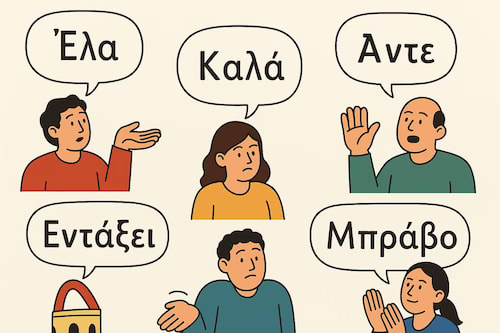
Here are five Greek words that simply cannot be translated without a live demonstration in front of a mirror.
Έλα (Ela)
Literal: Come.
Actual meaning: Anything from “come here immediately” to “are you out of your mind?”
Ela (“Έλα”) is the Swiss Army Knife of Greek expressions.
It can summon you, dismiss you, tease you, console you, flirt with you, or tell you that you’ve said something so stupid that we must now reboot the conversation.
Examples:
Ela re si (Έλα ρε συ) → “Seriously?”
Ela, ela (Έλα, έλα!) → “Hurry up!”
Elaaaa… (Έλαααα…) (with long vowels) → “Stop talking before I lose it.”
The meaning lives entirely in the wrist rotation.
Καλά (Kala)
Literal: Good, fine.
Actual meaning: A polite “okay,” a sarcastic “okay,” or a catastrophic “okay.”
Kala (“Καλά”) is what Greeks say when they need a single word to express:
approval
shock
disbelief
passive-aggressive judgment
emotional exhaustion
“I’m done with you for today”
and cynicism
Delivered with a raised eyebrow, it means “Try me. I dare you.”
Άντε (Ante)
Literal: Go on / Come on.
Actual meaning: Hurry up, get lost, or please stop being a disaster.
Ante (“Άντε”) is basically the Greek emotional traffic light.
Depending on the tone, it can mean: “Move!”, “Don’t you move!”, “I’m encouraging you!”, “I’m threatening you!”, or “I’m too tired to use a full sentence.”
When said with an upward hand flick?
90% chance it means “Enough!”
When said with a laugh?
Party time.
Εντάξει (Entaksi)
Literal: Okay.
Actual meaning: Nothing is okay, but we’re pretending it is.
Entaksi (“Εντάξει”) covers an entire spectrum from genuine acceptance to cold, dignified fury.
Listen carefully:
Soft entaksi (εντάξει) → “Alright, let’s do it.”
Sharp, clipped NTAKSI (ΝΤΑΞΕΙ); → “Say one more word and I will disown you.”
This is the national word for polite emotional suppression.
Μπράβο (Bravo)
Literal: Good job.
Actual meaning: Good job OR the exact opposite.
Bravo (“Μπράβο”) is the Greek mood ring.
You’ll know if it’s real or sarcastic based on volume:
Whispered bravo (μπράβο) → sincere pride.
Shouted BRAVO!! → “You have just achieved Olympic-level stupidity.”
One word. Two worlds.
Why does this happen?
Because Greek is not just a language.
It’s a performance art.
We communicate with our whole bodies: hands, eyebrows, shoulders, fingers, and occasionally baked goods.
These words are simply the soundtrack to the live show.
For years, both my Miami-born younger son and my New York wife were convinced I was a passive-aggressive person. They’d read my “Καλά…” as judgment, my “Έλα…” as annoyance, and my silences as weaponized Balkan tension. My Greek tone, gestures, eyebrow gymnastics, and strategic pauses looked like a toxic communication style handed down through generations the same way other families pass down heirloom silver.
Then we moved to Greece.
And suddenly the mystery unraveled faster than Greek bureaucracy on a coffee break.
She walked into a bakery and heard the lady behind the counter use my exact tone. Same eyebrow. Same pause. Same dramatic exhale. She saw two old men arguing at the kafeneio with what she assumed was nuclear-level hostility, only to discover they were discussing the weather. She watched a pharmacist explain ibuprofen dosage while sounding like he was breaking up with her. And the final confirmation came when she saw a barista slam down a freddo cappuccino and say “Εντάξει;” in a tone that could either mean “enjoy” or “prepare your will.”
That’s when she looked at me and said,
“You’re not passive-aggressive. You’re just… Greek.”
And honestly?
That might be the most accurate personality assessment I’ve ever received.
Your Turn
Which Greek word in your family carried thirteen meanings and one threat?
Comment below, I want to hear them.
P.S.
If this made you smile, subscribe to “My Big Fat Funny Life” for free.
It keeps my eyebrows in top comedic shape.

Discussion
Pull up a chair. Add a memory, a correction, a laugh, or something the story brought to mind.
No comments yet. We have been waiting for you...