

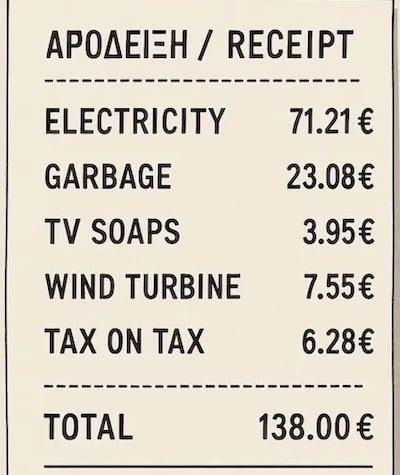
Ah, the Greek electricity bill. To the untrained eye, it looks less like a household invoice and more like a riddle composed by bureaucrats after too much coffee. Tourists renting a summer home in Greece open the envelope expecting to see a simple number: how much electricity was used, multiplied by how much it costs. Instead, they discover a cryptic novella full of acronyms, percentages, and mysterious fees that appear to have very little to do with keeping the lights on.
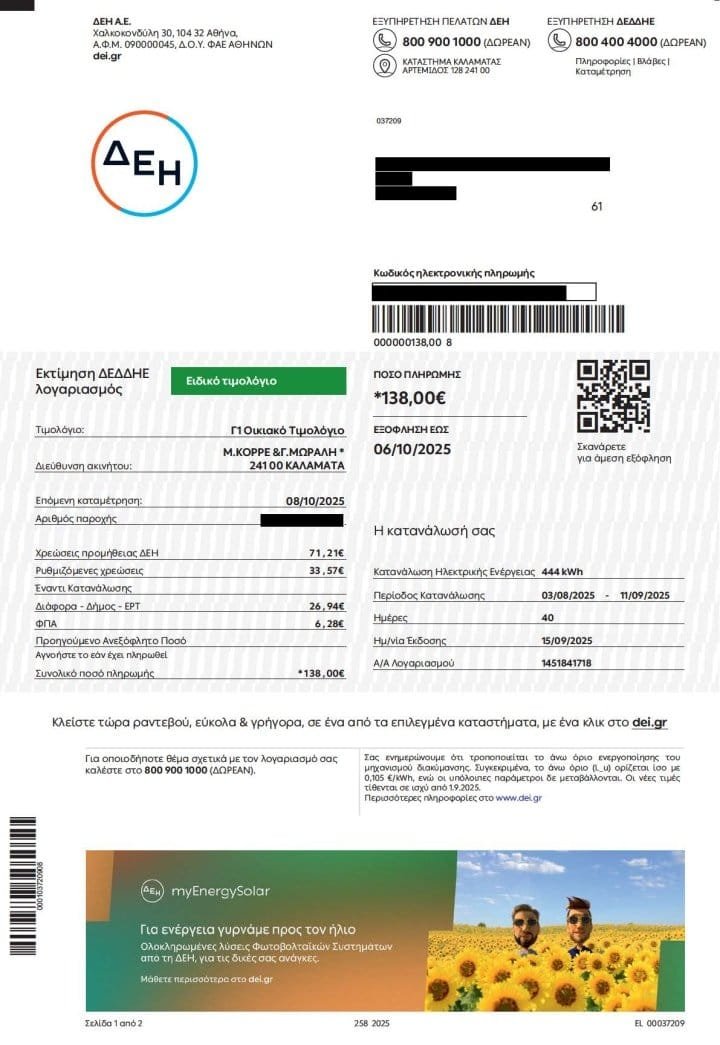
Let’s take our latest bill and try to decipher. By the way, we have Γ1/Γ1Ν Οικιακο Τιμολογιο (G1/G1N household invoice)1 and “special pricing” (ειδικό τιμολόγιο)—whatever that means.
First, we notice that only part of the bill has to do with the actual electricity we used. That’s the Supply Charges. Everything else falls under the umbrella of Regulated Charges or Third-Party Charges—fees that are the same no matter who our supplier is. These are not optional. They are the toll booths, the hidden service charges, the “cover” at the nightclub of Greek energy.
Supply Charges – The Part We Actually Used
This is the electricity itself—the “juice” that powered our air conditioning (“Your Wife Is Hot” as the billboard on I-95 close to Ft. Lauderdale says), boiled your spaghetti water, and kept your Wi-Fi running.
- Our consumption: 444 kWh over 40 days.
- Our supply charges: 71.21 € (about 52% of our total bill).
It’s broken down into:
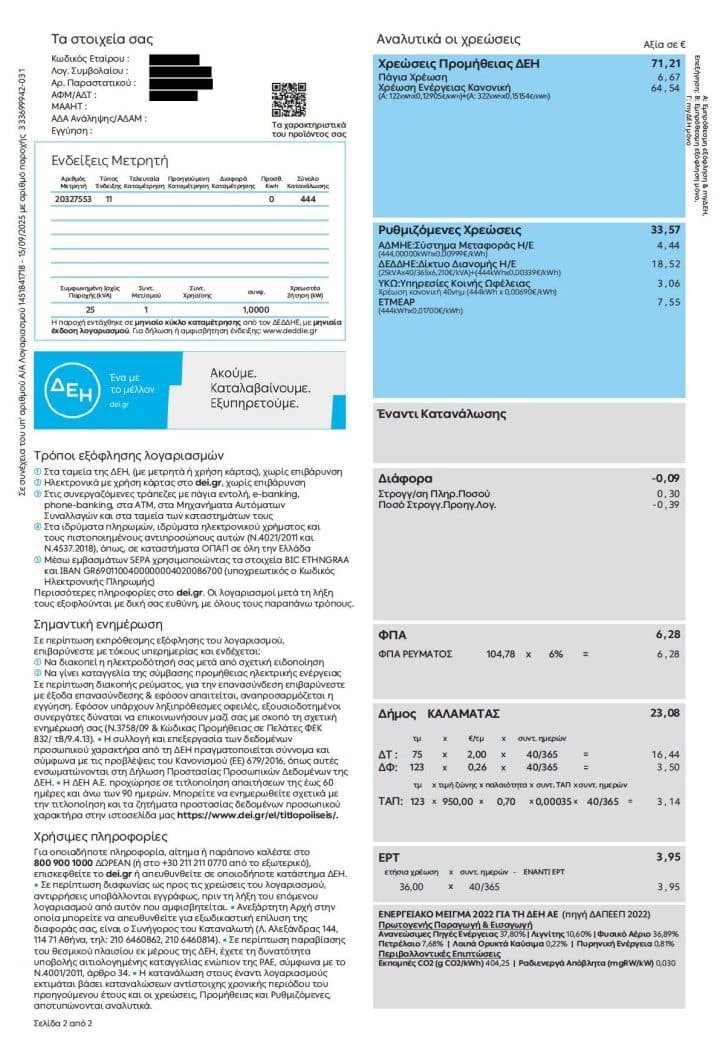
- Fixed Charge: 6.67 € just for having a connection.
- Consumption: 64.54 € based on two different rates (0.15154 €/kWh for one block of energy, 0.12905 €/kWh for another).
Result: 71.21 €. Not too bad. Except this is just the beginning.
Regulated Charges – The Tolls on the Electrical Highway
These charges keep the national grid alive and humming, whether we use a lot of power or not.
- ADMHE (ΑΔΜΗΕ): 4.44 € – runs the high-voltage highways that carry electricity across Greece. A toll for every electron that traveled to our sockets.
- DEDHEE (ΔΕΔΔΗΕ): 18.52 € – maintains the neighborhood poles, wires, and meters. Includes a hefty fixed fee based on our contracted power. If your villa once powered an olive press, you might still be paying for it and you don’t know it.
- YKO (ΥΚΩ): 3.06 € – subsidizes power for remote islands and social tariffs. Every espresso we brew in Kalamata helps a fisherman’s fridge run in Kastellorizo.
- ETMEAR (ΕΤΜΕΑΡ): 7.55 € – our contribution to renewable energy. Every air-conditioned nap supports a wind turbine spinning in the Cyclades.
By the time we add these up, nearly a quarter of our bill is gone—and we haven’t even reached the fun part.
Third-Party Charges – The Neighborhood Fundraiser
Now the bill takes a surreal turn. DEH acts as tax collector for everyone from our mayor to the TV station.
- Municipality (ΔΤ, ΔΦ, ΤΑΠ) – This is where things get properly Greek. Our property’s square meters (in our case 123 m²) are multiplied by coefficients that sound like something from a physics exam. ΔΤ are municipal cleaning and lighting fees. ΔΦ is a municipal tax. ΤΑΠ is a property tax linked to the zone price of the neighborhood, the age of the building, and a mysterious coefficient that feels like a secret handshake between mayors. The logic is simple: if you have floors, windows, and walls—you will pay.
- ERT (ΕΡΤ): 3.95 € – Greece’s public broadcaster. Even if you don’t own a TV, you help fund Greek soap operas and Nana Mouskouri reruns. Every household pays 3 € per month; our 40-day bill works out to 3.95 €.
- Excise Tax & Special Fee 5‰: tiny state taxes on top of your consumption, because bureaucracy loves layers—like baklava.
- Miscellaneous & Rounding: Greece is thorough. Fractions of a cent are carried over bill to bill, with “corrective entries” sprinkled in for good measure.
And finally, ΦΠΑ (VAT) at 6%. But not on everything—only on supply charges, regulated charges, and excise tax. Not on municipal fees or ERT. Because taxing your TV tax would be excessive.
On this bill: 104.78 € × 6% = 6.28 €.
At the bottom, after wrestling through acronyms, coefficients, and decimals, you find the total: 138 €. And this where it went:
- To DEH (for the actual electricity you used).
- To ADMHE & DEDHEE (the grid managers).
- To YKO & ETMEAR (island solidarity and renewables).
- To your municipality (garbage, lights, property tax).
- To ERT (public broadcasting).
- To the state (excise taxes).
- And finally, to the EU’s favorite—VAT.
We may have consumed electricity worth 71 €, but you’re billed like a small hotel with staff and a radio station. The Greek electricity bill is not a receipt, it’s a crash course in public finance, disguised in kWh. Congratulations: you’ve earned your honorary PhD in Physics, Mathematics, and Philosophy.
So next time a tourist complains that their villa’s bill is astronomical, you can smile and say: “Don’t worry, you just paid for public TV, garbage collection, wind turbines, and probably a lightbulb in Kastellorizo. It’s all part of the experience. Welcome to Greece.”
Siga-siga,
Nick the Greek (nobody would dare say my last name in America)
There’s a mysterious formula in fine print involving sinφ (the power factor). Don’t panic. Unless you’re running an industrial cheese factory out of your rental, the system assumes sinφ = 1. Which is bureaucratic math-speak for: “Don’t worry, we made it up for you.”

Discussion
Pull up a chair. Add a memory, a correction, a laugh, or something the story brought to mind.
No comments yet. We have been waiting for you...