

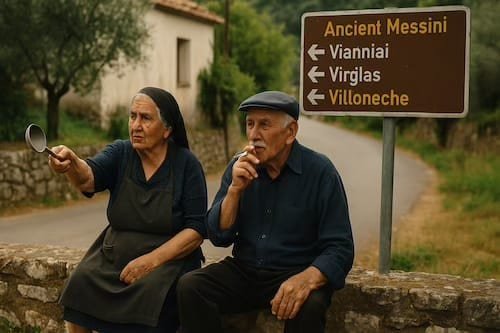
In Greece, distances weren’t measured in kilometers but in cigarettes—and directions came with gossip.
Before Google Maps, before Apple told us to “turn left in 100 meters,” there was a simpler, smokier system of navigation, one powered by Karellaki afiltro (Greek cigarette brand without filter), memories, and motherly certainty. The original Greek GPS: Yiayia (Grandmother) and Pappou (Grandfather).
Back in the day, distances in Greece weren’t measured in kilometers or minutes. They were measured in cigarettes.
“How far is the next village?” you’d ask.
Pappou would squint into the horizon, take a thoughtful drag, and reply:
“Δύο τσιγάρα δρόμος.” (About two cigarettes away.)
That was the standard unit of measurement, a universally understood metric that required no batteries, no Wi-Fi, and absolutely no updates.
The trouble, of course, was that it wasn’t an exact science. A “two-cigarette” drive could mean ten minutes, or half an hour, depending on the quality of the tobacco, the sharpness of the bends, and whether you got stuck behind a tractor hauling hay, goats, or both. And if it was a hand-rolled cigarette, well, then you were in for the long haul.
Yiayia, meanwhile, ran her own analog navigation network. She didn’t need GPS, she had an internal compass powered by gossip, intuition, and the collective brainpower of every other yiayia in a five-kilometer radius.
“Πού πας παιδάκι μου;” (Where are you going, my child?) she’d ask from her front porch, apron dusted with flour.
“Στην εκκλησία της Παναγίας.” (To the church of the Panagia.)
“Όχι έτσι!” (Not that way!) she’d shout, waving her ladle like a wand. “Από εκεί να πας, έχει σκιά.” (Go that way, there’s shade.)
And somehow, without fail, that route would always get you there faster, cooler, and happier. She didn’t just navigate roads, she navigated life.
To this day, in many villages, the Yiayia-Pappou GPS still operates flawlessly. As you drive through the countryside, you’ll find them sitting on low stone walls, watching the world go by with the quiet confidence of people who already know where everyone’s going.
Yesterday, in fact, I experienced a textbook example.
We were driving to Ancient Messini with a friend visiting from the U.S. of A, land of confident GPS and timid goats. I wanted to show her one of the old gates, and when we got there, I spotted a brown road sign, the kind that always hints at ruins, history, or at least an excellent photo opportunity. The sign pointed to three villages, one with that mysterious brown tag. So off we went.
Except… we never found the village.
We did, however, find couple other lovely ones, you know, the kind with an imposing church, one kafenio, two cats, and an elderly man staring at you like you just drove through his living room. Google Maps was having a nervous breakdown, recalculating every 15 seconds. No yiayia in sight.
We circled back to our original spot, where Google insisted we were “somewhere between confused and fictional.” A kilometer later, that supposed mistake turned into something magical: a stretch of the 9.5-kilometer wall that once surrounded Ancient Messini. We pulled over, got out, and started exploring the stones that had seen two millennia of lost travelers far more impressive than us.
And then, as if summoned by the gods of navigation themselves, there she was.
A yiayia!
Apron, kerchief, sandals, the whole uniform. She approached us, squinted like she’d been expecting this exact moment, and said the standard opening line appropriate for poor little lost children: “Πού πάτε παιδάκια μου;” (Where are you going, my children?)
We told her we were looking for ancient Malthi. She nodded knowingly, took a beat, and with the gravitas of Apollo himself, declared:
“Λαθος. Απο την αλλη μερια να πατε.” (Wrong. Go the opposite way.)
And then, as if that wasn’t enough, we got the Yiayia Deluxe Edition of directions, the one that comes with a full social update.
A full rundown of who’s who of the other parea (company) that was inspecting the old wall nearby. “That guy,” she said, “is from Trikorfo, you know, the nearby village. He left when he was nine with his family to go to Australia. That’s his wife,” she pointed, “and the other lady is his sister-in-law. Those are their kids. One has been recently engaged with that “Asian” woman. Yesterday they were in Kalamata. They came for vacation…”
By the time she was done, we knew their names, migration histories, and emotional status better than their own relatives in Melbourne.
When you ask for directions, be prepared to receive not only the route but a slice of community history. “Go left at the cypress tree where you will see the remains of Kostas’ car flipped that now serves as a chicken coop. Pass the field that used to belong to Panagiota’s cousin before she married that butcher from Kalamata. If you reach the donkey with the limp, you’ve gone too far.”
Turn-by-turn instructions, Greek edition.
Meanwhile, Google might still be spinning, insisting you “make a U-turn when possible.” Apple Maps will probably lead you straight into an olive grove, but that’s fine, because Pappou’s sitting there anyway, pruning his trees and ready to wave you back onto the road with the authority of a retired general.
You see, the modern apps can only calculate routes. But Yiayia and Pappou, they calculate you. They size you up instantly: where you’re from, who your parents are, and how lost you really look. Within seconds, they’ve shared your coordinates telepathically with every café and mini-market in the region.
So by the time you reach your destination, someone will be waiting with a freddo cappuchino and a “we heard you were coming.”
You can’t get that from Siri.
In Greece, navigation isn’t about precision. It’s about presence. It’s about slowing down, trusting local wisdom, and remembering that sometimes the best detours are the ones that lead you to a chapel built under a rock you didn’t even know existed.
And when you finally get there, wherever “there” ends up being, you’ll know she was right. Because in Greece, every road leads to somewhere worth getting to, even if you are totally lost.
If this made you smile, subscribe for free.
It helps keep one mildly confused Greek writer properly caffeinated.
Siga, siga 💙
Nick in Kalamata
Footnotes:
¹ Two-cigarette distance: Standard rural Greek unit of measurement equal to roughly 4 km, depending on tobacco humidity and gossip intensity.
² Yiayia Network: Ancient social mapping system connecting all grandmothers via coffee gossip, church attendance, and balcony surveillance.
³ Turn left at the donkey: Valid direction in 73% of Greek villages. Accuracy improves with tsipouro.
⁴ Google Maps in rural Greece: Optimized for testing patience and marital stability.

Discussion
Pull up a chair. Add a memory, a correction, a laugh, or something the story brought to mind.
No comments yet. We have been waiting for you...