

You can learn the language. Understanding the words takes a lifetime.
Every tourist thinks Greek is easy. You land in Athens, order a souvlaki, say “efharistó” (ευχαριστώ, thank you), and think you’ve cracked the code. Congratulations, you’ve mastered about 0.0001% of the language. The rest of it will sneak up on you in cafés, in taxis, in bureaucratic offices, and leave you muttering malaka to yourself like a true local.
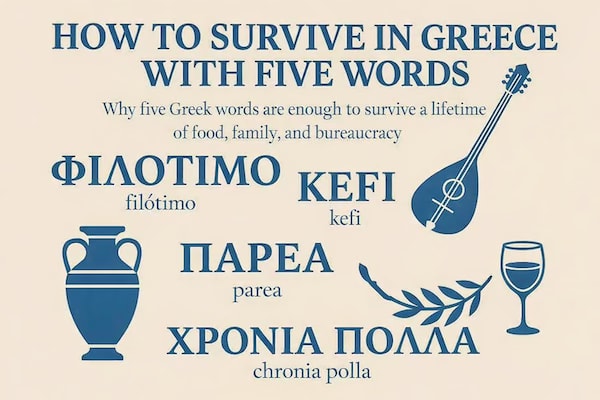
Take filotimo (φιλότιμο). If Greece had a national anthem beyond Zorba the Greek, it would just be this one word repeated until somebody got up and started dancing. Ask a Greek what it means and you’ll get misty-eyed answers: honor, generosity, doing the right thing even when nobody’s watching. Which sounds noble, until you realize filotimo is also a form of social blackmail. Skip your cousin’s wedding in Patras? No filotimo. Don’t bring loukoumades when visiting your neighbor? No filotimo. Forget to refill your uncle’s glass of tsipouro? Absolutely no filotimo. Socrates questioned the universe; your aunt in Kalamata questions your filotimo. Same energy.
I once watched a grandmother scold her grandson with the phrase, “Where is your filotimo, re?” and the poor boy immediately stood up, kissed her hand, and took out the trash, as if the word itself had hypnotized him. You could almost see the invisible leash pulling him into obedience. Try that in New York and you’ll just get a shrug and a door slam.
Then there is kefi (κέφι), which foreigners believe they can schedule. They cannot.
Are we going to the beach?
Depends, if we have kefi?
How is your “kefi” today?
My wife is calling me “kefi…less” many times.
Kefi means joy, enthusiasm, that sudden burst of energy when you hear bouzouki music and decide smashing plates is the correct life choice. It’s not happiness. It’s not even mood. It’s the divine spark that explains why your Greek friend cancels dinner plans because he “has no kefi,” then shows up at midnight with ten other people and a guitar.
Foreigners plan. Greeks wait for kefi. The Germans have timetables, the Greeks have vibes. I once met a British couple in Naxos who proudly announced, “Tomorrow at seven, we will all have kefi.” They even wrote it in their itinerary between “swim at beach” and “dinner.” At seven sharp, they sat on their balcony, waiting. Nothing happened. By eleven, they were asleep. Meanwhile, the locals were dragging tables into the street, pouring wine, and dancing until sunrise. You cannot schedule kefi. It arrives like a thunderstorm. Or doesn’t. That’s the point.
Another word you’ll meet is parea (παρέα). Outsiders translate it as “group of friends,” but that’s like calling the Parthenon “a pile of stones.” A parea is a permanent ecosystem. Once you’re in, you can’t get out. A proper parea can sit in one taverna for six hours, order three plates of meze, one bottle of ouzo, and never run out of conversation. Outsiders think they’re solving world peace; in reality, they’re still arguing about a penalty kick Olympiakos took in 1997.
The danger of parea is that you can never escape it. You can move abroad, delete Facebook, change your name—your parea will still find you. I once received a video call at three in the morning in London. On the screen were six sunburned faces shouting from Thessaloniki: “We are drinking. Where are you? Malaka!” Escape is not an option.
And that brings us to malaka (μαλάκα), the Swiss Army knife of Greek words as I mentioned before. Technically it means something rude. In practice, it means everything. It can be affectionate, hostile, ironic, or kefi. It punctuates conversations the way commas do in English. A Canadian tourist I once overheard in Mykonos said to his waiter, “Efharistó, malaka,” thinking it meant “sir.” The waiter froze, then burst out laughing, then clapped him on the back. “Now you are Greek,” he declared, and brought out free shots. By accident, the Canadian had achieved full cultural assimilation.
The language also hides traps in the most innocent places, like bakeries. A friend of mine walked in and confidently asked for “psomi” (bread). The baker stared at him as if he had just asked for “a piece of the Earth.” Bread here is never just bread. Do you want horiatiko (country), psomi tou toast (toast bread), prozymi (pre-dough)? White, black, sesame, no sesame, with olives, without olives? By the time you finish the interrogation, your kefi has evaporated and your parea has gone out drinking. And heaven help you if the baker decides to compliment you. Greeks are generous with compliments, especially toward women, and not in the careful, politically correct way of other countries. Here it’s blunt. “Kormara!”—great body. “Oraia matia!”—beautiful eyes. “Eisai Thea!”—you are a Goddess. It can be charming, or alarming, depending on how many coffees the baker has had.
Speaking of coffee, ordering one in Greece is its own oral exam. You think you’re ordering a “coffee.” Wrong. Do you want ellinikó (Greek coffee)? Frapé (the national fuel)? Freddo espresso? Freddo cappuccino? With sugar? Medium sugar? Sweet? No sugar but with foam? By the time you’ve decided, you need another coffee to recover from ordering the first one. A foreign friend once asked for “just coffee, black” and was handed a Greek coffee so thick you could stand a spoon in it. He drank it in one gulp. Ten minutes later he looked like he’d seen God.
And then there’s the cheerful tyranny of xronia polla (χρόνια πολλά). One birthday is not enough here; you also get a name day. That means at least twice a year the entire world wishes you xronia polla! until your ears ring. The postman, your neighbor’s cousin, the baker, the taxi driver—everyone participates. Once I stayed in a village on January 7th, St. Ioannis’ Day. Every man was named Yiannis (Ioannis). By mid-morning, I had said xronia polla two hundred times. By evening, people were saying it back to me, even though my name isn’t Yiannis it’s Nikos. I was eating my seventh slice of cake and wondering if death by sugar overdose counted as cultural integration.
Taxis are another linguistic adventure. In other countries, you give an address. In Greece, you give landmarks, emotions, and hand gestures. “Take me near the old stadium, you know, but not exactly there, the other road, next to the bakery with the good koulouria.” The driver nods sagely and somehow knows exactly where you mean. My favorite phrase is, “Don’t worry, I’ll leave you closer.” Closer to what? Nobody knows. But you always arrive.
Football games bring out their own dictionary. Words like golara (a huge goal), penaltara (a penalty of cosmic proportions), and endless variations of malaka shouted at referees in creative new ways. Entire stadiums can chant insults so poetic they should be studied in literature departments. And yet, when Greece won the Euro 2004, every insult melted into one giant scream of Ellada!—a reminder that the language of football is universal, even when the vocabulary isn’t.
The supermarket is no refuge. At the checkout, the cashier will inevitably ask if you want a bag, and if you hesitate for half a second, the entire line will collapse into a debate about plastic waste, the price of tomatoes, and whether last year’s olives were better. Strangers will recommend brands to you. Someone will comment on your choice of feta. And before you know it, you’ve been absorbed into a temporary parea of shoppers, bonded forever over discounted olive oil.
And of course, no survival guide is complete without yiayia (grandmother). A yiayia requires no translation. She is the supreme authority of the household, armed with a ladle and a mystical radar that detects when you’ve skipped a meal. You say you’re not hungry. She says nothing, disappears, and returns with a plate the size of a small continent. You repeat, “Really, yiayia, I’m full.” She nods sympathetically and places another dolma on your plate. Resistance is futile. Once I tried logic on a yiayia, explaining that I had just eaten. She looked me dead in the eye and said, “Then eat again.” That was the end of the argument.
So in the end, survival in Greece comes down to five words: filotimo, kefi, parea, malaka, xronia polla. Learn them, wave your hands when you talk, accept food even when you said no, and never argue with a yiayia. The words may confuse you, the rules may feel impossible, but the truth is simple: eat, talk, laugh, repeat. And if you don’t understand what’s going on, just raise your glass, smile, and say: Yamas!
Subscribe. We’ll take it one word at a time.

Discussion
Pull up a chair. Add a memory, a correction, a laugh, or something the story brought to mind.
No comments yet. We have been waiting for you...